Technical City E-Bike — Product, Identity & Launch Book
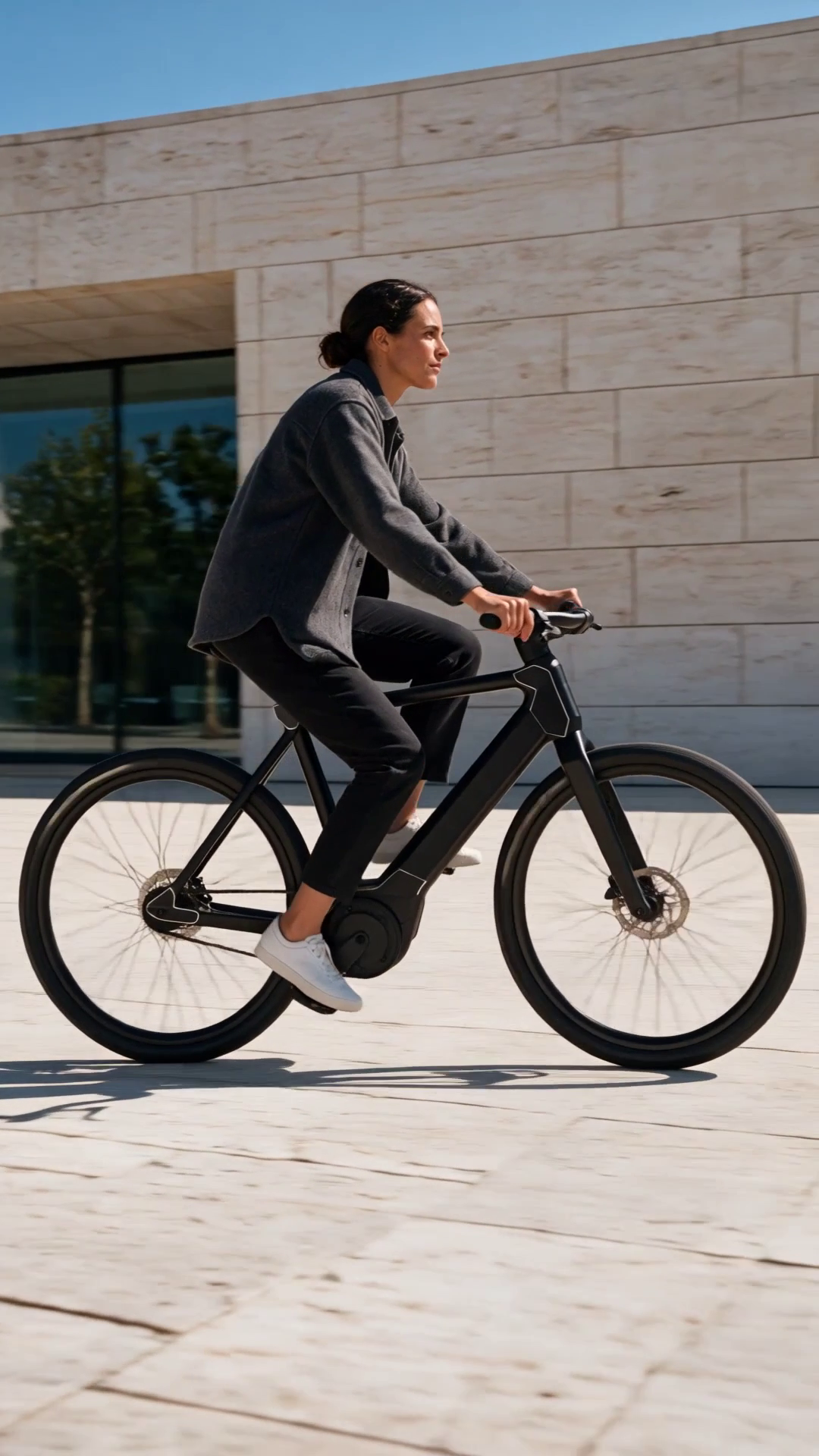
KANTE 01 — the hero film, wide (16:9)
Also in this package
 KANTE 01 — the launch book
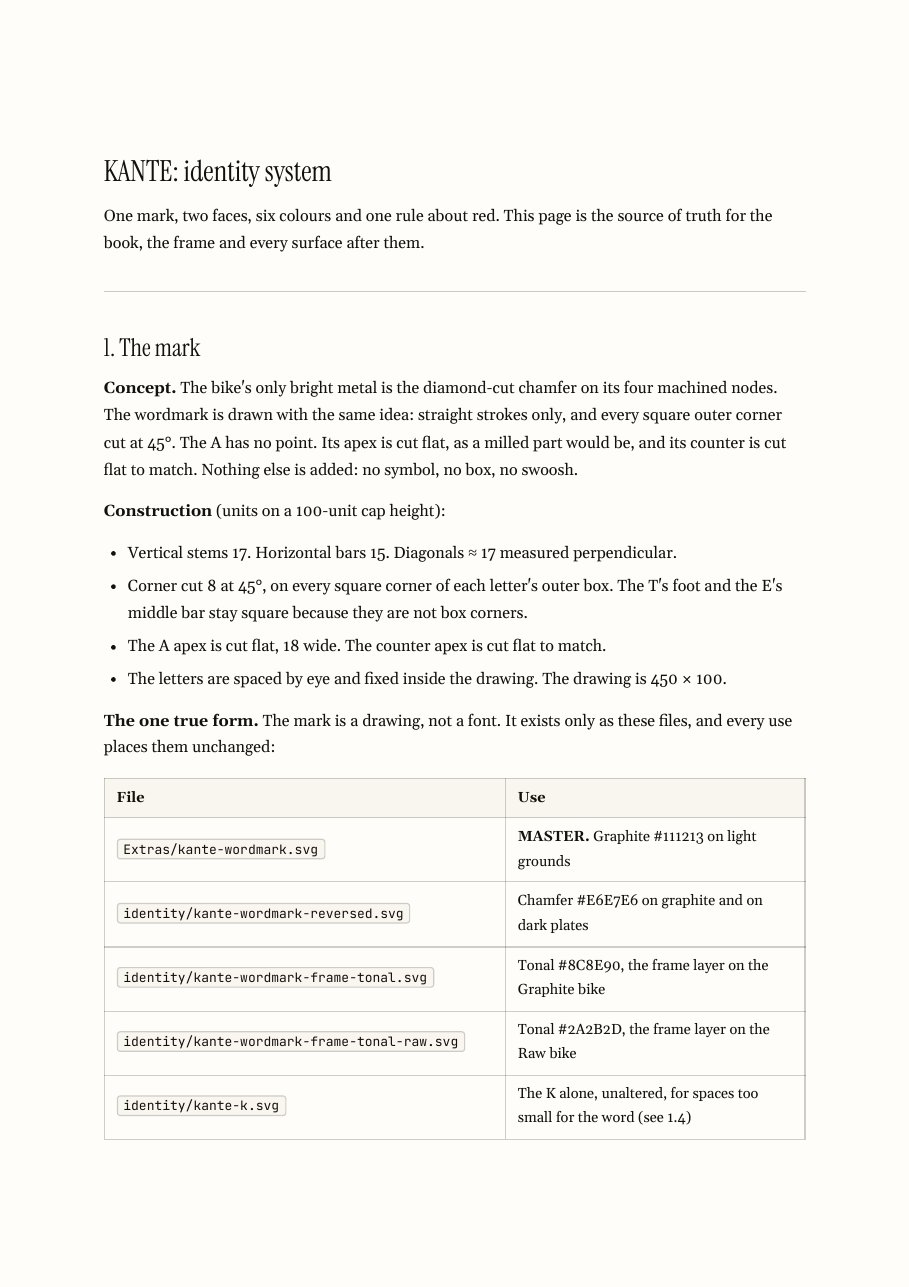 KANTE identity system — mark, type, colour, placement
 The name — KANTE, and why
 The locked specification
KANTE: identity system
One mark, two faces, six colours and one rule about red. This page is the source of truth for the book, the frame and every surface after them.
1. The mark
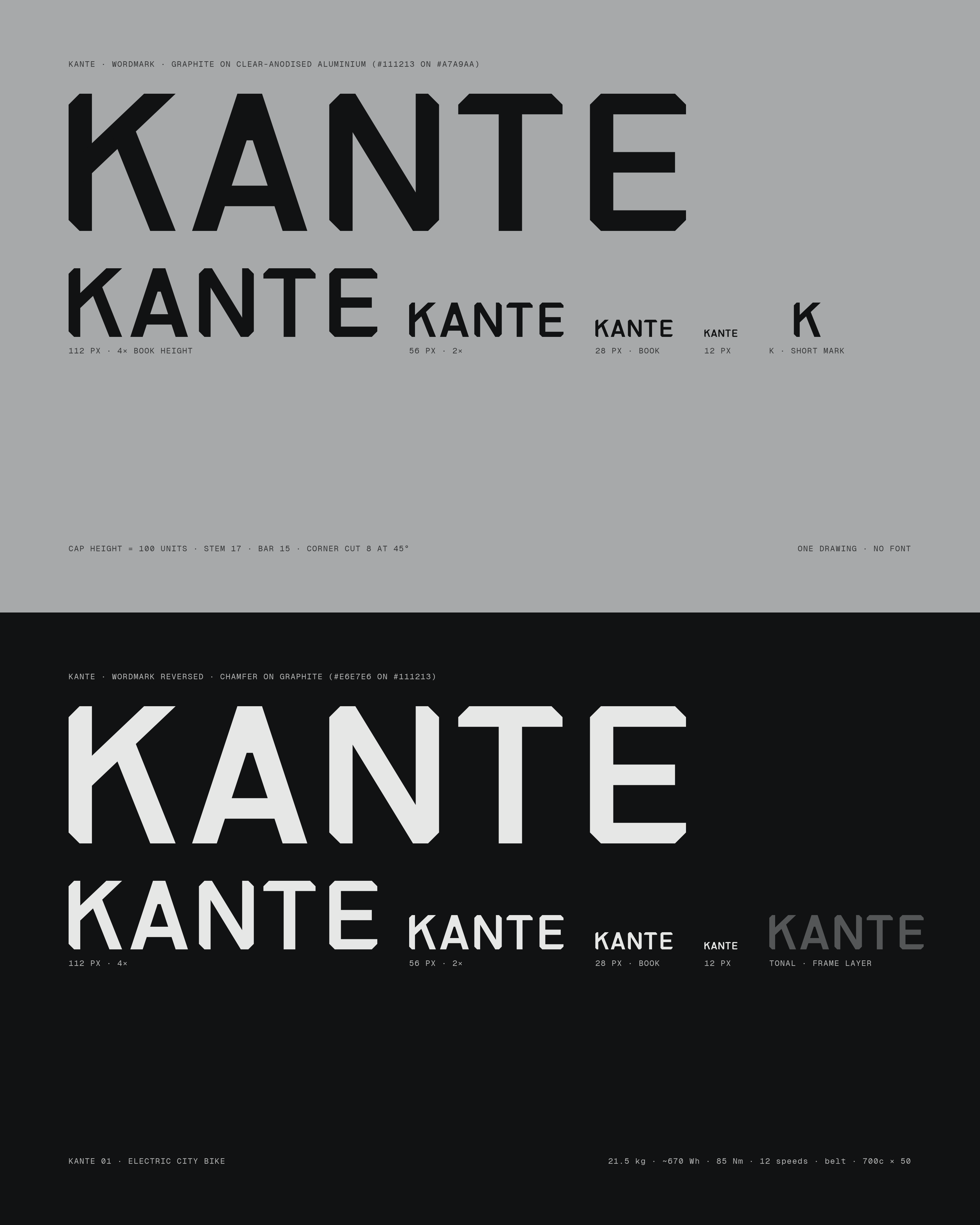
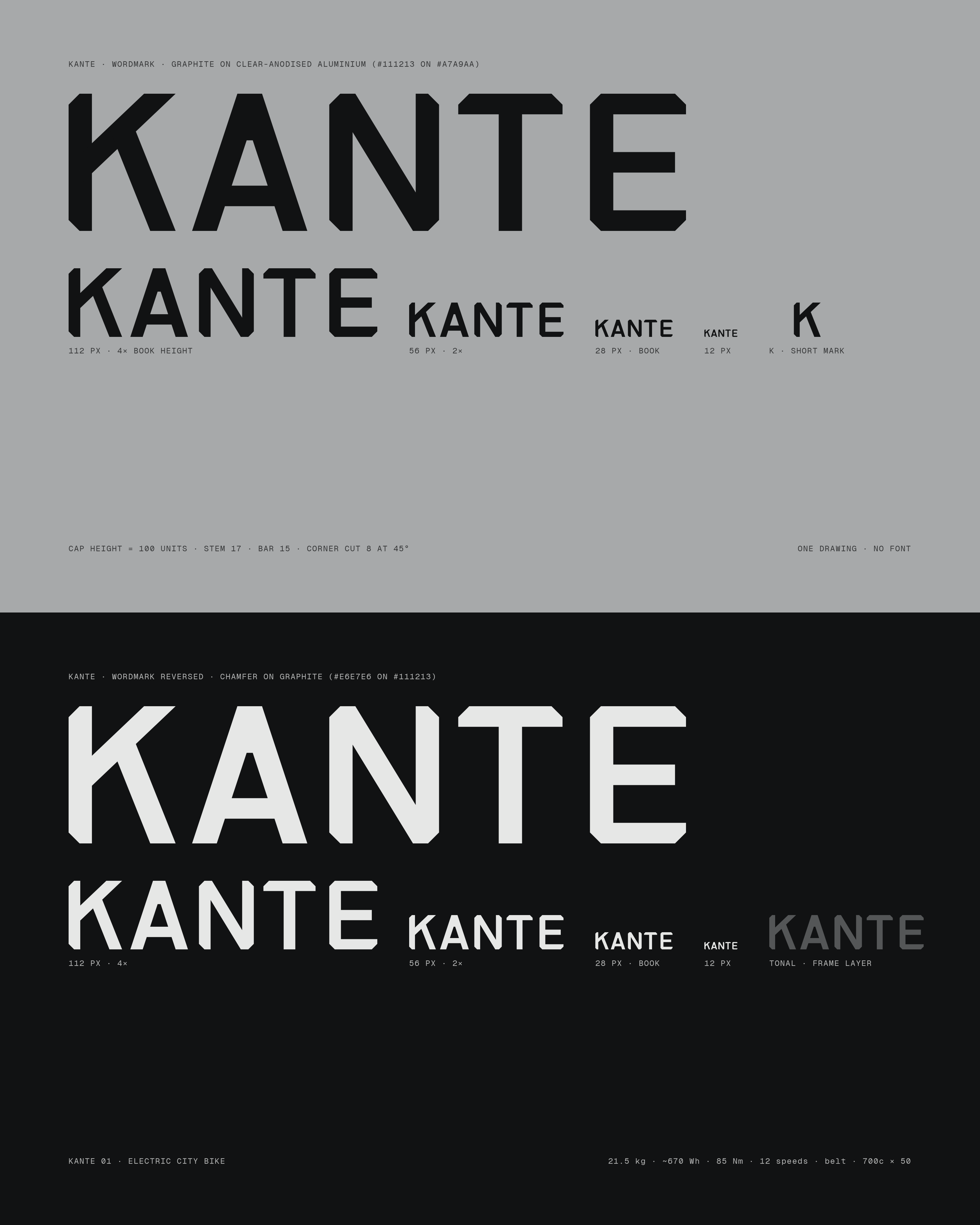
Concept. The bike's only bright metal is the diamond-cut chamfer on its four machined nodes. The wordmark is drawn with the same idea: straight strokes only, and every square outer corner cut at 45°. The A has no point. Its apex is cut flat, as a milled part would be, and its counter is cut flat to match. Nothing else is added: no symbol, no box, no swoosh.
Construction (units on a 100-unit cap height):
- Vertical stems 17. Horizontal bars 15. Diagonals ≈ 17 measured perpendicular.
- Corner cut 8 at 45°, on every square corner of each letter's outer box. The T's foot and the E's middle bar stay square because they are not box corners.
- The A apex is cut flat, 18 wide. The counter apex is cut flat to match.
- The letters are spaced by eye and fixed inside the drawing. The drawing is 450 × 100.
The one true form. The mark is a drawing, not a font. It exists only as these files, and every use places them unchanged:
| File | Use |
|---|---|
artifacts/identity/kante-wordmark.svg | MASTER. Graphite #111213 on light grounds |
artifacts/identity/kante-wordmark-reversed.svg | Chamfer #E6E7E6 on graphite and on dark plates |
artifacts/identity/kante-wordmark-frame-tonal.svg | Tonal #8C8E90, the frame layer on the Graphite bike |
artifacts/identity/kante-wordmark-frame-tonal-raw.svg | Tonal #2A2B2D, the frame layer on the Raw bike |
artifacts/identity/kante-k.svg | The K alone, unaltered, for spaces too small for the word (see 1.4) |
artifacts/identity/kante-wordmark-graphite.png / -reversed.png / -frame-tonal.png | 3000 × 638 transparent PNG, for surfaces that cannot take SVG |
All of them share the same path data. Only the fill changes. Never retype KANTE in Geist or any other face. Never stretch, outline, add a shadow to, or re-space the mark.
1.1 Clear space
Keep half the cap height (X/2) empty on every side. No type, image edge or rule enters it.
1.2 Minimum size
- Screen: 12 px cap height. Proofed: it holds at 12 px, and at 28 / 56 / 112 / 224 px it is clean on both grounds (see
kante-mark-sheet-2.png). - Print: 3 mm cap height.
- Laser-marked metal: 4 mm cap height. Below that, use the K.
1.3 Lockup (the only one)
The wordmark, then below it, flush left to the K stem, the descriptor in Geist Mono at 22% of the mark's cap height, tracking +8%, uppercase: KANTE 01 · ELECTRIC CITY BIKE The gap between the mark's baseline and the descriptor's cap line is 35% of cap height. Specs never join the lockup. They live on their own line, in sentence case with correct unit case (kg, Wh, Nm, km).
1.4 The K
The K is the first letter of the wordmark, cut out unchanged. It appears in exactly two places: the boot screen of the 32 mm stem display (white, 9 mm tall, centred), and the head of the battery lock key. It never appears beside the full wordmark.
2. Type: two faces
| Role | Face | Weights | Use |
|---|---|---|---|
| Display + text | Geist | 300 Light (display), 400 Regular (text), 500 Medium (rare emphasis, table heads) | Headlines, body, captions |
| Figures + technical | Geist Mono | 400 | Every spec figure, table, unit, plate caption, page folio, the lockup descriptor |
The drawn wordmark is the third voice. It is never set in type.
- Files:
artifacts/identity/fonts/Geist-Regular.ttf,artifacts/identity/fonts/GeistMono-Regular.ttf. In HTML, load both families from Google Fonts with the 300/400/500 weights. SIL Open Font License. - Display: Geist Light, tracking −2%, tight leading (1.0–1.05). Sentence case. Big and quiet. Headlines never go to bold.
- Text: Geist Regular 9.5–10.5 pt, leading 1.45, measure 60–72 characters.
- Figures: always Geist Mono, so columns align like a drawing's dimension table. The number and its unit are separated by a thin space:
21.5 kg,~670 Wh,60–120 km,85 Nm,700c × 50. - Labels and folios: Geist Mono 7–8 pt, uppercase, +8% tracking. Uppercase is for labels only. Units keep their own case.
3. Colour: the frame's own palette
| Token | Hex | What it is | Use |
|---|---|---|---|
graphite | #111213 | Hard-anodised matte black | Primary dark ground, the master mark, text on paper |
anodise | #1C1D1F | The frame's lit black face | Second dark surface: panels and table bands on dark spreads |
tonal | #8C8E90 | Laser-marked grey on black anodise | The frame mark, secondary text on dark, hairlines |
raw | #A7A9AA | Clear-anodised satin aluminium | The aluminium ground, the Raw colourway |
chamfer | #E6E7E6 | Diamond-cut bright edge | Reversed mark, text on dark, the single hairline rule |
paper | #F1F0EC | Uncoated book stock | Text pages |
The edge rule. The system has one graphic device, and it is the bike's: a 0.5 pt chamfer hairline on dark grounds (a graphite hairline on paper) used as the only divider. It is never a box and never a frame around anything.
Red is functional only. It is not a brand colour. The rear light slot is red because the law needs it to be. That is a signal, not a choice of style. Red appears in the identity exactly where the bike emits it: in photographs of the lit rear slot, and nowhere else. No red type, no red rules, no red dot. That restraint is part of the register. A red accent beside matte black and silver would also read as a borrowing from Leica, which is the last thing a mark in this register can afford. The white front light is treated the same way: it is light, not colour.
4. The mark on the frame
Home: both flanks of the down tube, and only there. The down tube is the largest flat face on the bike, and the battery lives inside it. The head-tube node was the other candidate, but its front face and flanks carry the white light slot, and the light owns that face. One mark per flank, nowhere else on the frame. The nodes stay clean, because the chamfers are already the signature.
- Orientation: reads from the bottom bracket up toward the head tube, on both sides. Baseline parallel to the tube axis (≈ 47° in the master profile).
- Position: centred on the tube's flat flank at mid-length between the drive cradle and the head-tube node.
- Size: cap height 35% of the flank's width, which is ≈ 24 mm on the 70 mm tube and gives a mark ≈ 108 mm long.
- Process (stated as design intent):
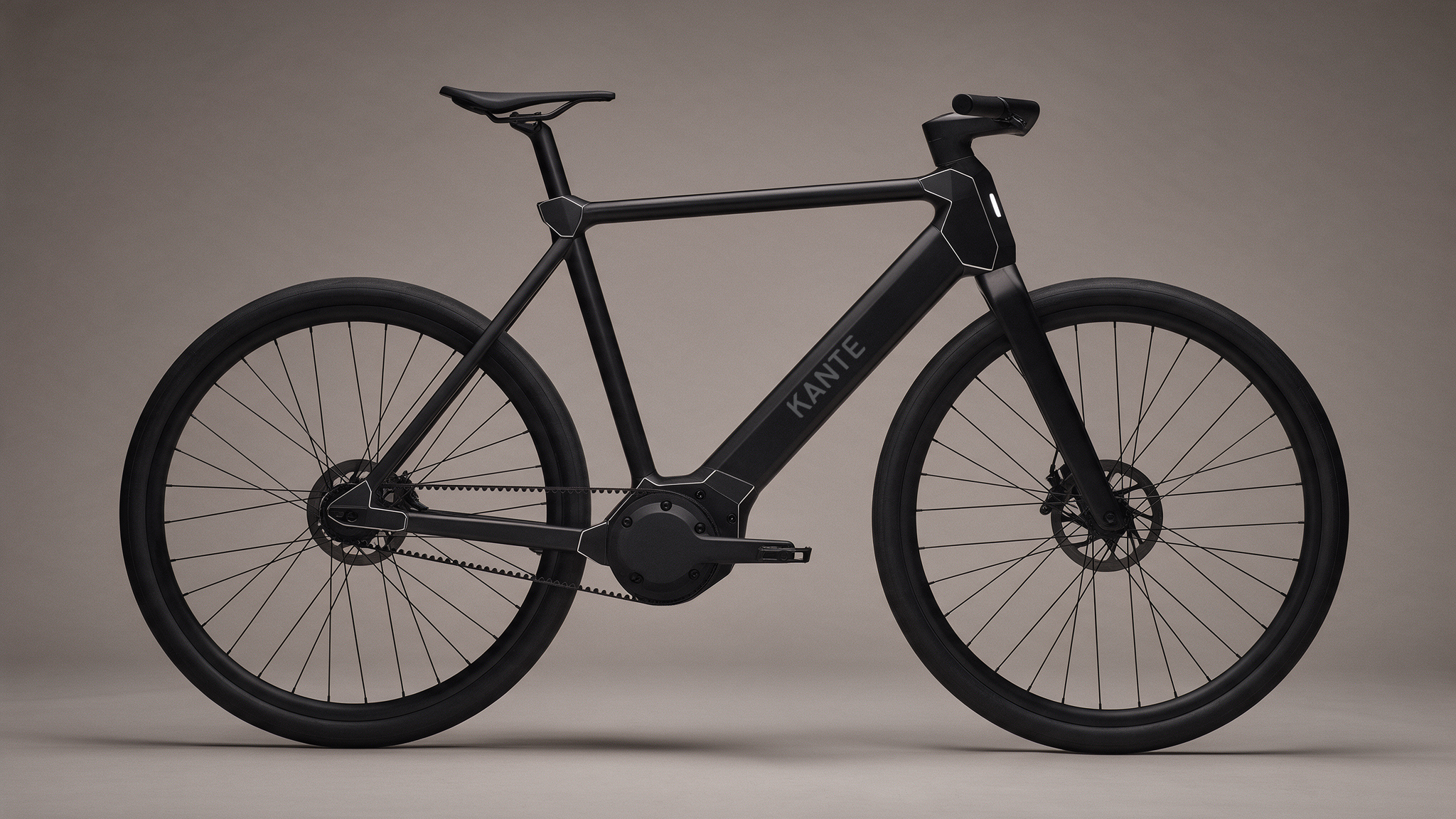
- Graphite: laser-marked into the hard anodise. It reads as tonal grey,
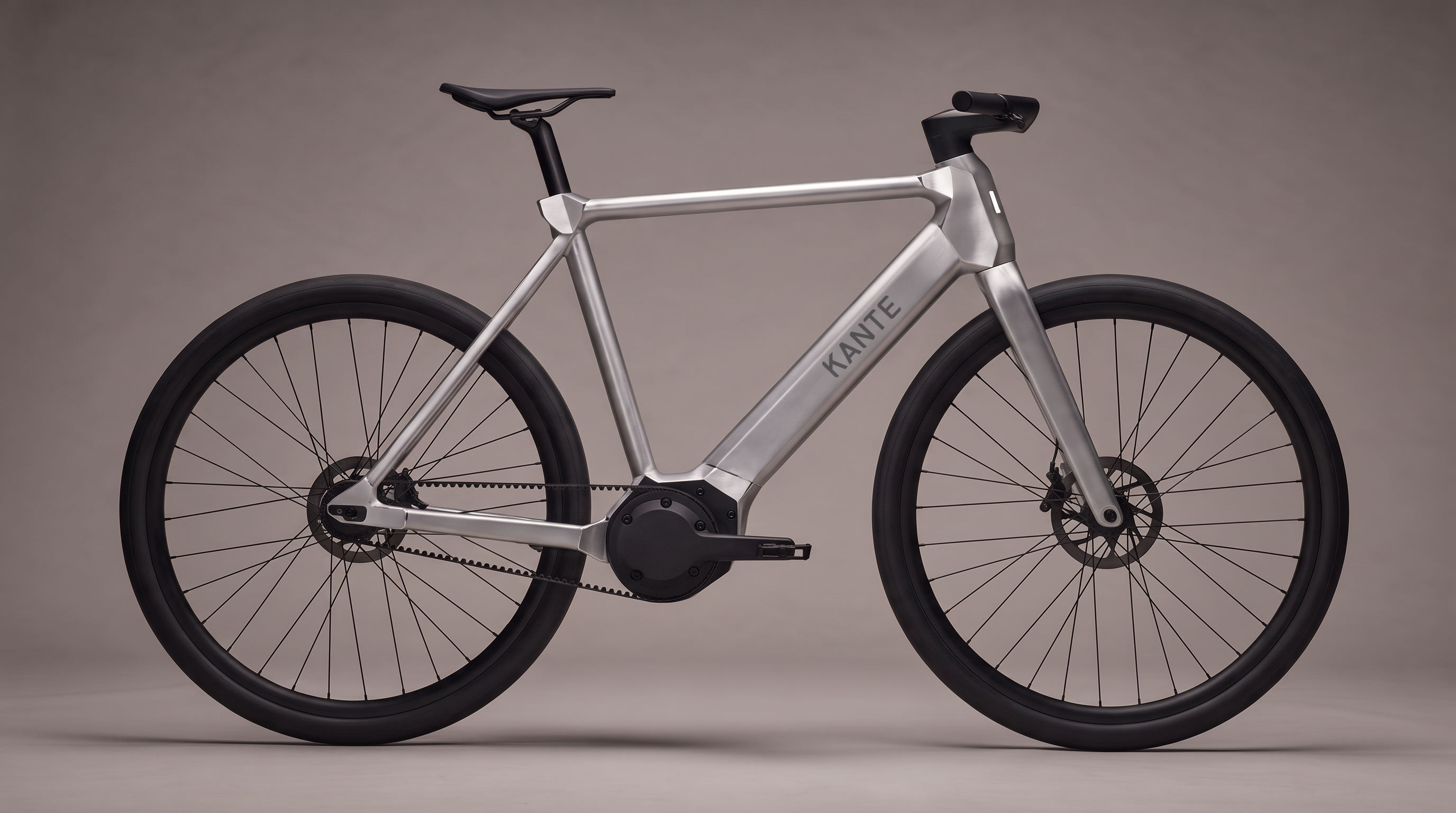
tonal#8C8E90, roughly 50% visual weight against the black. - Raw: laser-darkened on the clear anodise. It reads as
#2A2B2Dat about 60%. - No paint, no decal, no lacquer.
- Graphite: laser-marked into the hard anodise. It reads as tonal grey,
- The layer, never the pixels. On every image the mark is composited over the canonical frame as a separate layer with a perspective pin. It is never asked of an image engine.
artifacts/identity/mark-on-frame-graphite.png: the master side profile with the tonal layer. Corners in source px: TL 1104.75,568.45 · TR 1196.95,469.85 · BR 1218.85,490.35 · BL 1126.65,589.15.kante-wordmark-frame-tonal.svg, opacity 0.5.artifacts/identity/mark-on-frame-raw.png: the Raw profile. TL 1551.7,687.6 · TR 1676.1,556 · BR 1705.3,583.6 · BL 1580.9,715.2.kante-wordmark-frame-tonal-raw.svg, opacity 0.6.- For any new plate, take the down tube's two silhouette edges, centre the mark between them, and set the cap height to 0.35 × the distance between them.
5. The mark in the book
- Cover: graphite ground, or a full-bleed dark plate. Reversed wordmark in
chamferat one third of the page width, top-left on the margin grid. Nothing else on the cover except the lockup descriptor at the foot. - Over plates: the wordmark alone, reversed, in the plate's calm zone (the studio sweep, never across the bike). Cap height at most 6% of the page height. Never a sentence over a plate. A plate carries the mark, a Geist Mono caption, or nothing.
- Front matter / running head: the master or reversed mark at 28 px (≈ 5 mm) cap height, top-left, with clear space kept.
- Back cover / colophon: the lockup, plus the headline line in Geist Mono:
21.5 kg · ~670 Wh · 60–120 km · 85 Nm · 12 speeds · belt drive · 700c × 50. These figures agree withartifacts/product/spec.md§10. Weight, battery and range are design targets, and the book says so once. - Never: the K and the wordmark on the same page; the mark inside a box or a badge; the mark in red.
6. Tokens, for the editorial designer
--graphite:#111213; --anodise:#1C1D1F; --tonal:#8C8E90;
--raw:#A7A9AA; --chamfer:#E6E7E6; --paper:#F1F0EC;
--font-text:'Geist',sans-serif;          /* 300 / 400 / 500 */
--font-mono:'Geist Mono',monospace;      /* 400 */
--mark:url(kante-wordmark.svg);          /* 450 × 100; clear space = 0.5 × cap height */
KANTE
Recommendation: the brand and the bike are called KANTE. The first machine is KANTE 01.
Say it KAHN-tuh. Two syllables, hard K, hard T. It is the German word for edge: the edge of a table, the edge of a milled part, the line where two faces of a solid meet.
Why this word belongs to this machine
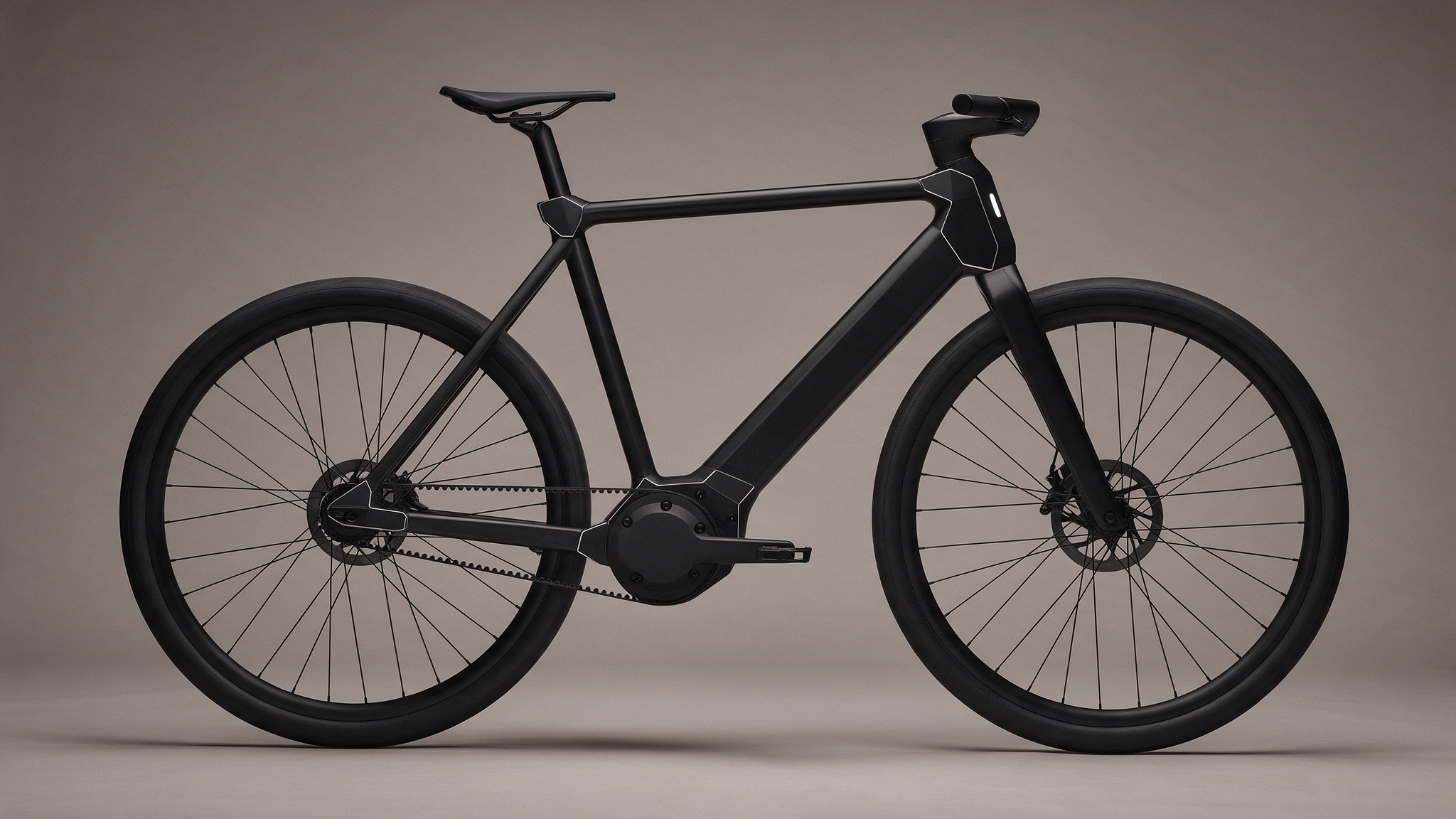
Look at the bike before you read the name. It is a matte-black frame with four machined nodes, and on every node the edges have been diamond-cut back to bright aluminium. Those cut edges are the only bright metal on the frame. In the master profile they are the first thing the eye finds: thin silver lines tracing the head-tube node, the seat cluster, the drive cradle and the dropouts. Nothing else on the bike is decorated, so the edges are the bike's signature.
KANTE names that. It doesn't describe a feeling, a city or a sustainability promise. It names the one physical detail that tells you how the object was made: a solid block, cut on a machine, its edges finished by hand-set tooling. A rider who asks "why Kante?" can be shown the answer on the frame with one finger.
It works on three levels, and all three are true of the bike:
- The literal edge. The diamond-cut chamfer on each 7075 node. The mark itself carries it: every square corner of every letter is cut at 45°, the same cut the nodes carry.
- The engineering edge. In machining, Kante is shop-floor language: Kante brechen ("break the edge") is the instruction on German drawings to deburr and chamfer a sharp corner. The name comes from the drawing office, not from a marketing deck.
- The city edge. A city is built of kerbs and corners, so the word sits naturally beside the street. It does that without the usual urban-mobility vocabulary (no "metro", "urban", "volt", "flow" or "e-").
How it reads and sounds
- Five letters, all capitals, all straight strokes. K, A, N, T, E contain no curves. That matters for a drawn wordmark meant to be laser-marked on anodised tube: straight lines and 45° cuts mark cleanly at 4 mm cap height, where curves break into stair-steps.
- It is understood across Europe. In German it is an ordinary word. In English, French, Italian and Dutch it reads as a short proper name with no unfortunate meaning that we found. It has the Braun / Leica / Rimowa cadence: one word, consonant-led, nothing to explain.
- It is not cute and not eco. No leaf, no spark, no wordplay on "e". It is the register the client chose, technical and precise, said in one word.
The alternates behind it
- FUGE ("joint", "seam"; also the musical fugue). It names the TIG-welded joints where tube meets node. It is honest and quieter, but it softens the register, and in English it lands close to "fudge".
- KERN ("core"). It names the sealed gearbox-motor at the centre of the bike, and it is a typographer's word too. It is strong, but KERN & SOHN already owns that name in German precision weighing, so it starts with a neighbour.
I lead with KANTE and would not trade it for either.
What has to be checked before this name goes public
These are stated plainly so nobody discovers them late:
- Trademark clearance has not been run. A web search in this sitting turned up no bicycle or e-bike brand trading as Kante. A web search is not a clearance, though. A registry search (EUIPO, DPMA, USPTO, classes 12 and 9) is required before launch.
- Homograph. The footballer N'Golo Kanté shares the spelling, apart from the accent. In football-literate English-speaking markets some readers will make the link. It is a neutral-to-warm association (he is famously modest, and famously a cyclist), but it is real, and the client should know about it.
- Domains and handles were not checked.
In use
- The brand: KANTE. Set only as the drawn wordmark, never typed in a font.
- The machine: KANTE 01. In running text: "the Kante 01". In spec tables:
KANTE 01 · Electric city bike. - Running text uses sentence case ("Kante"). Only the wordmark is all capitals.
The Bike: Locked Specification
Status: LOCKED, 9 October 2026. One revision before the master frame was fixed, same day: the front light slot wraps onto the flanks of the head-tube node (section 6), a side-visibility refinement; nothing else moved.
Canonical master frame: artifacts/product/hero-side-profile.png. Every later frame of the bike is made with that file as its reference. One true form. Every render, every number in the identity work and the launch book descends from this sheet. A frame whose pixels contradict this sheet is a defect and is re-made, never explained away.
Register: technical and precise. Leica, Porsche Design, Unno. Nothing decorative; every line carries load, current or light.
Concept status: this is a concept product. Figures marked design target are honest engineering intent for a prototype, not tested results. Figures marked supplier are the drive-unit maker's published numbers, read on its own page (source at the foot).
1. The idea in one paragraph
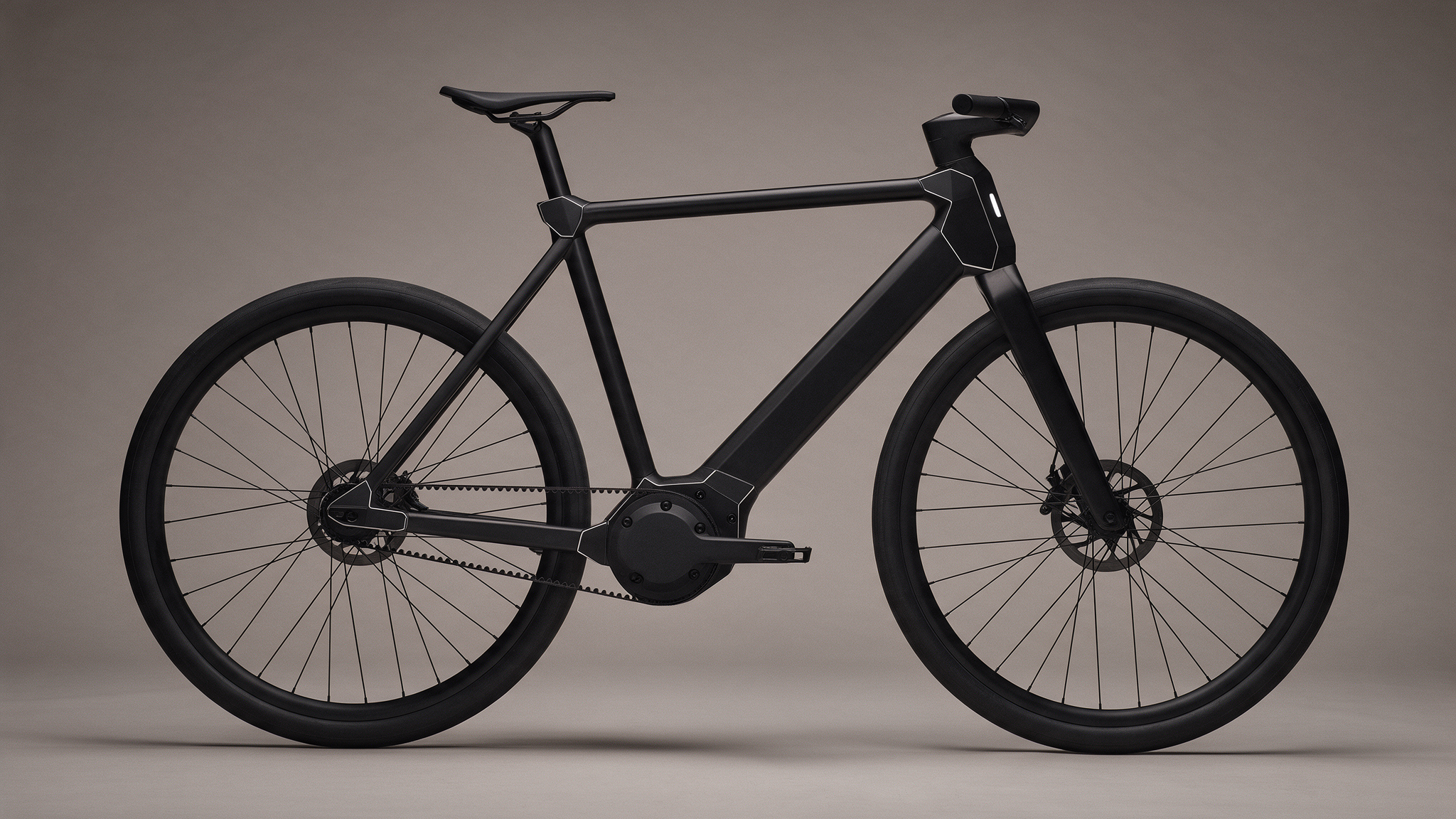
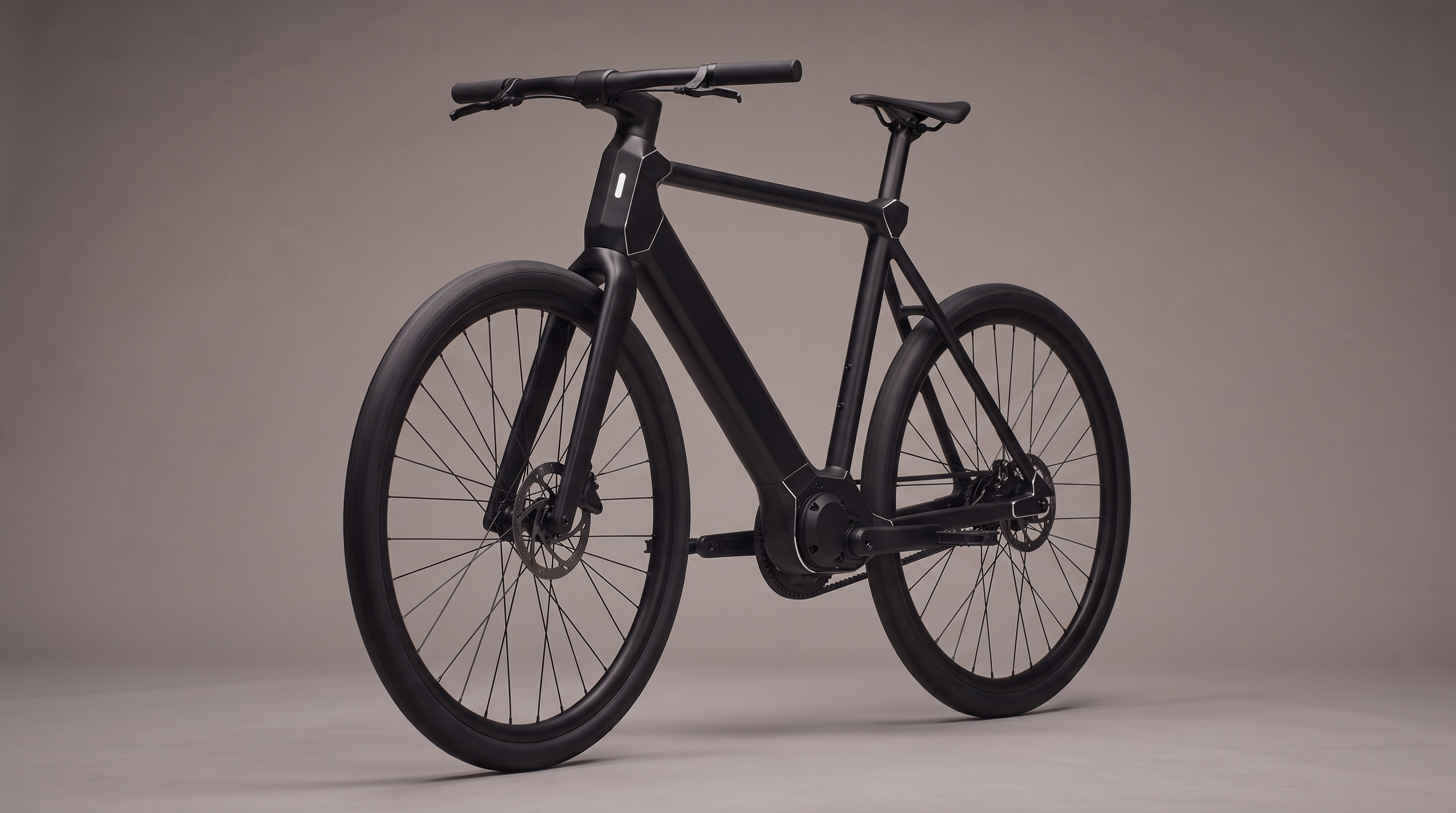
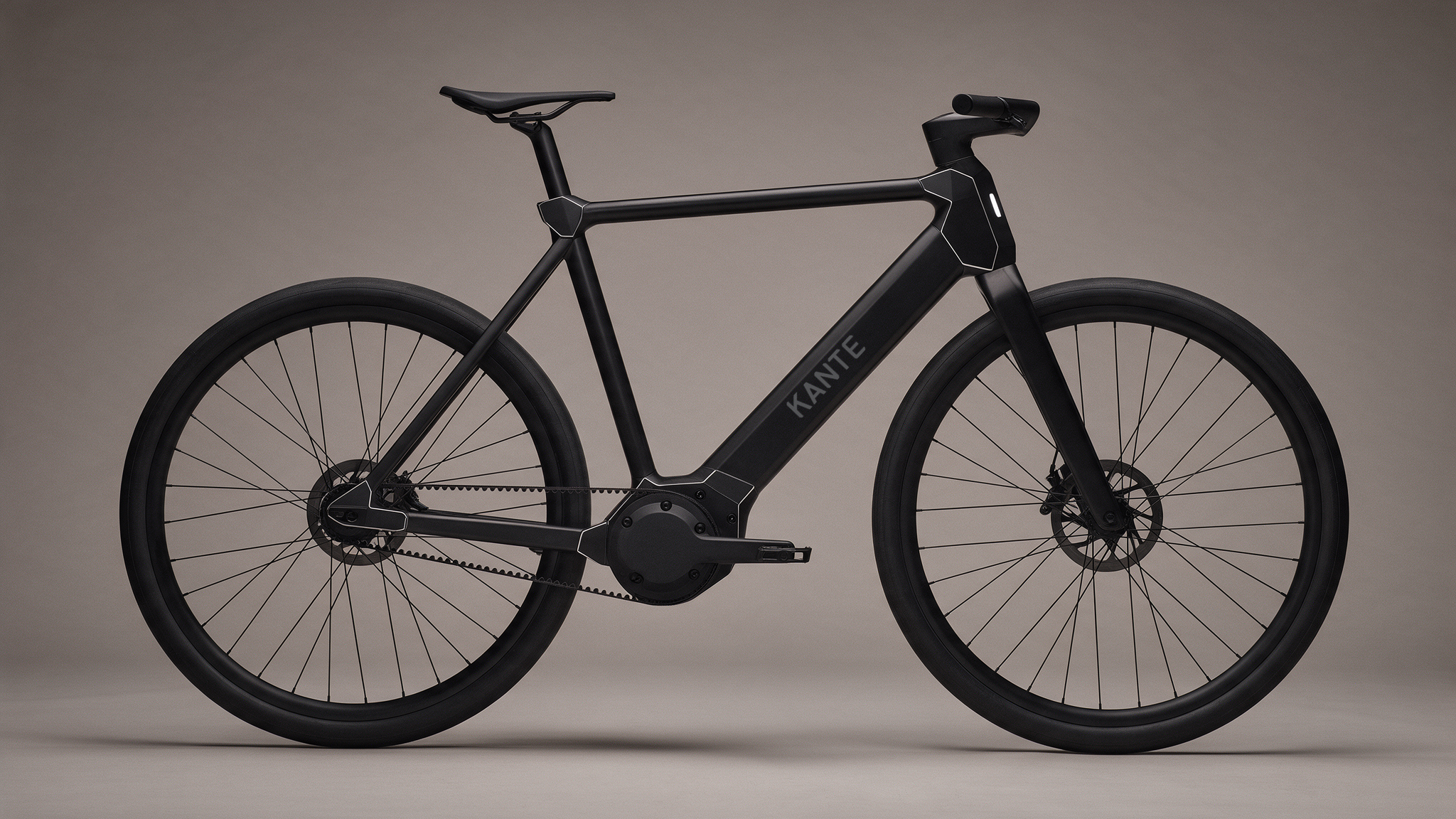
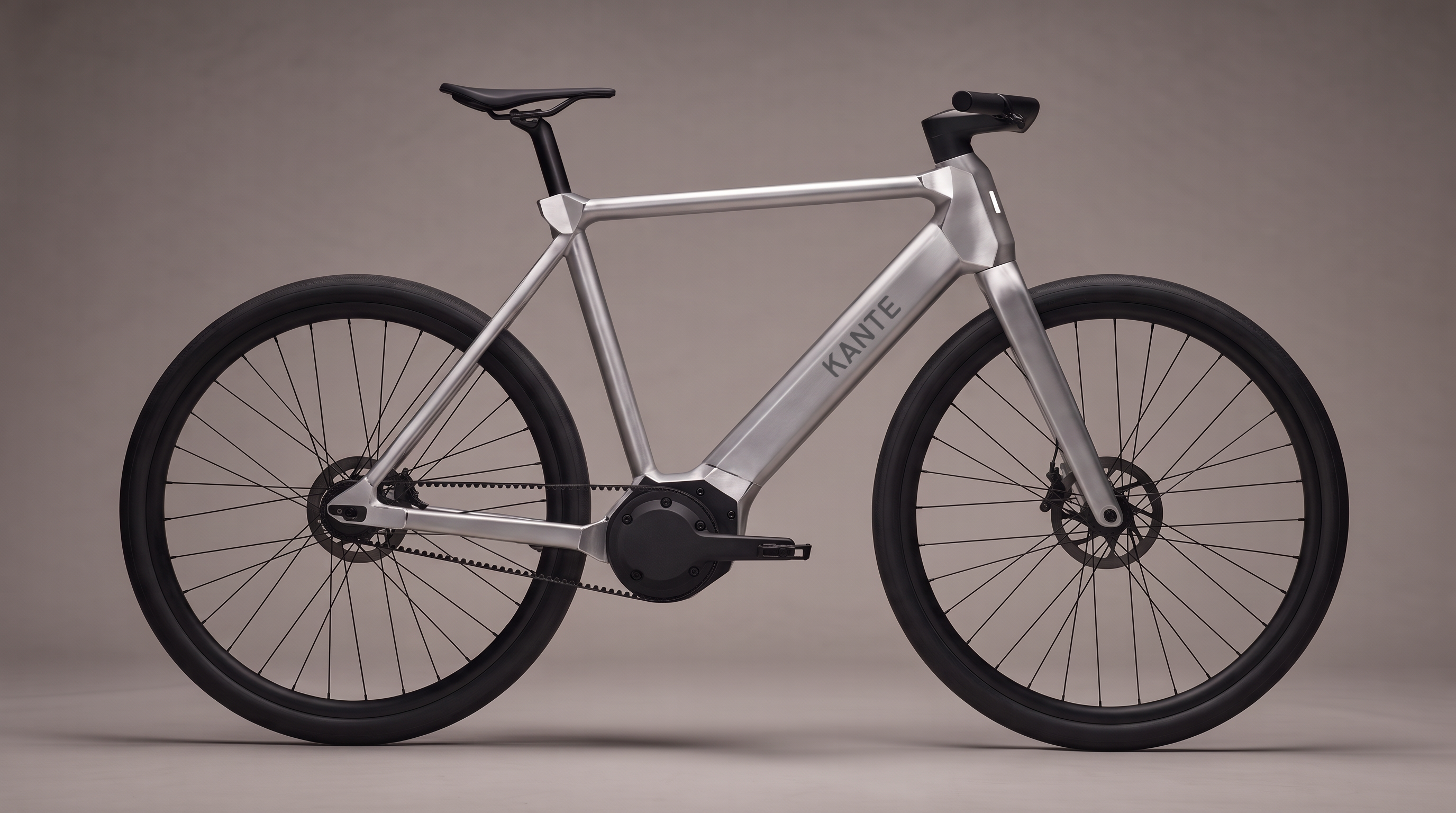
A city bike built around a sealed gearbox. A motor and a 12-speed transmission share one housing at the bottom bracket, so the rear of the bike carries nothing but a single belt sprocket: no derailleur, no cassette, no chain, no oil on a trouser leg. The frame is a straight-tube triangle of 6061 aluminium joined by CNC-machined 6061-T6 nodes, hard-anodised matte black, with the machined edges of each node diamond-cut back to bright metal. The battery is concealed inside an oversized down tube, honestly: you see the tube and its machined end cap, never a bolted-on box. Lights live inside the structure. The drivetrain is the jewellery.
2. Frame architecture
| Item | Locked decision |
|---|---|
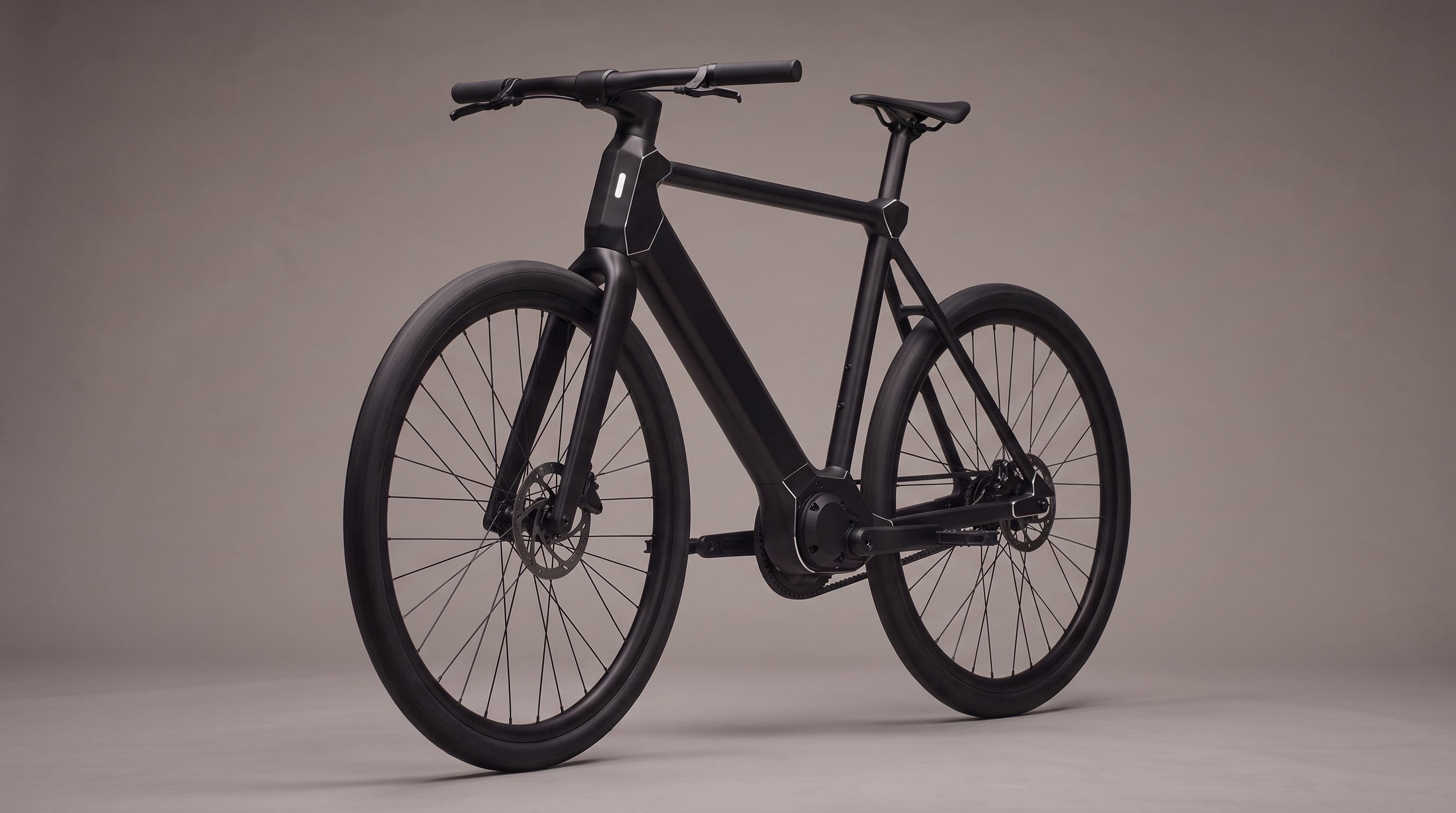
| Architecture | Classic closed diamond: straight horizontal top tube, straight seat tube, large straight down tube, straight seat stays and chain stays. No step-through, no curved tubes, no suspension. |
| Tubes | 6061-T6 aluminium. Top tube and stays round-section; down tube a large rounded-rectangle section (approx. 70 × 58 mm) that houses the battery. |
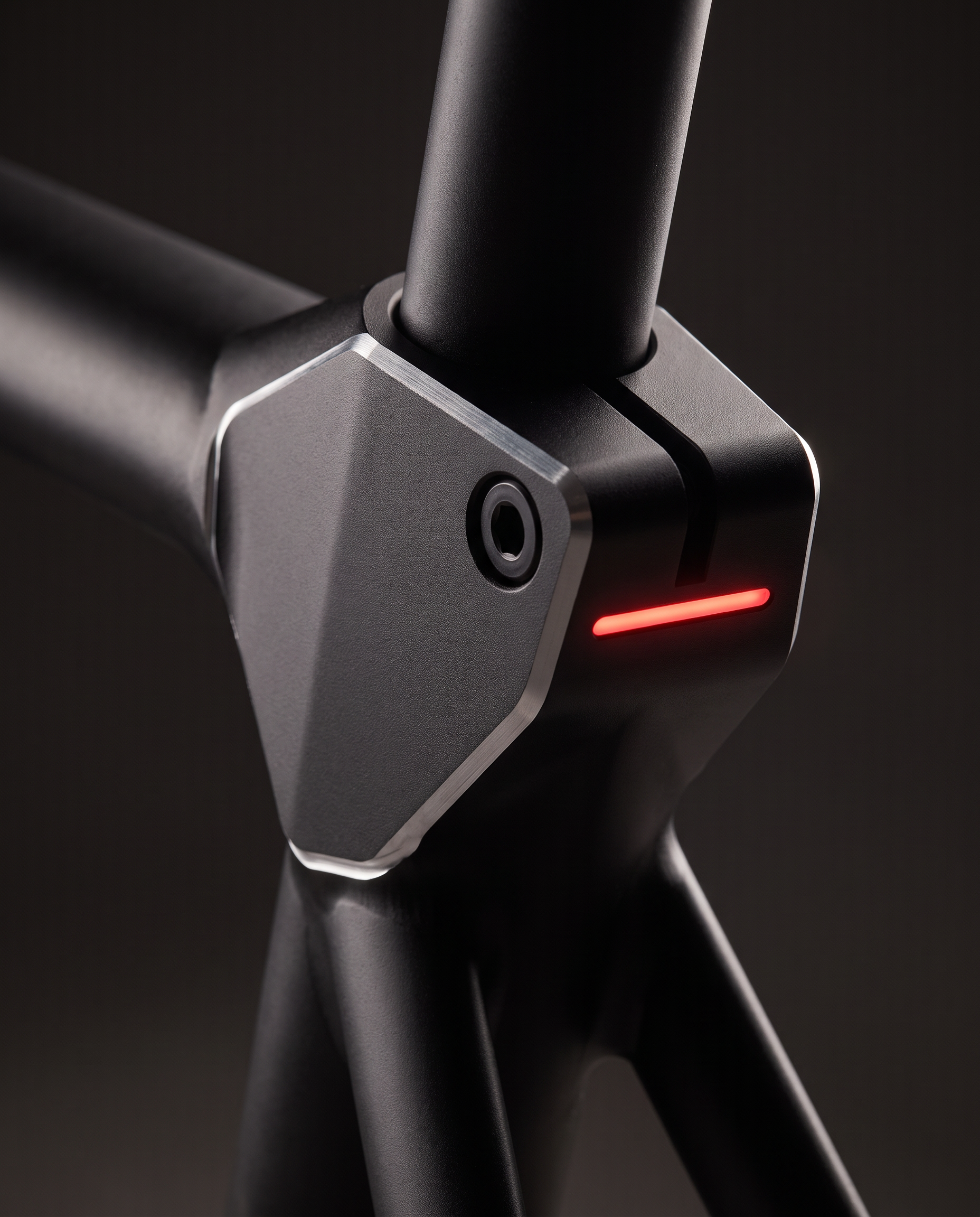
| Nodes | Four CNC-machined 6061-T6 nodes, welded to the tubes: (1) head-tube node, (2) seat-cluster node, (3) drive-unit cradle at the bottom bracket, (4) rear dropouts. Each node shows its milled facets and a diamond-cut chamfer of bright raw aluminium along its edges. |
| Belt split | Drive-side seat stay carries a machined, bolted split link just above the dropout (two exposed hex-socket bolts) so the one-piece belt can be fitted. Shown, not hidden. |
| Rear dropouts | Machined sliding dropouts with an exposed tension bolt, for belt tension. 12 × 142 mm thru-axle. |
| Fork | Rigid aluminium, two straight tapered blades, machined crown, 12 × 100 mm thru-axle, flat-mount disc. Same black finish. |
| Joining | TIG-welded, welds dressed smooth at the nodes. Nodes and tubes share one alloy (6061-T6), so the welds are sound and heat-treat uniformly after fixturing. |
| Fasteners | Exposed stainless hex-socket (Allen) bolts, black-oxide finish, where they do work: the drive-unit cradle (six bolts), the belt split (two), the stem clamp, the dropout tensioners. Never decorative bolts. |
| Mounts | Hidden threaded bosses for fenders, rack and stand exist; NONE are fitted in the canonical configuration. |
3. Drive
| Item | Locked decision |
|---|---|
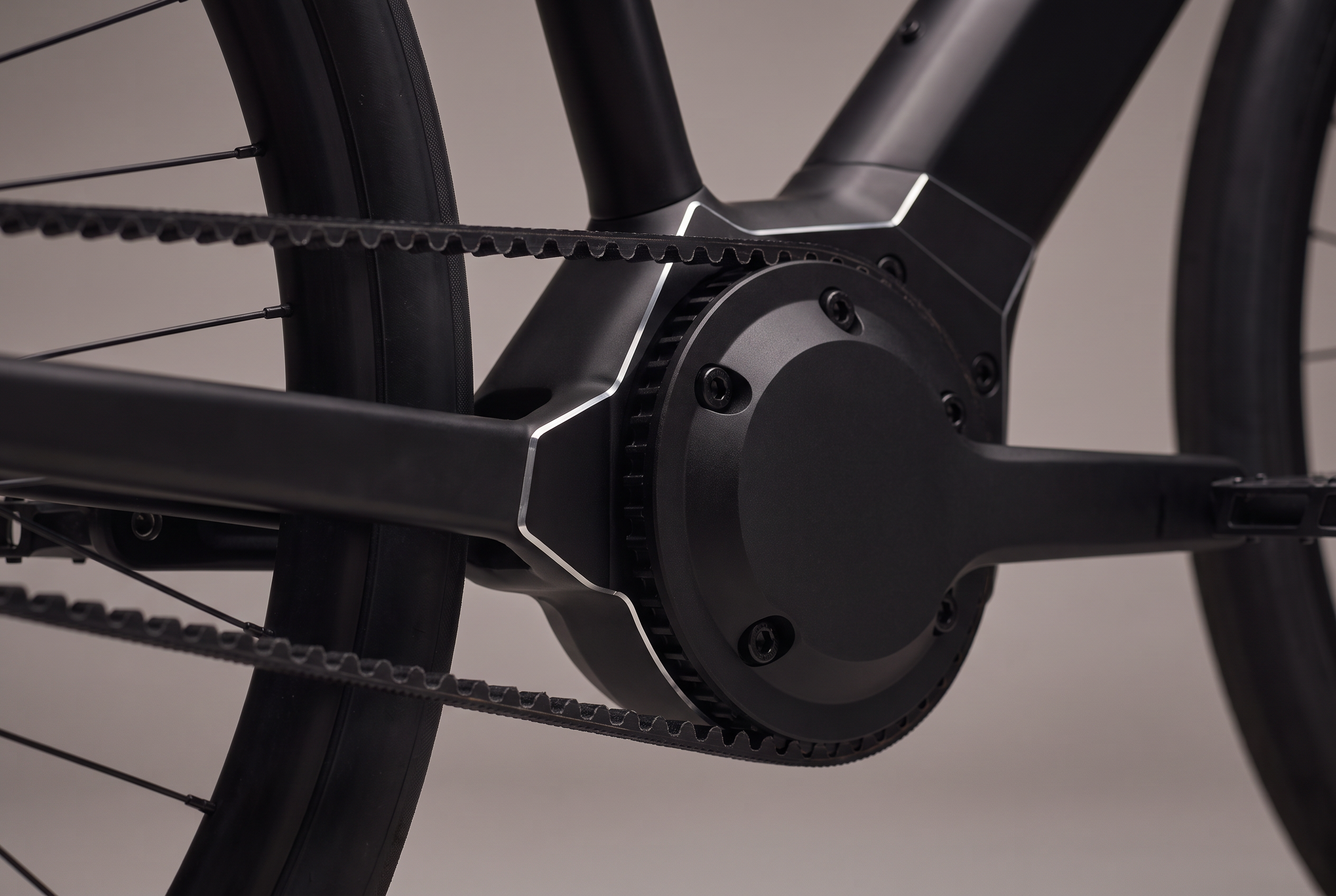
| Drive type | Mid-mounted motor-gearbox unit. The motor and a 12-speed gearbox in one sealed housing at the bottom bracket. |
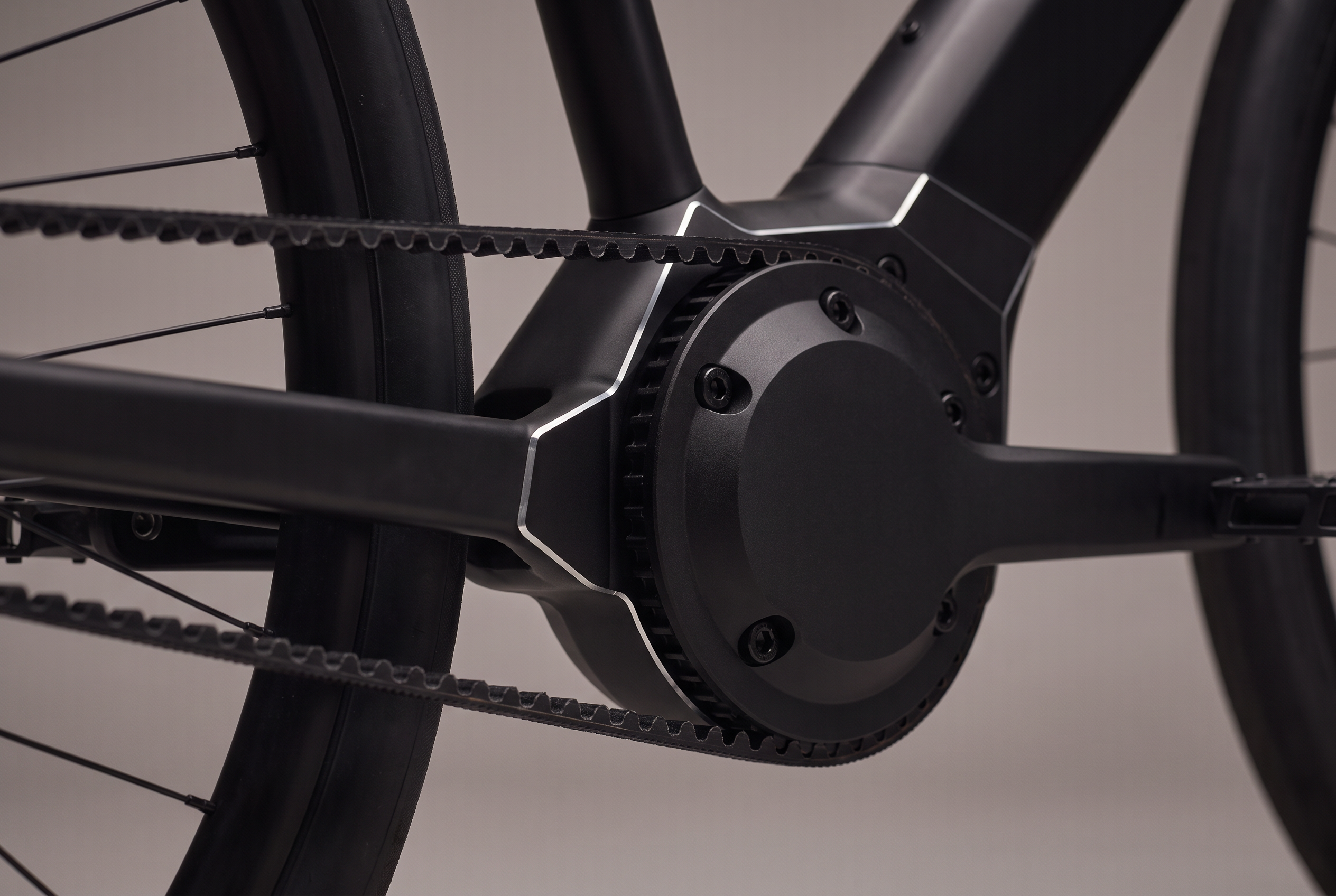
| Drive unit | Pinion MGU E1.12 (supplier). Held in a two-piece machined aluminium cradle; the outer face of the cradle is what the eye sees, a round-cornered matte-black housing with six exposed bolts. |
| Gears | 12, electronic shifting, 600 % range, ~17.7 % steps (supplier). |
| Torque | 85 Nm competitive torque (supplier); up to 160 Nm at the rear wheel in the lowest gears (supplier). |
| Peak power | 600 W (supplier, pedelec setting). Assist limited to 25 km/h in the EU pedelec build. |
| Drive unit mass | ~4,100 g (supplier). |
| Q-factor | 174 mm (supplier). |
| Service | Oil change after 10,000 km (supplier). Belt: no lubrication. |
| Final drive | Belt. Gates Carbon Drive CDX CenterTrack, 12 mm wide, 11 mm pitch, black. Front sprocket on the drive unit, single rear sprocket on a plain hub. Sprocket pair: design target 24T front / 28T rear, final ratio to be set against the supplier's ratio guidance. |
| What is NOT there | No chain. No derailleur. No cassette. No chain guard. No front chainring of a chain drive. |
| Cranks | Forged aluminium, matte black, 170 mm. Flat aluminium pedals, black. |
4. Battery
| Item | Locked decision |
|---|---|
| Decision | Concealed, honestly. The cells live inside the down tube; nothing is bolted to the outside of the frame. |
| Cells | 13s3p, 21700 lithium-ion cells, 48 V-class nominal (13s ≈ 46.8 V). Voltage match to be confirmed against the drive-unit supplier's documentation. |
| Capacity | ~670 Wh nominal (design target). |
| Removal | Drops out of the underside of the down tube, ahead of the drive unit, after unlocking. The visible trace is a fine machined split line along the underside of the down tube and a milled end cap with a keyed lock. |
| Charge port | Sealed port with a machined aluminium cover on the non-drive side of the down tube, just above the drive-unit cradle. |
| Charge time | ~4.5 h, 0–100 % on a 4 A charger (design target). |
5. Cockpit and controls
| Item | Locked decision |
|---|---|
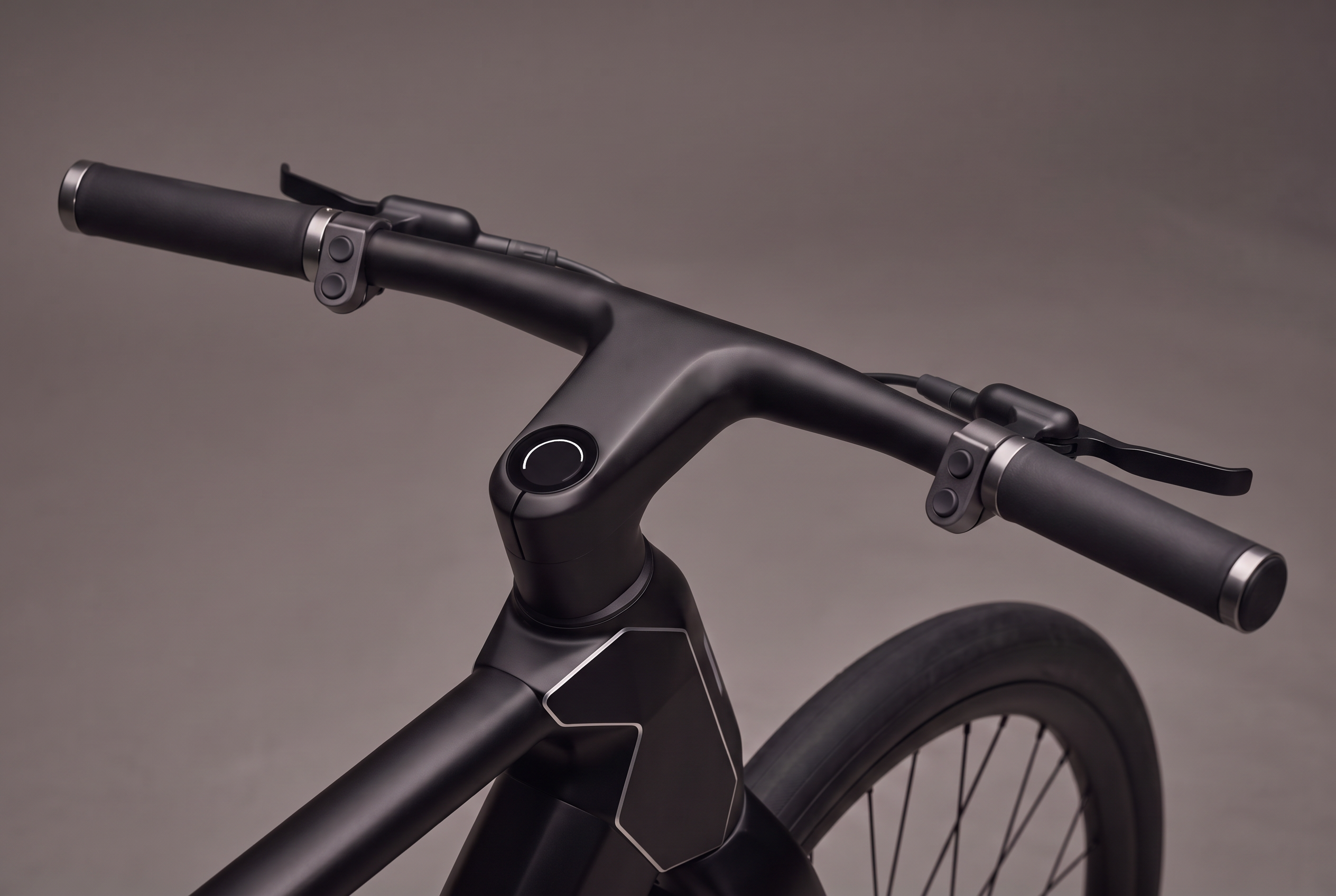
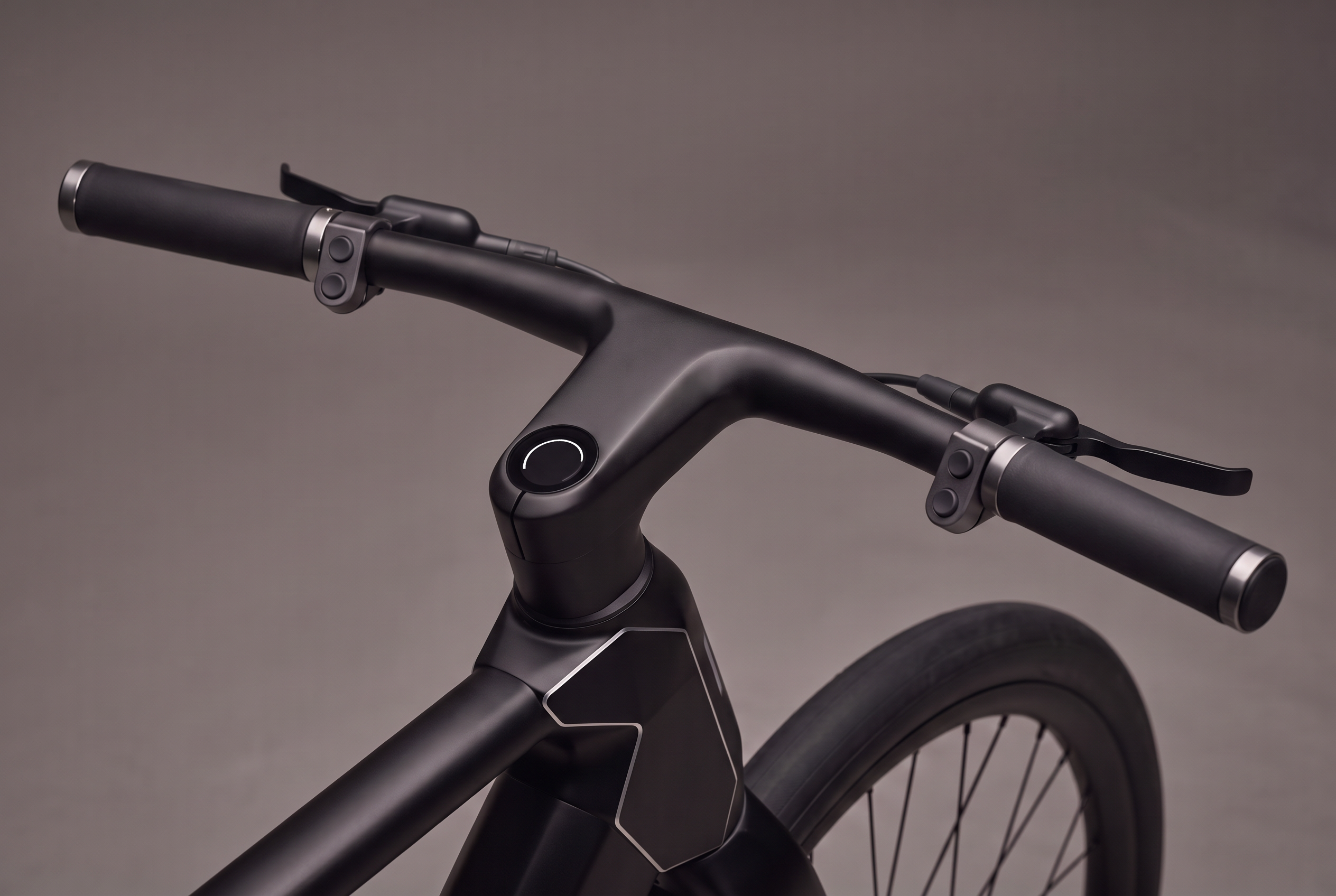
| Bar and stem | One-piece machined aluminium bar-stem, matte black. Flat bar, 640 mm wide, 8° backsweep. |
| Display | A small circular display, 32 mm, set flush into the top face of the stem, glass flush with metal. Monochrome white on black: speed, assist level, gear, charge. Off, it is a black disc. |
| Controls | Two machined aluminium thumb remotes, one per side, each a small block with two backlit buttons. Left: assist up/down. Right: shift up/down (electronic). No twist shifter, no shift cables. |
| Brakes | Hydraulic disc, two-piston, black levers. Rotors 180 mm front, 160 mm rear. |
| Cables | All lines enter the frame at the head-tube node and run internally. |
| Grips | Black rubber, plain, with a machined aluminium outer collar. |
| Bell | Integrated as a tone from the display unit; no separate bell in the canonical configuration. |
6. Lighting
| Item | Locked decision |
|---|---|
| Front | A slim white LED slot milled into the head-tube node: a horizontal bar across the front face (~60 mm) that wraps round onto both flanks of the node as a short vertical slot, so the bike is seen from the side at a junction as well as head-on. Flush; no lamp housing, no bracket. |
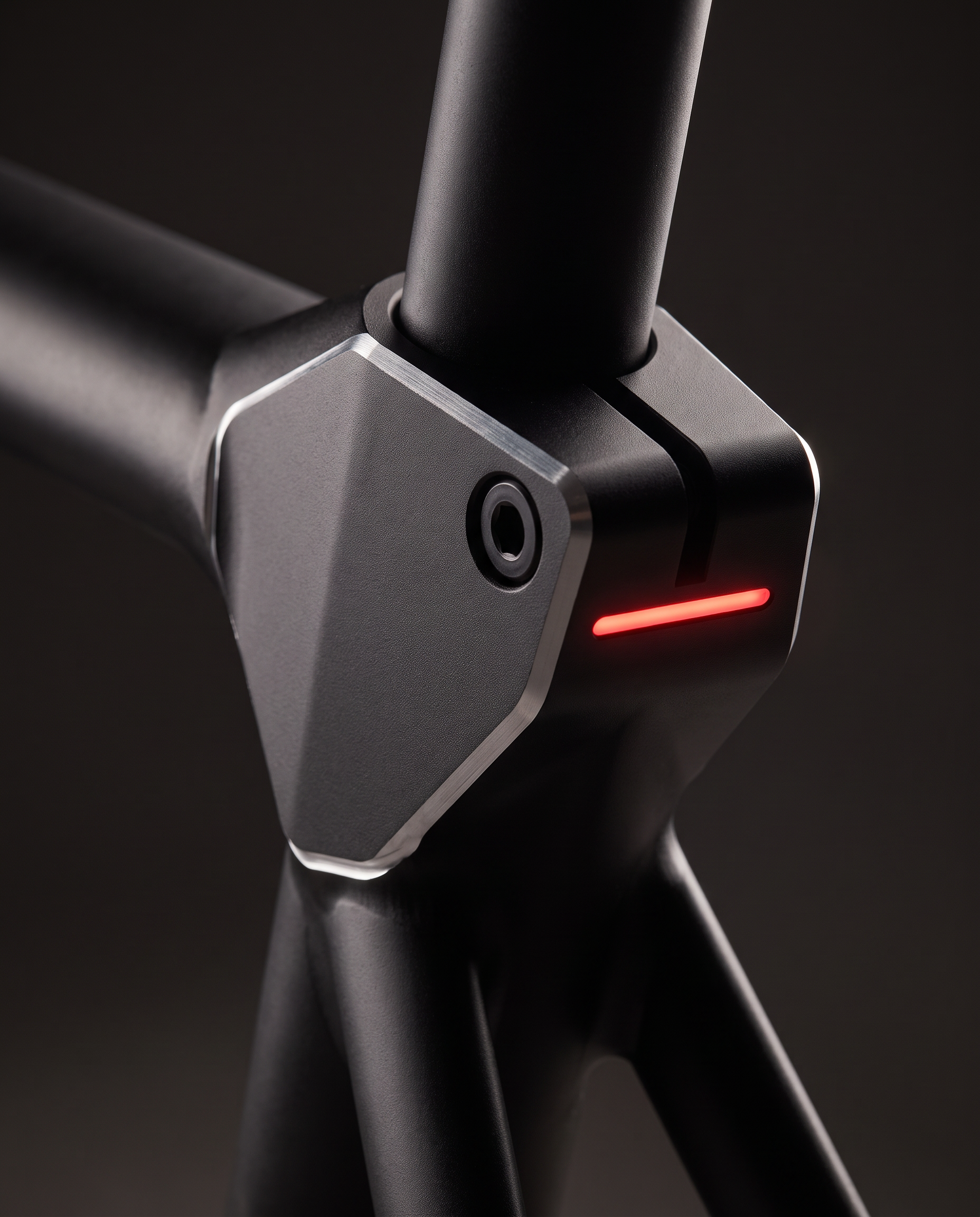
| Rear | A horizontal LED slot, ~40 mm wide, milled into the rear face of the seat-cluster node, below the saddle. Red. Flush. |
| Power | From the main battery, always on with the system. |
7. Wheels and contact points
| Item | Locked decision |
|---|---|
| Wheel size | 700c (ISO 622), both wheels. |
| Rims | Aluminium, 25 mm internal, matte black, 28 spokes, black spokes. |
| Tyres | 700 × 50 mm (ISO 50-622), smooth city tread, all-black sidewall. |
| Hubs | Front: plain 12 × 100. Rear: plain single-sprocket 12 × 142 (all gearing is in the drive unit). |
| Saddle | Slim black saddle, flat profile. |
| Seatpost | 30.9 mm aluminium, matte black, clamped in the seat-cluster node. |
8. Finish and colourways
| A. Graphite (canonical) | B. Raw | |
|---|---|---|
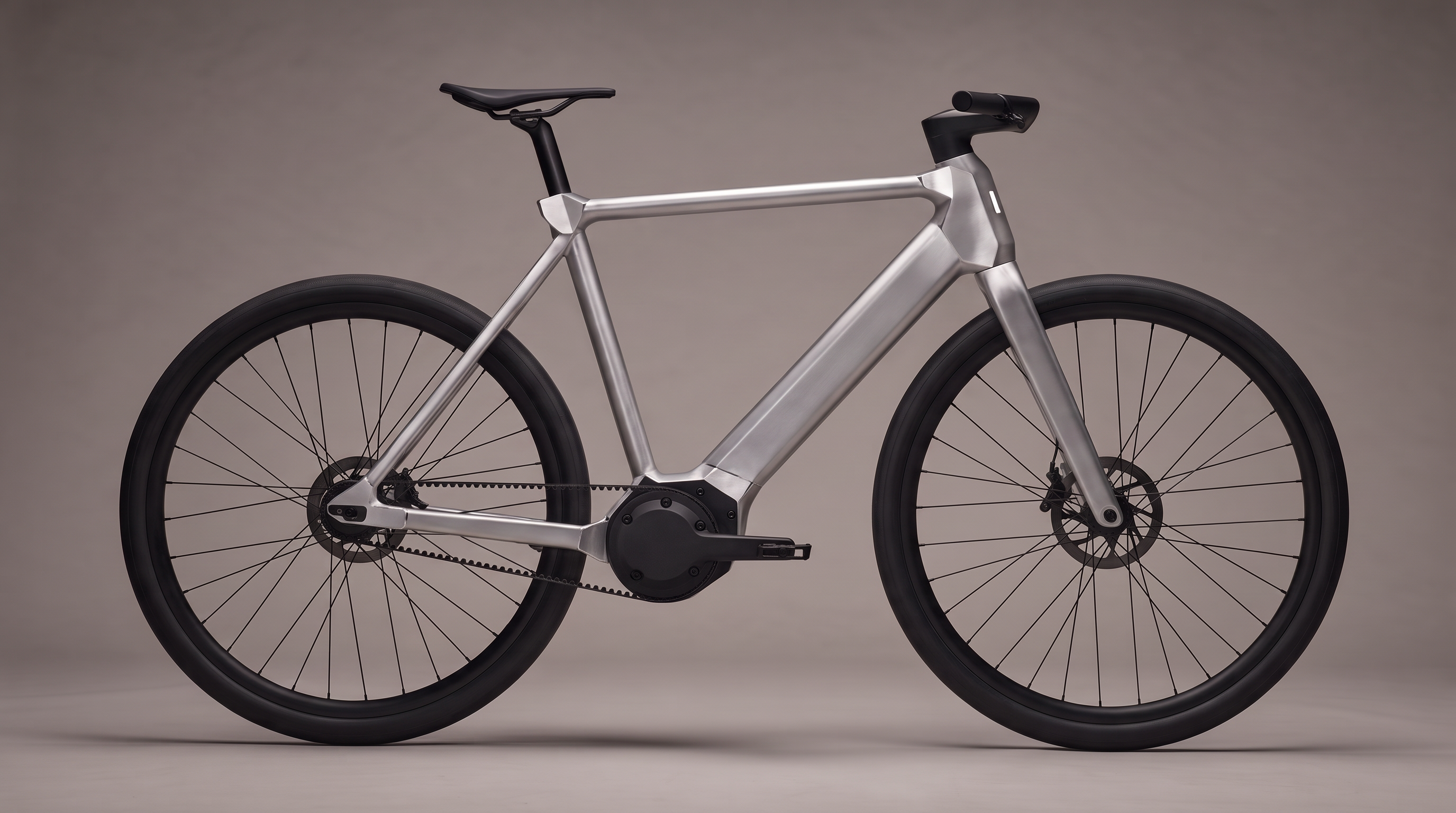
| Frame + fork | Hard-anodised matte black, fine bead-blasted surface | Clear-anodised natural aluminium, bead-blasted satin grey |
| Node chamfers | Diamond-cut to bright raw aluminium | Diamond-cut to bright aluminium (higher polish against satin) |
| Drive cradle, bar-stem, cranks, rims, tyres, belt | Matte black | Matte black (same parts) |
| Fasteners | Black oxide | Black oxide |
No graphic, no stripe, no decal on either colourway. The only mark the frame will ever carry is added later as an identity layer; every render leaves the surfaces blank.
9. Geometry (size M, rider 172–184 cm)
| Measure | Value |
|---|---|
| Seat tube (centre to top) | 520 mm |
| Effective top tube | 585 mm |
| Reach | 400 mm |
| Stack | 620 mm |
| Head-tube angle | 70.0° |
| Seat-tube angle | 73.5° |
| Head tube length | 160 mm |
| Chainstay | 455 mm |
| BB drop | 70 mm |
| Fork offset | 50 mm |
| Wheelbase | ~1,130 mm |
| Standover | ~810 mm |
Sizes S, M and L; the canonical renders are size M.
10. Headline figures (the numbers every surface must agree with)
| Figure | Value | Basis |
|---|---|---|
| Weight, complete bike, size M | 21.5 kg | design target |
| Battery | ~670 Wh | design target |
| Range | 60–120 km (mode and terrain dependent) | design target (≈ 5.5–11 Wh/km) |
| Torque | 85 Nm | supplier |
| Gears | 12, 600 % range | supplier |
| Assist speed | 25 km/h (EU pedelec) | regulatory |
| Final drive | Belt, Gates CDX | supplier |
| Wheels | 700c × 50 mm | locked |
| Service interval | 10,000 km drive-unit oil change; belt needs no lubrication | supplier |
11. The render checklist (every frame is held against this)
- Belt, never chain. One thin black toothed belt, straight between two sprockets. No derailleur, no cassette.
- Compact black drive unit at the bottom bracket in a machined cradle with exposed bolts.
- Large straight down tube; NO external battery pack anywhere.
- Straight horizontal top tube; closed diamond triangle; rigid straight-blade fork.
- Two 700c wheels, black rims, black 50 mm smooth tyres, disc rotors front and rear.
- Flat bar, one-piece bar-stem; no headlamp housing, no bracket; light is a flush slot in the head-tube node, visible on its flank in side view.
- NO rack, NO fenders, NO kickstand, NO basket, NO bottle cage, NO bell, NO reflectors.
- NO text, NO logo, NO decal, NO badge anywhere on the bike.
- Bright diamond-cut chamfers on the machined nodes; everything else matte.
12. The canonical frames (the one true form)
Every later frame of this bike is made with these as references. Name hero-side-profile.png first in every reference call; add the detail that matches the shot.
| Frame | Path |
|---|---|
| Side profile, Graphite (MASTER) | artifacts/product/hero-side-profile.png |
| Front three-quarter, Graphite | artifacts/product/hero-three-quarter-2.png |
| Side profile, Raw colourway | artifacts/product/colorway-raw-side-profile.png |
| Drive unit and belt, macro | artifacts/product/detail-drivetrain.png |
| Cockpit, rider's view | artifacts/product/detail-cockpit-3.png |
| Seat-cluster node, finish and rear light | artifacts/product/detail-finish-node-2.png |
| The set on one sheet | artifacts/product/hero-set-overview.png |
Known liberties in the master at macro scale (invisible at plate size, named so nobody copies them into a drawing): the belt's lower run shows its teeth on the outer face, and a rear disc rotor reads through on the drive side. The drivetrain macro is the correct reference for belt and sprocket detail.
Sources for supplier figures
- Pinion GmbH, Motor.Gearbox.Unit page, "Hard Facts" table and feature text, read 9 Oct 2026: pinion.eu/en/e-drive (12 gears, 600 %, ~17.7 % steps, ~4,100 g, Q-factor 174 mm, 600 W peak, 85 Nm competitive torque, up to 160 Nm at the rear wheel, oil change after 10,000 km).
- Gates Carbon Drive CDX CenterTrack belt (12 mm width, 11 mm pitch): Gates Carbon Drive technical manual as surfaced in search, not read on Gates' own page in this sitting; re-check before print.
The reel
The gallery

Everything in the package16 piecesDownload everything
- KANTE 01 — the hero film, wide (16:9)13.3 MBFilm
- KANTE 01 — the launch book46.6 MBDocument
- KANTE 01 — the hero film, vertical (9:16)13.6 MBFilm
- KANTE identity system — mark, type, colour, placement99 KBDocument
- The name — KANTE, and why39 KBDocument
- The locked specification83 KBDocument
- The bike — side profile, Graphite (the master render)4.0 MBImage
- The bike — front three-quarter, Graphite5.0 MBImage
- The bike — Raw colorway, clear-anodised aluminum5.0 MBImage
- Detail — drive unit and belt5.0 MBImage
- Detail — cockpit and controls4.5 MBImage
- Detail — seat-cluster node, finish and rear light5.6 MBImage
- KANTE wordmark — master drawing (vector)875 bytesImage
- The wordmark at every size240 KBImage
- KANTE on the frame — Graphite5.6 MBImage
- KANTE on the frame — Raw alloy6.7 MBImage