The Discrepancy — opening chapter
The Quiet Verification — the opening chapter, set as a book


Also in this package
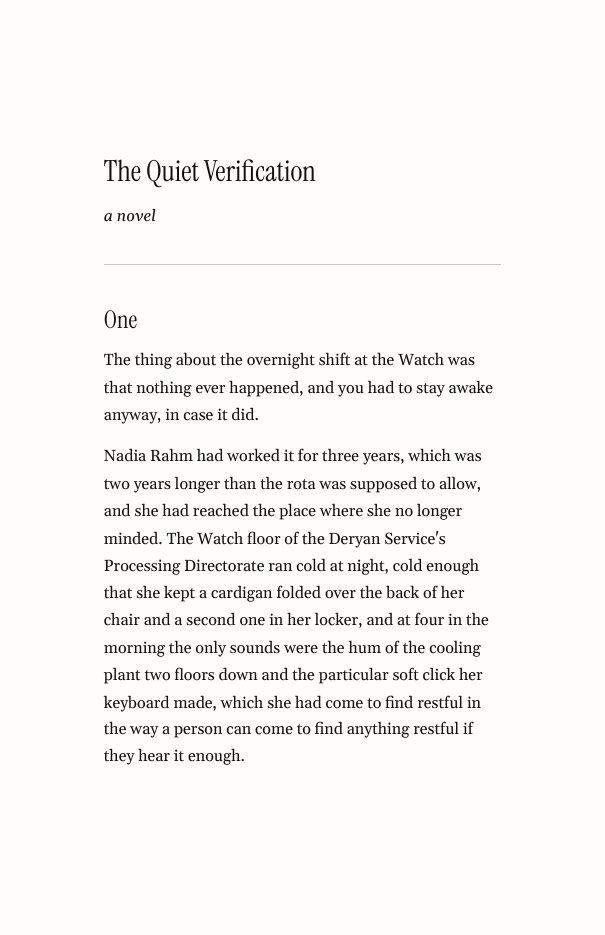
The Quiet Verification
a novel
One
The thing about the overnight shift at the Watch was that nothing ever happened, and you had to stay awake anyway, in case it did.
Nadia Rahm had worked it for three years, which was two years longer than the rota was supposed to allow, and she had reached the place where she no longer minded. The Watch floor of the Deryan Service's Processing Directorate ran cold at night, cold enough that she kept a cardigan folded over the back of her chair and a second one in her locker, and at four in the morning the only sounds were the hum of the cooling plant two floors down and the particular soft click her keyboard made, which she had come to find restful in the way a person can come to find anything restful if they hear it enough.
She was reconciling border crossings. It was not glamorous and it was not supposed to be. Every night, the Service received a bulk feed from the republic's eleven points of entry — the two airports, the land bridge at Sevrin, the river crossings, the ferry terminal at the delta — and every night, a watch officer went through the exceptions. Not every crossing. Only the ones the system flagged: a name on a list, a document that had been reported, a face the machines thought they recognised but could not place with confidence. The work was to agree with the machine or to correct it. Mostly you agreed with it. The machines were very good now, better than people, and the entire architecture of the night shift was built on the assumption that a human being would only ever need to confirm what the software already knew.
Nadia had a theory about this, which she had never told anyone, because it would have sounded either arrogant or insane and she was not sure which was worse. Her theory was that the machines were good at being right and bad at being wrong. When a thing was ordinary, the software saw it instantly and completely. But the software had no sense of occasion. It could not feel the small electric wrongness of a detail that fit every rule and was nonetheless impossible, because impossibility was not a field in any database. Impossibility was something you carried in your body. You had to have been there.
She had been there. That was the whole of why she was good at this, and also the whole of why she was still on the night shift at thirty-eight when people she had trained had offices with doors.
The flag that night came up at 4:11.
She remembered the time afterward with the precision of someone who had learned, late, that times mattered. The entry was routine on its face. A man had crossed into the republic at Sevrin, the land bridge, at 23:40 the previous evening, inbound from the federal territories to the north. The system had flagged it on a facial-similarity hit — a soft match, sixty-one per cent, against a name in the archive. Below the threshold for an alert, above the threshold for a human to look. Sixty-one per cent meant probably nobody, glance and clear. She saw forty of them a night.
She opened the record. There was the gate photograph, the flat frontal capture the biometric lanes took, lit by the ring of cold light above the reader so that every face looked faintly surprised and faintly guilty, which was the honest condition of most people at a border at midnight. A man, perhaps fifty. A grey coat, buttoned to the throat. Heavy at the jaw now, the softness of a man who had stopped being lean a while ago. The hairline had gone. He was looking slightly up and to the left, the way people do when a machine tells them to look at a dot and the dot is not where they expect.
The name the system had matched him to was Emir Dalca.
Nadia sat very still.
She did not feel anything yet, in the way you do not feel the cut until you have seen the knife. She read the name again. She read the sixty-one per cent. She looked at the heavy, surprised, guilty face under the cold ring of light, and she felt the floor of the thing she knew begin, very quietly, to give.
Because she had closed Emir Dalca.
Not metaphorically. She had been the verifying officer. Eleven months ago, in the long autumn when the service was still reeling from the Harbour affair and half the directorate had been reassigned to damage, she had sat at a different desk in a different room and confirmed, from the forensic packet, that Emir Dalca was dead. She remembered the packet the way you remember a smell from a bad year. He had gone into the water off the Kessin coast during an operation that was not hers and that she was told nothing about, and the body that came back — what came back — had been in the sea for nine days before a trawler fouled its nets on it, and there was not a face left to photograph. There had been dental. There had been a partial from the left hand. There had been a watch, inscribed, that his sister recognised. And there had been Nadia, whose job had been to look at the whole of it and write the word that let a man be legally, administratively, finally dead.
She had written it. Confirmed. Rahm, N. The file had closed. His name had gone from the active boards to the archive, and the archive was where the system had reached, eleven months later, to tell her with sixty-one per cent confidence that a heavy man in a grey coat had walked across the Sevrin bridge at twenty to midnight wearing Emir Dalca's face.
Sixty-one per cent. The machine was not even sure.
Nadia was sure. That was the trouble. She was more sure than the machine, and in the opposite direction, and there was no field for that either.
She told herself the obvious things, because that was discipline, and discipline was the only thing that separated a watch officer from a person having a private crisis at four in the morning. A sixty-one per cent match was nothing. The archive was full of faces, and the republic was full of heavy men of fifty with grey coats and gone hairlines; the machine matched on geometry, on the distance between the eyes and the set of the jaw, and geometry was generous. The name attached to the match was the archive's name, the dead man's name, because that was the record the geometry had surfaced — it did not mean the living man carried it. The man at Sevrin had crossed on a document, a real document, scanned and read, and the document would say who he actually was, and the name on the document would be some unremarkable name belonging to some unremarkable man who happened, at midnight, under cold light, to have a face that shared sixty-one per cent of its angles with a man who had been nine days in the sea.
That was the explanation. It was a good explanation. It accounted for everything.
She opened the document scan to confirm it and make the night ordinary again.
The document was a travel pass issued by the federal territories, the kind the north handed out to its own nationals for short crossings, machine-readable, chipped, entirely in order. The lane had read the chip and photographed the face and matched the one to the other to ninety-eight per cent, which was the real match, the document-to-face match, the one that mattered, the one the system trusted. The travel pass belonged to the man in the grey coat. There was no mystery in it at all.
The name on the travel pass was Tomas Veil.
Nadia read it twice and felt the explanation hold, and was relieved, in the specific way you are relieved when a stair you thought was missing turns out to be there. Tomas Veil. An ordinary northern name. A heavy man of fifty crossing home at midnight. The sixty-one per cent was coincidence, the way coincidences are, which is to say not interesting, only frequent.
She moved the cursor to clear the flag.
And then she did not clear it, because something at the edge of the record had caught, the way a thread catches on a nail you cannot see, and she went back to find the nail.
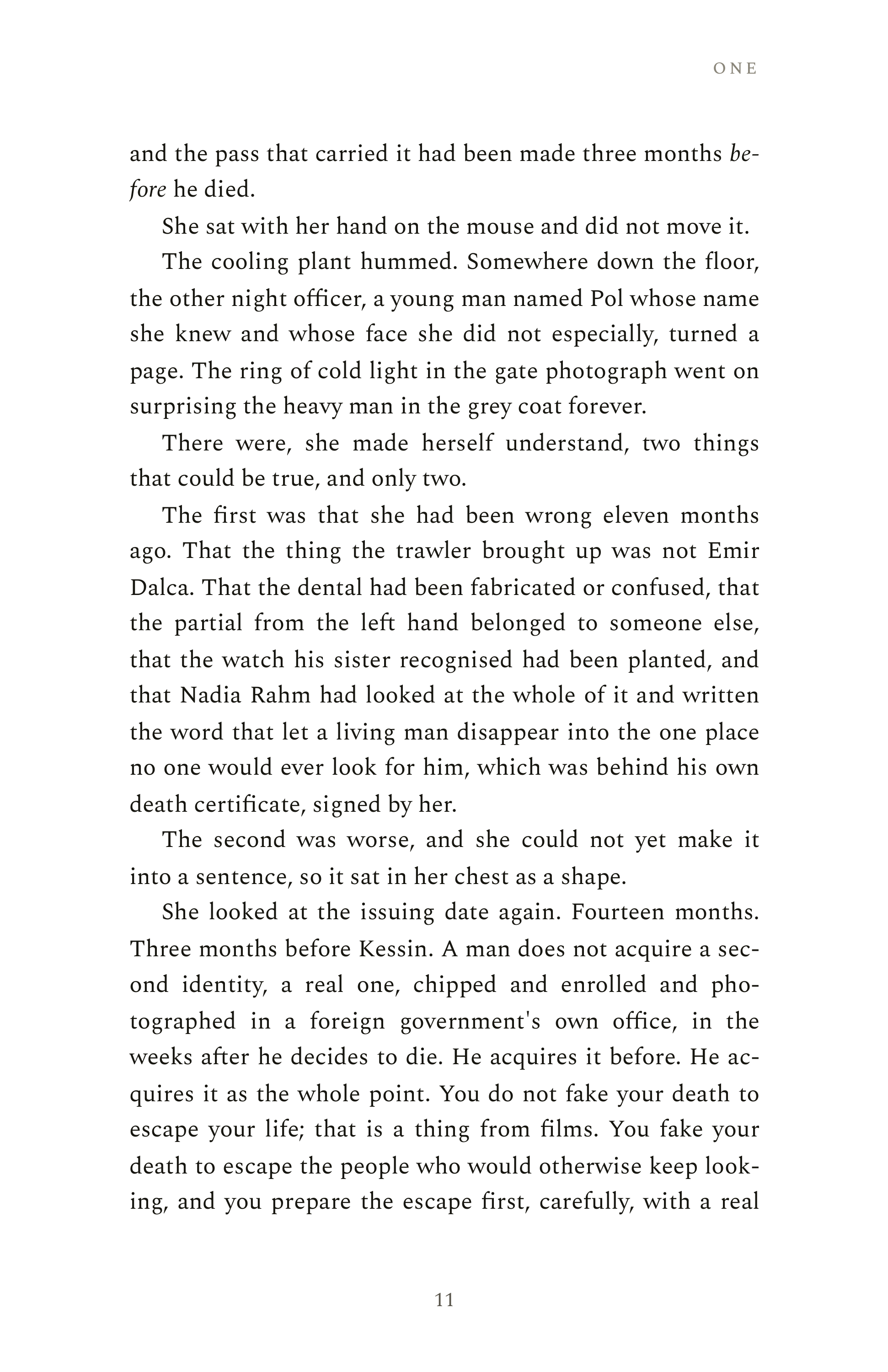
It was the issuing date. The travel pass had been issued fourteen months ago. That was ordinary; the passes ran five years. But fourteen months ago was three months before Emir Dalca went into the water off Kessin. And the pass carried a biometric photograph, the enrolment photograph, the one taken when the document was made, printed small in the corner of the scan the way these things always were, a thumbnail, grey and official.
She enlarged it.
The enrolment photograph of Tomas Veil, taken fourteen months ago in a federal office in the north, was the face of Emir Dalca.
Not sixty-one per cent of it. Not the geometry of it. The face. The particular asymmetry of the mouth that she had spent a week of her life staring at in a forensic packet trying to reconcile with a jaw the sea had taken. The small notch in the left ear that the dental people had flagged as a pre-existing feature, present in the service photographs from his recruitment, present in the enrolment photograph of a northern national called Tomas Veil who did not, could not, must not exist, because the man whose ear that was had been confirmed dead by Nadia Rahm eleven months ago, and the pass that carried it had been made three months before he died.
She sat with her hand on the mouse and did not move it.
The cooling plant hummed. Somewhere down the floor, the other night officer, a young man named Pol whose name she knew and whose face she did not especially, turned a page. The ring of cold light in the gate photograph went on surprising the heavy man in the grey coat forever.
There were, she made herself understand, two things that could be true, and only two.
The first was that she had been wrong eleven months ago. That the thing the trawler brought up was not Emir Dalca. That the dental had been fabricated or confused, that the partial from the left hand belonged to someone else, that the watch his sister recognised had been planted, and that Nadia Rahm had looked at the whole of it and written the word that let a living man disappear into the one place no one would ever look for him, which was behind his own death certificate, signed by her.
The second was worse, and she could not yet make it into a sentence, so it sat in her chest as a shape.
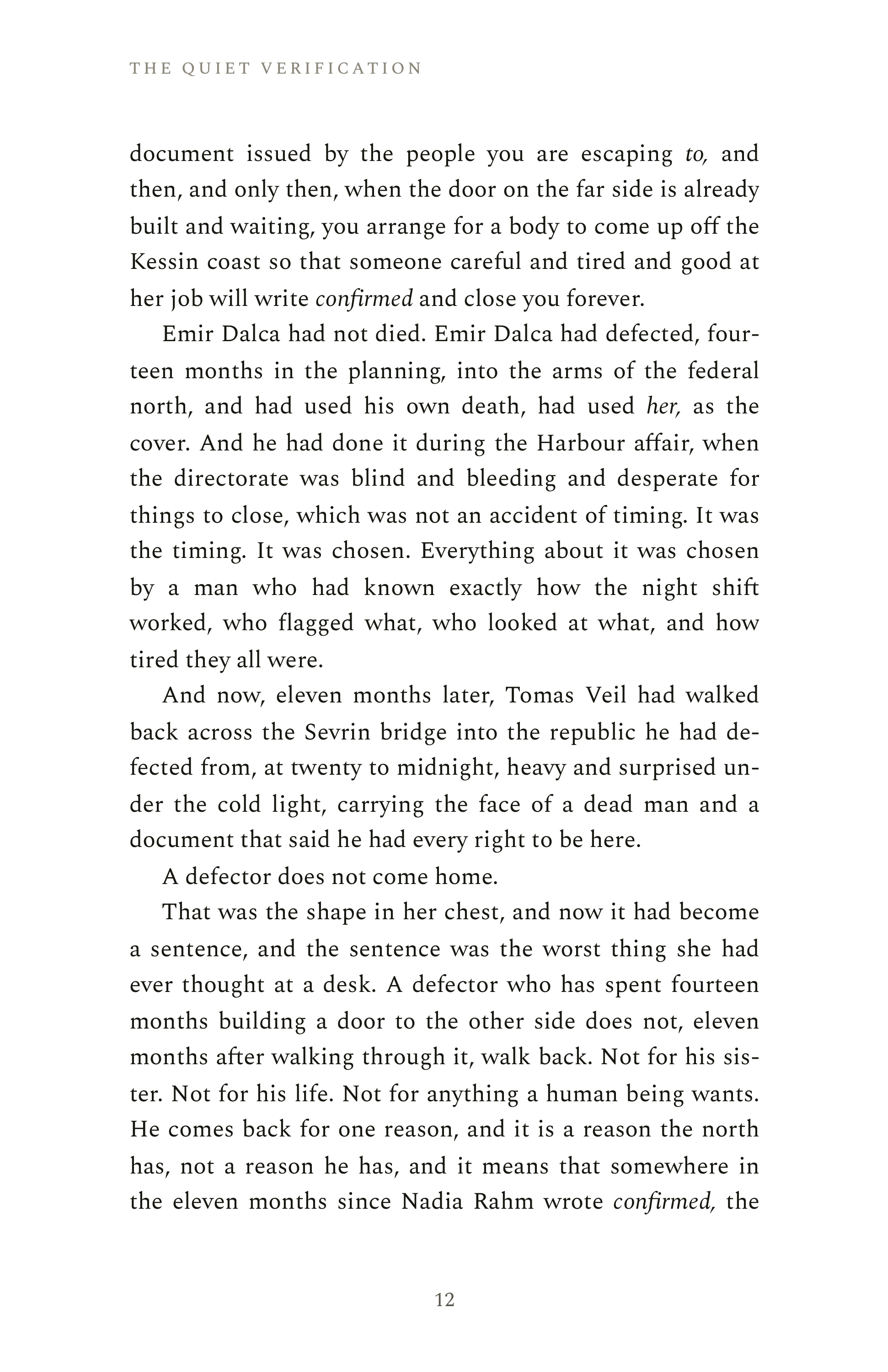
She looked at the issuing date again. Fourteen months. Three months before Kessin. A man does not acquire a second identity, a real one, chipped and enrolled and photographed in a foreign government's own office, in the weeks after he decides to die. He acquires it before. He acquires it as the whole point. You do not fake your death to escape your life; that is a thing from films. You fake your death to escape the people who would otherwise keep looking, and you prepare the escape first, carefully, with a real document issued by the people you are escaping to, and then — and only then, when the door on the far side is already built and waiting — you arrange for a body to come up off the Kessin coast so that someone careful and tired and good at her job will write confirmed and close you forever.
Emir Dalca had not died. Emir Dalca had defected, fourteen months in the planning, into the arms of the federal north, and had used his own death — had used her — as the cover. And he had done it during the Harbour affair, when the directorate was blind and bleeding and desperate for things to close, which was not an accident of timing. It was the timing. It was chosen. Everything about it was chosen by a man who had known exactly how the night shift worked, who flagged what, who looked at what, and how tired they all were.
And now, eleven months later, Tomas Veil had walked back across the Sevrin bridge into the republic he had defected from, at twenty to midnight, heavy and surprised under the cold light, carrying the face of a dead man and a document that said he had every right to be here.
A defector does not come home.
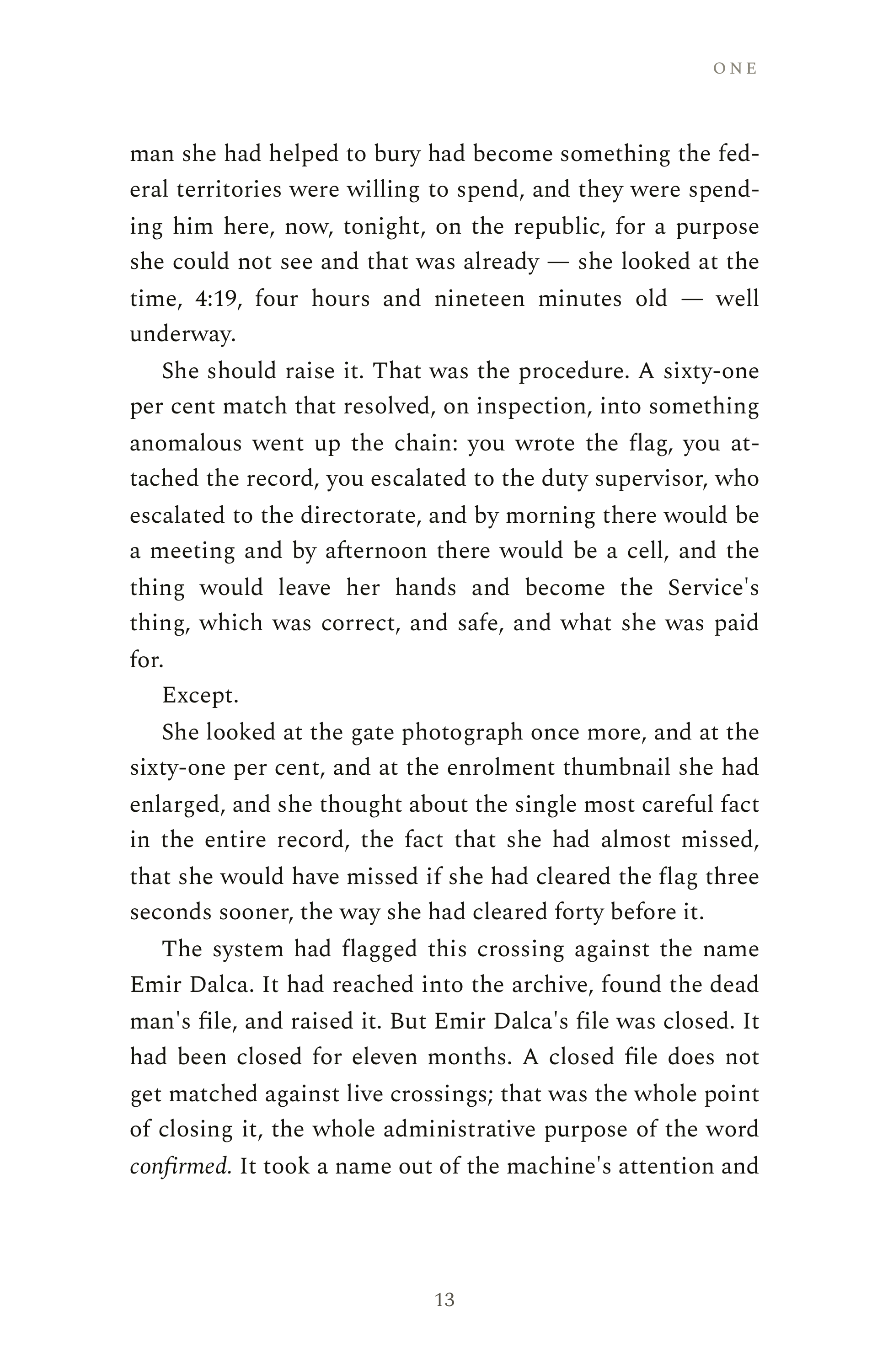
That was the shape in her chest, and now it had become a sentence, and the sentence was the worst thing she had ever thought at a desk. A defector who has spent fourteen months building a door to the other side does not, eleven months after walking through it, walk back. Not for his sister. Not for his life. Not for anything a human being wants. He comes back for one reason, and it is a reason the north has, not a reason he has, and it means that somewhere in the eleven months since Nadia Rahm wrote confirmed, the man she had helped to bury had become something the federal territories were willing to spend, and they were spending him here, now, tonight, on the republic, for a purpose she could not see and that was already — she looked at the time, 4:19, four hours and nineteen minutes old — well underway.
She should raise it. That was the procedure. A sixty-one per cent match that resolved, on inspection, into something anomalous went up the chain: you wrote the flag, you attached the record, you escalated to the duty supervisor, who escalated to the directorate, and by morning there would be a meeting and by afternoon there would be a cell, and the thing would leave her hands and become the Service's thing, which was correct, and safe, and what she was paid for.
Except.
She looked at the gate photograph once more, and at the sixty-one per cent, and at the enrolment thumbnail she had enlarged, and she thought about the single most careful fact in the entire record, the fact that she had almost missed, that she would have missed if she had cleared the flag three seconds sooner, the way she had cleared forty before it.
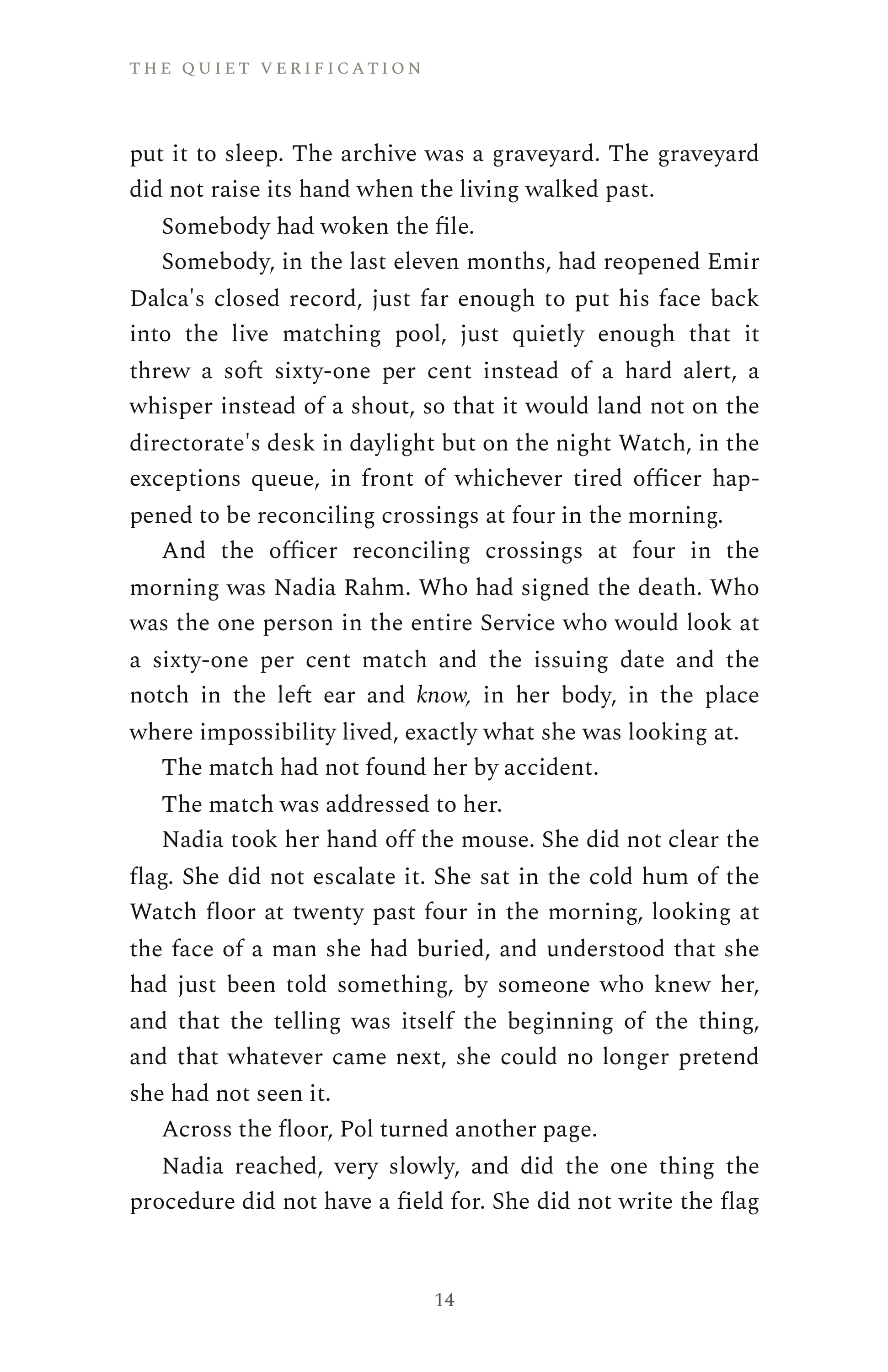
The system had flagged this crossing against the name Emir Dalca. It had reached into the archive, found the dead man's file, and raised it. But Emir Dalca's file was closed. It had been closed for eleven months. A closed file does not get matched against live crossings; that was the whole point of closing it, the whole administrative purpose of the word confirmed. It took a name out of the machine's attention and put it to sleep. The archive was a graveyard. The graveyard did not raise its hand when the living walked past.
Somebody had woken the file.
Somebody, in the last eleven months, had reopened Emir Dalca's closed record, just far enough to put his face back into the live matching pool, just quietly enough that it threw a soft sixty-one per cent instead of a hard alert — a whisper instead of a shout — so that it would land not on the directorate's desk in daylight but on the night Watch, in the exceptions queue, in front of whichever tired officer happened to be reconciling crossings at four in the morning.
And the officer reconciling crossings at four in the morning was Nadia Rahm. Who had signed the death. Who was the one person in the entire Service who would look at a sixty-one per cent match and the issuing date and the notch in the left ear and know, in her body, in the place where impossibility lived, exactly what she was looking at.
The match had not found her by accident.
The match was addressed to her.
Nadia took her hand off the mouse. She did not clear the flag. She did not escalate it. She sat in the cold hum of the Watch floor at twenty past four in the morning, looking at the face of a man she had buried, and understood that she had just been told something, by someone who knew her, and that the telling was itself the beginning of the thing, and that whatever came next, she could no longer pretend she had not seen it.
Across the floor, Pol turned another page.
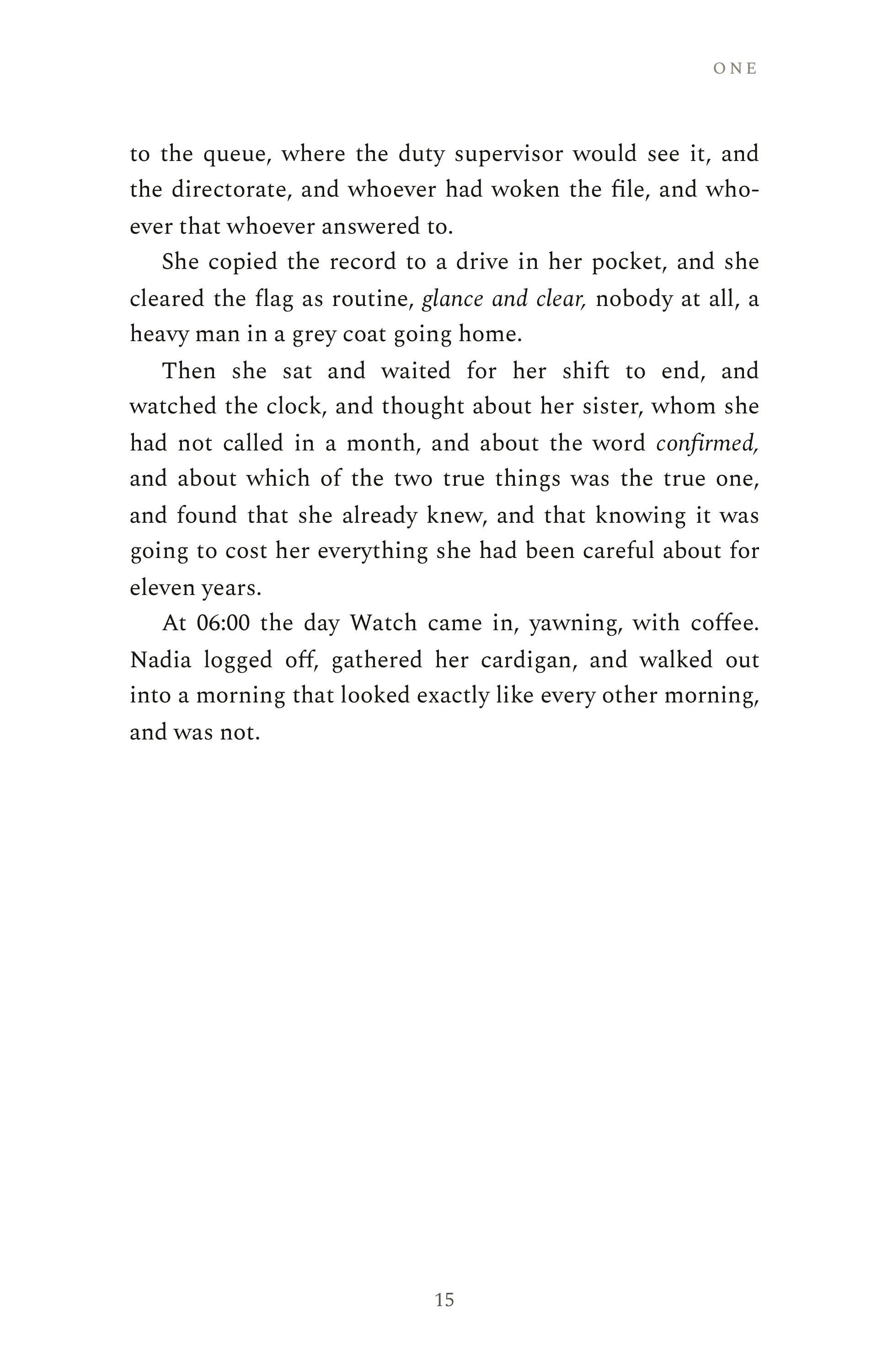
Nadia reached, very slowly, and did the one thing the procedure did not have a field for. She did not write the flag to the queue, where the duty supervisor would see it, and the directorate, and whoever had woken the file, and whoever that whoever answered to.
She copied the record to a drive in her pocket, and she cleared the flag as routine, glance and clear, nobody at all, a heavy man in a grey coat going home.
Then she sat and waited for her shift to end, and watched the clock, and thought about her sister, whom she had not called in a month, and about the word confirmed, and about which of the two true things was the true one, and found that she already knew, and that knowing it was going to cost her everything she had been careful about for eleven years.
At 06:00 the day Watch came in, yawning, with coffee. Nadia logged off, gathered her cardigan, and walked out into a morning that looked exactly like every other morning, and was not.
Everything in the package2 piecesDownload everything
- The Quiet Verification — the opening chapter, set as a book75 KBDocument
- The manuscript — clean, editable text41 KBDocument