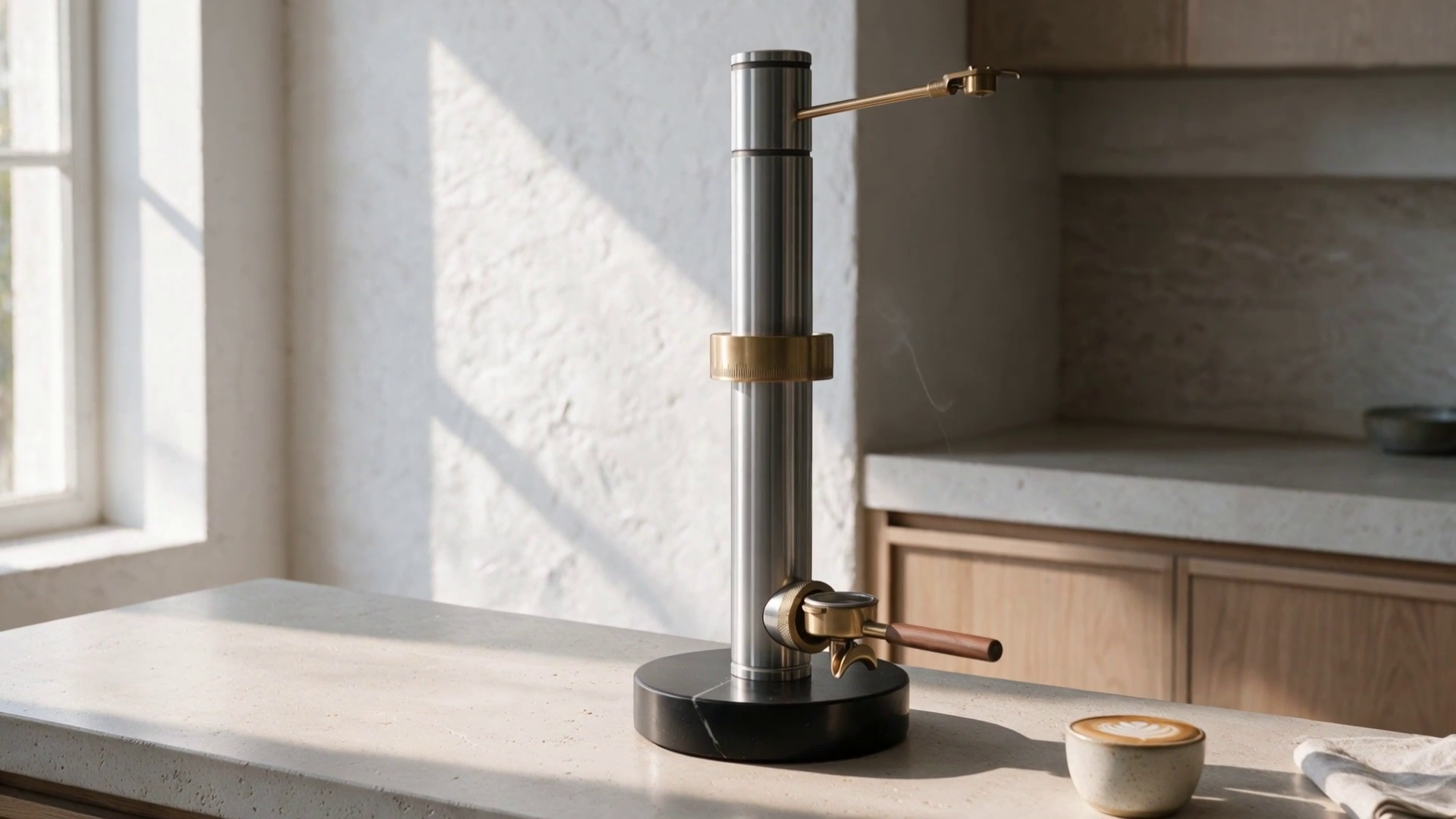
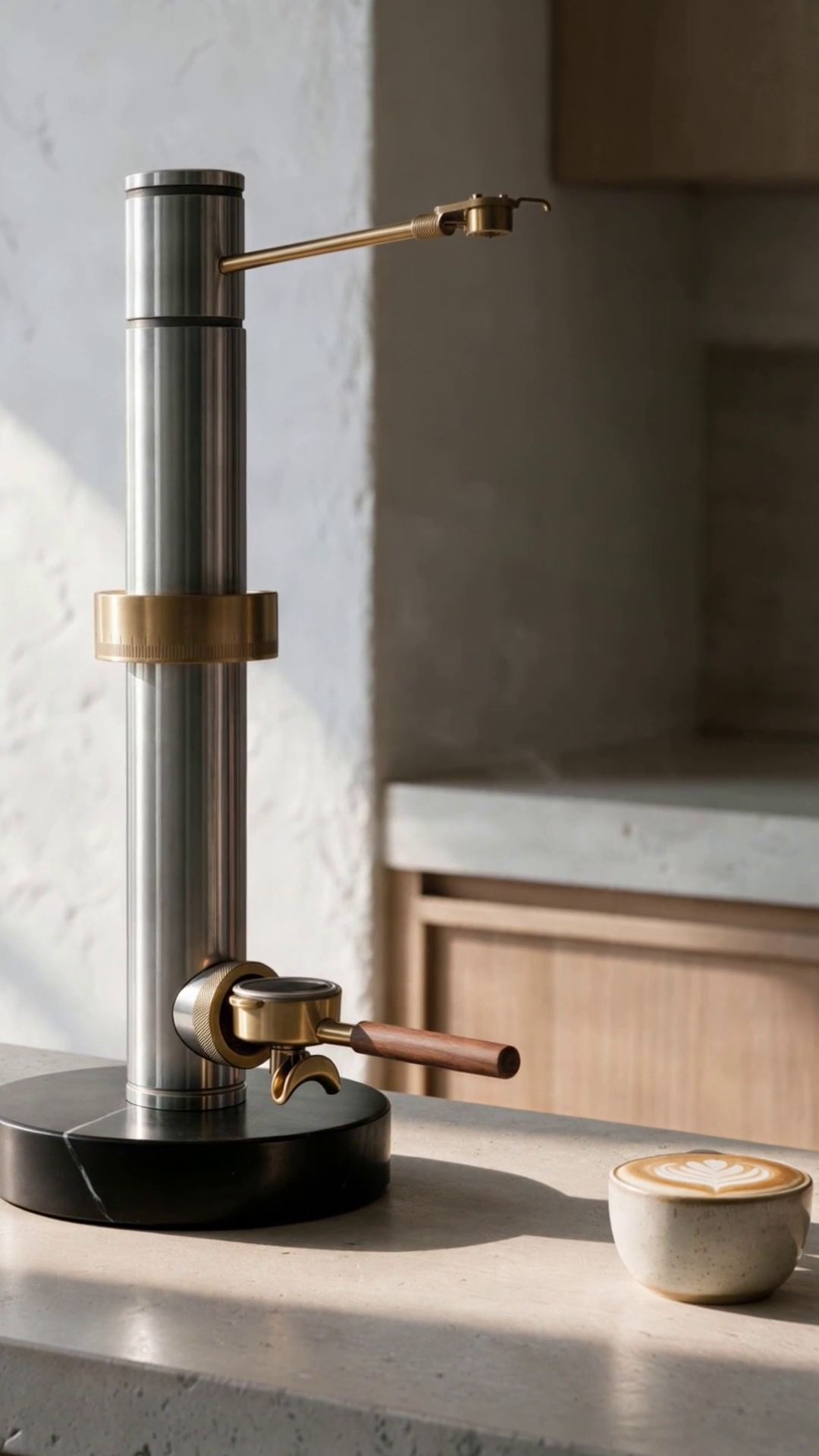
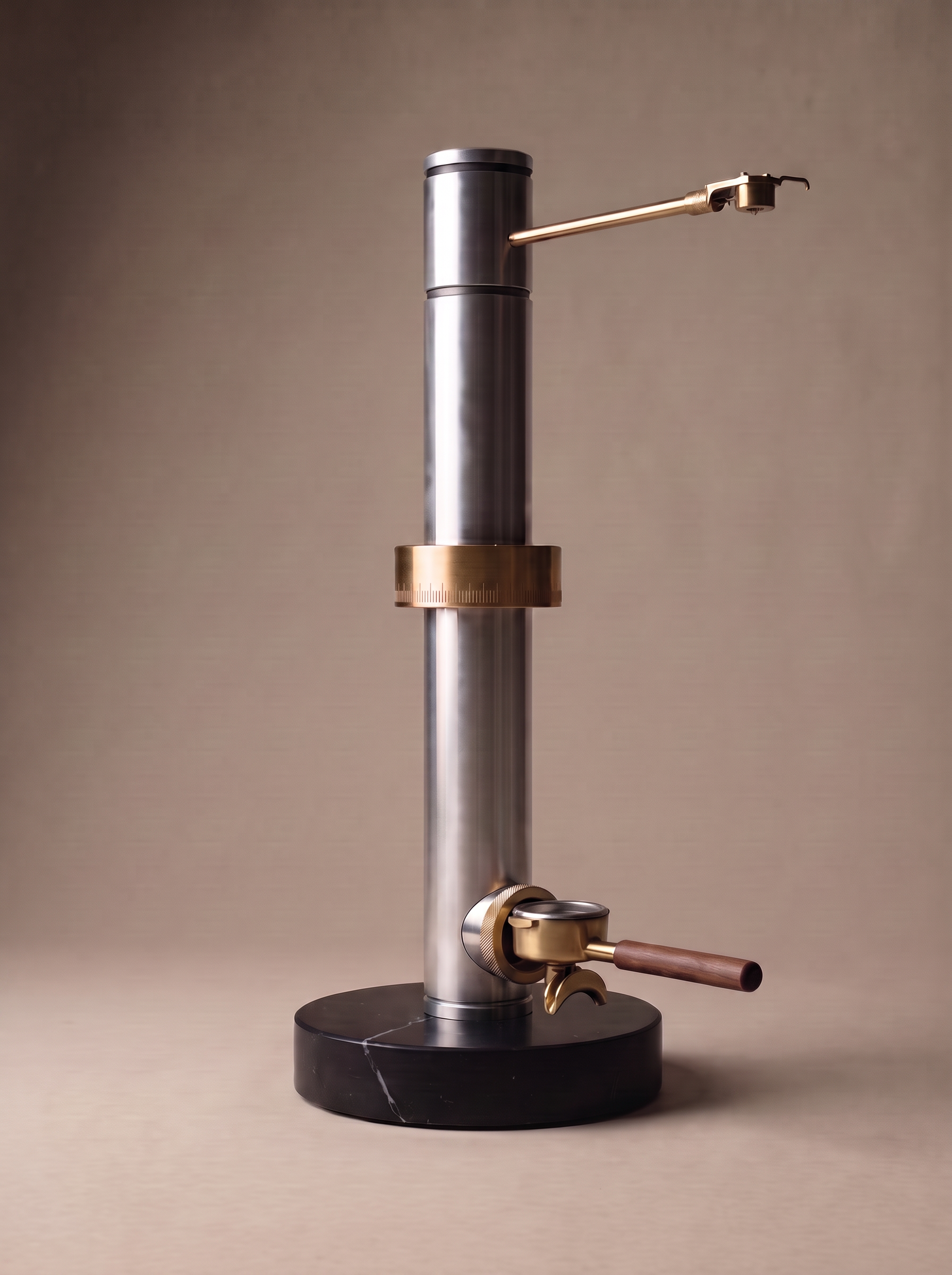
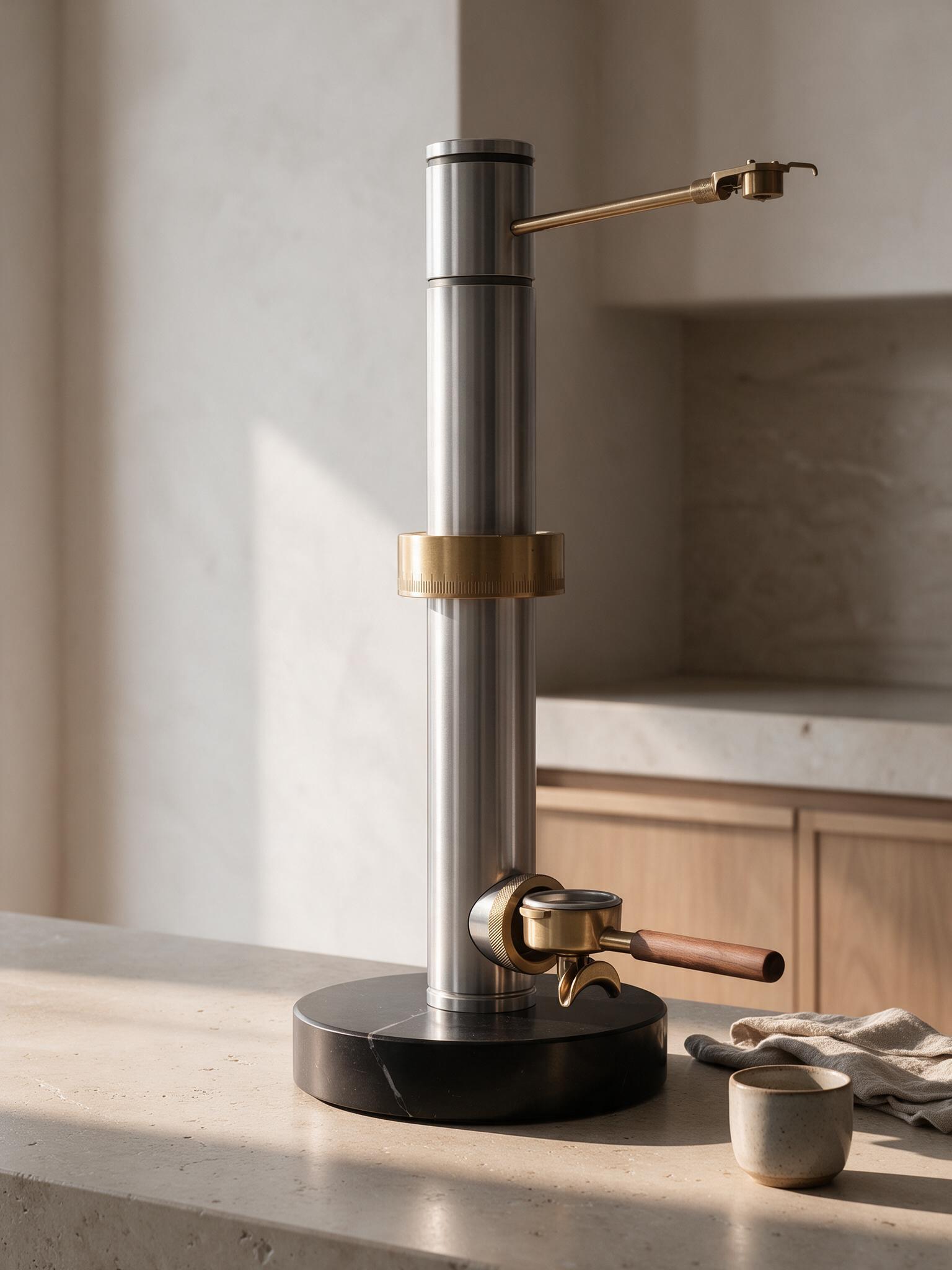
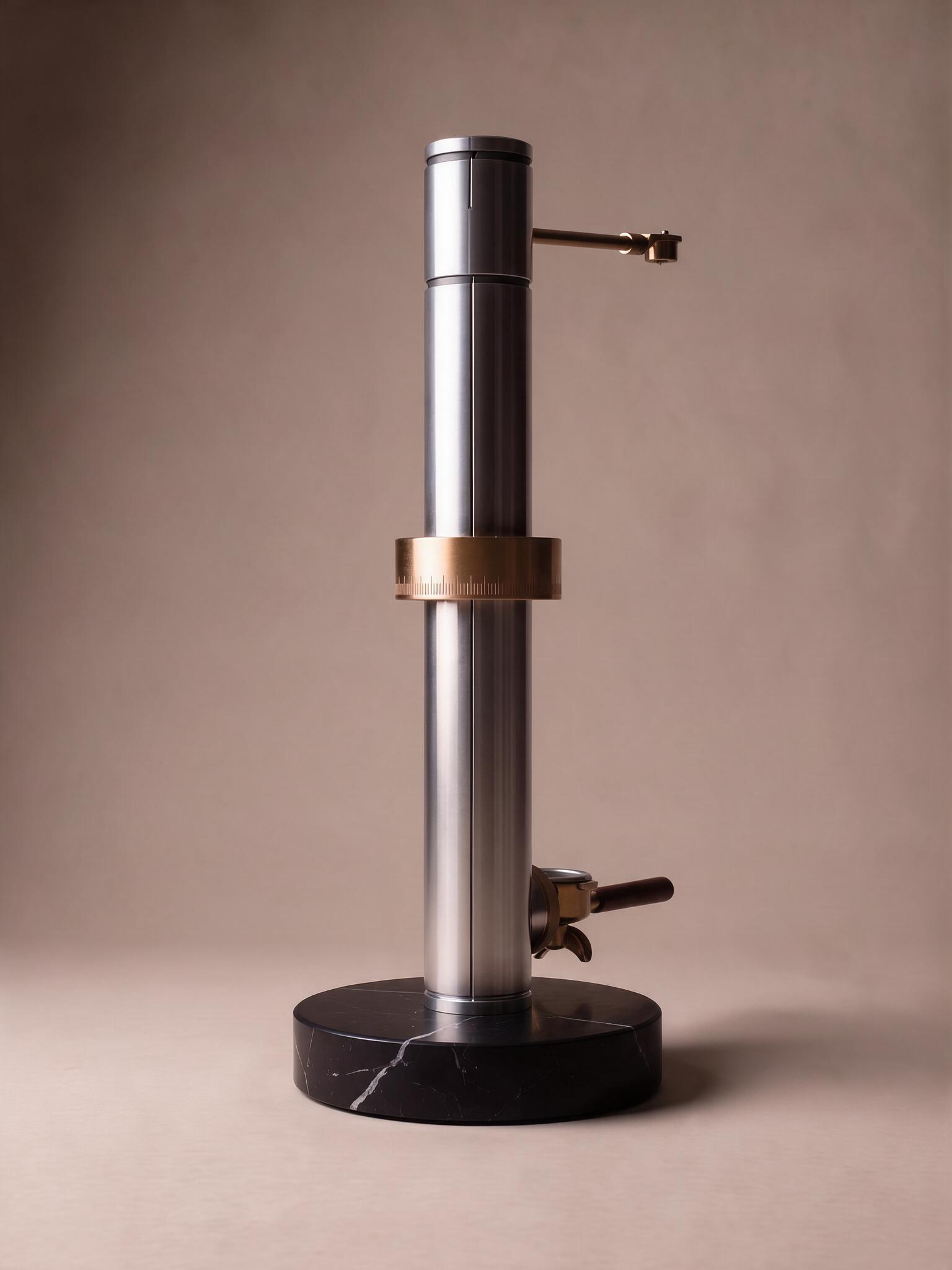
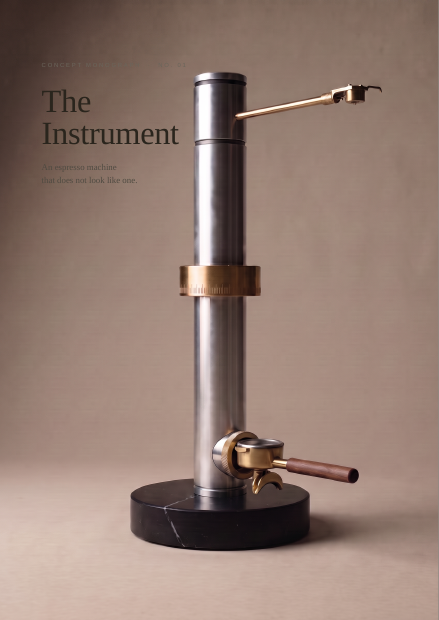
The Instrument
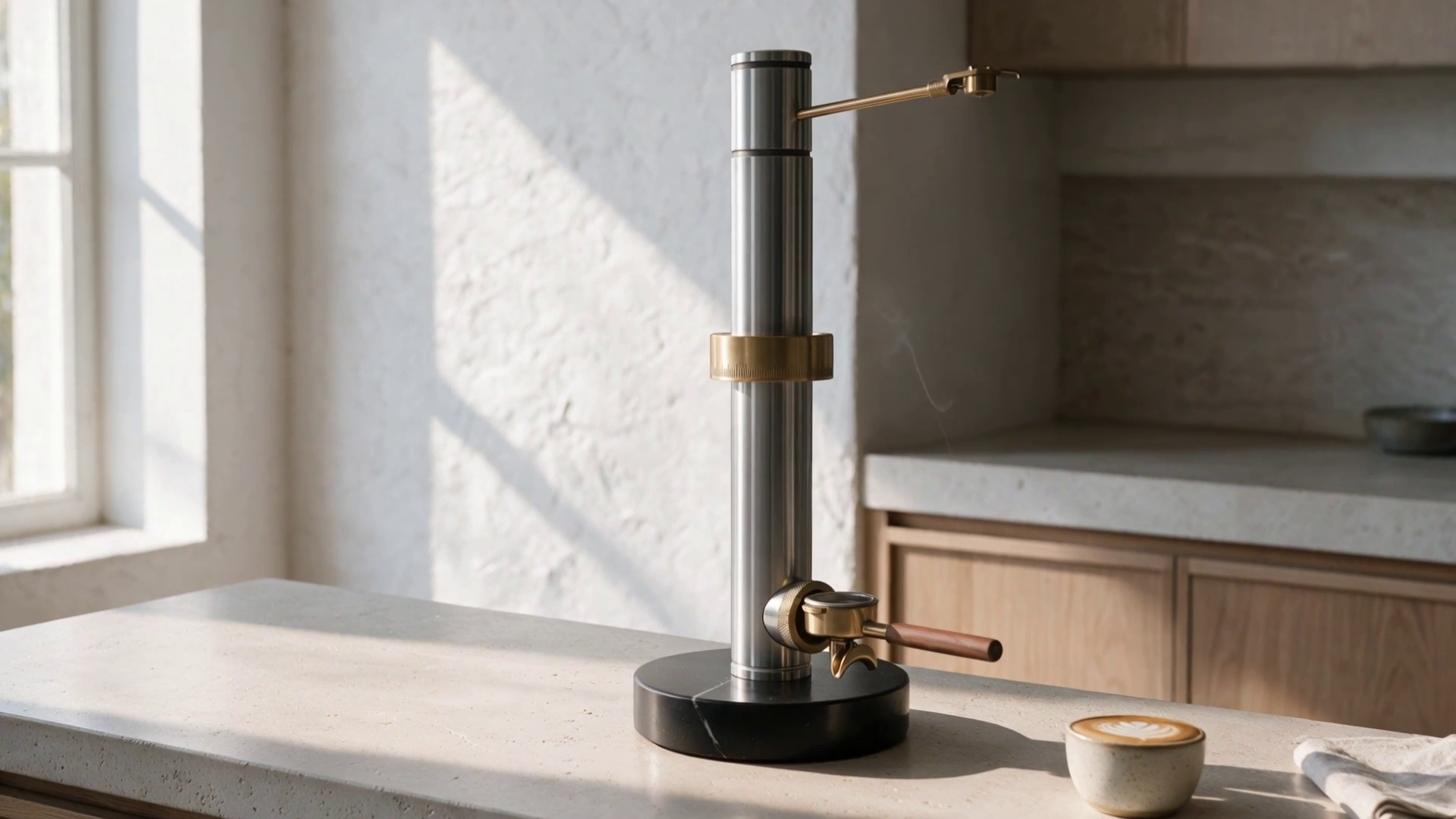
The Instrument — product film (16:9, for the top of the page)
Also in this package
The Machine Inside the Column
Engineering & Build Case — Direction C, The Column / Totem
Prepared for the concept book and the manufacturer/investor pitch. Written to be handed to someone who builds countertop appliances for a living. The hero form is locked — Direction C, the slender machined-aluminum column on a Nero Marquina stone base, brass tonearm steam arm, brass graduation collar, low group port. This is the tightest of the four forms to engineer, and this brief proves it is genuinely buildable in that footprint. Every checkable figure names what it is anchored to; anything not yet verifiable against a real source is written as an honest range or marked "to confirm at DFM."
0. The engineering thesis in one paragraph
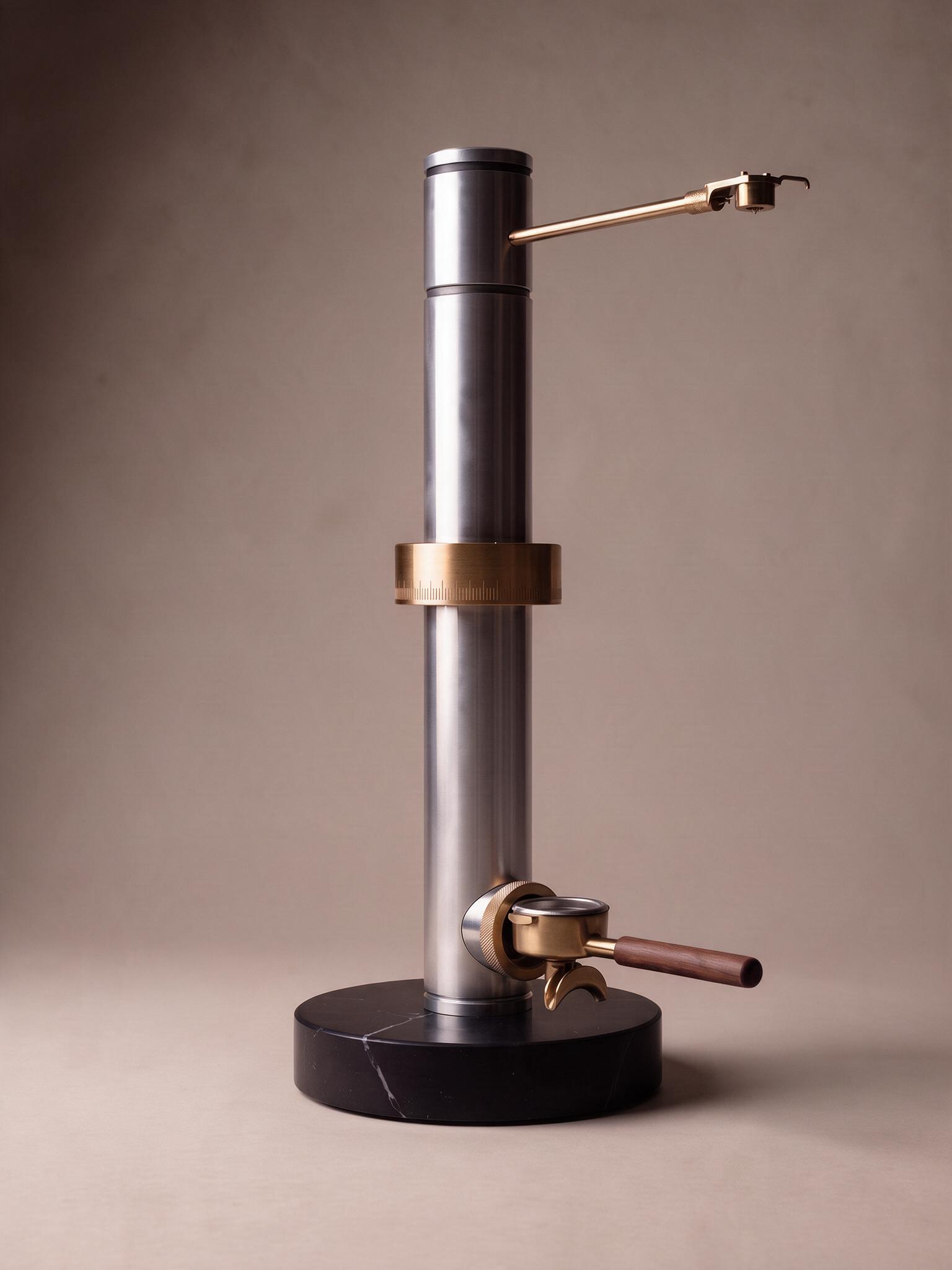
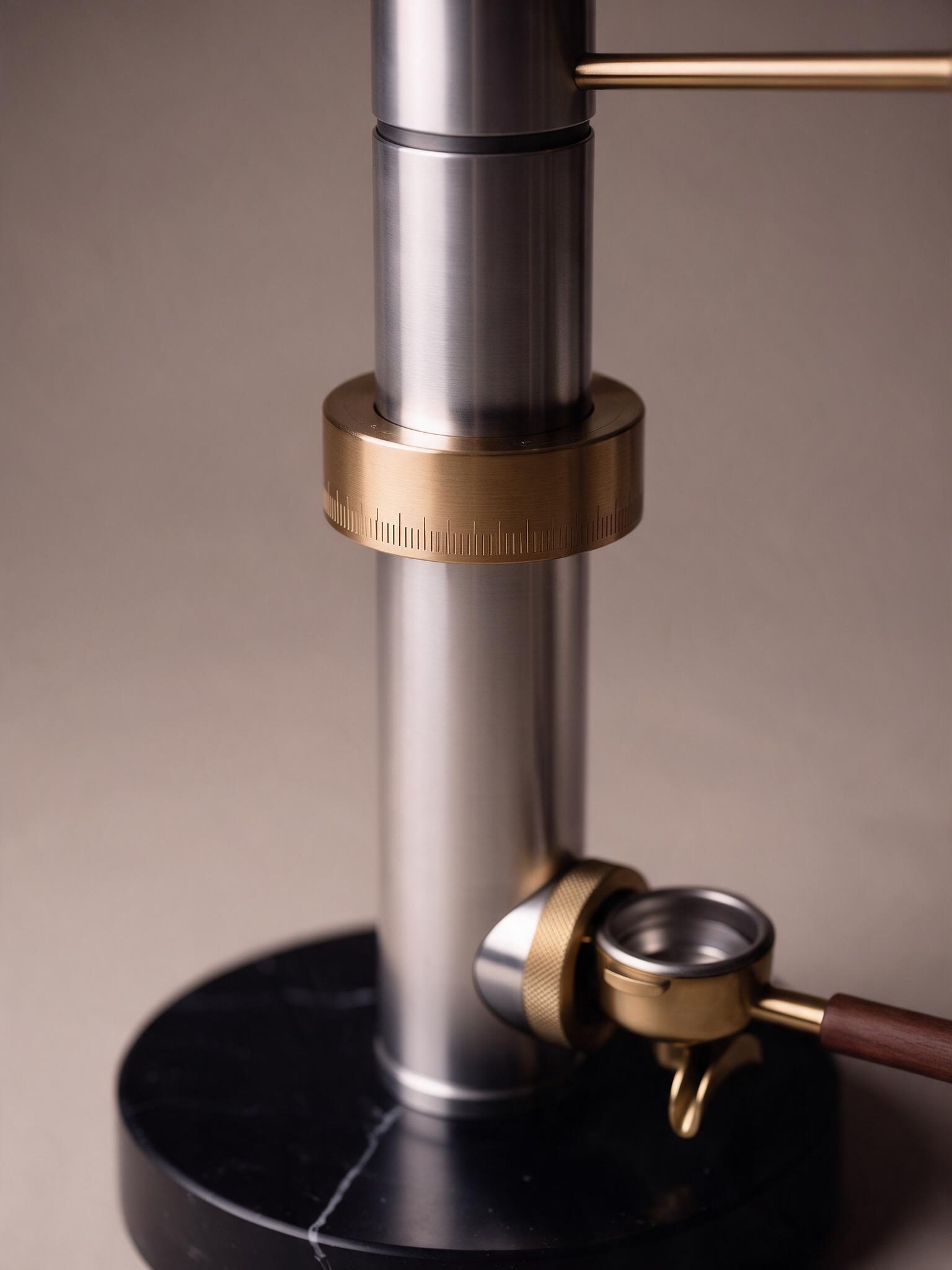
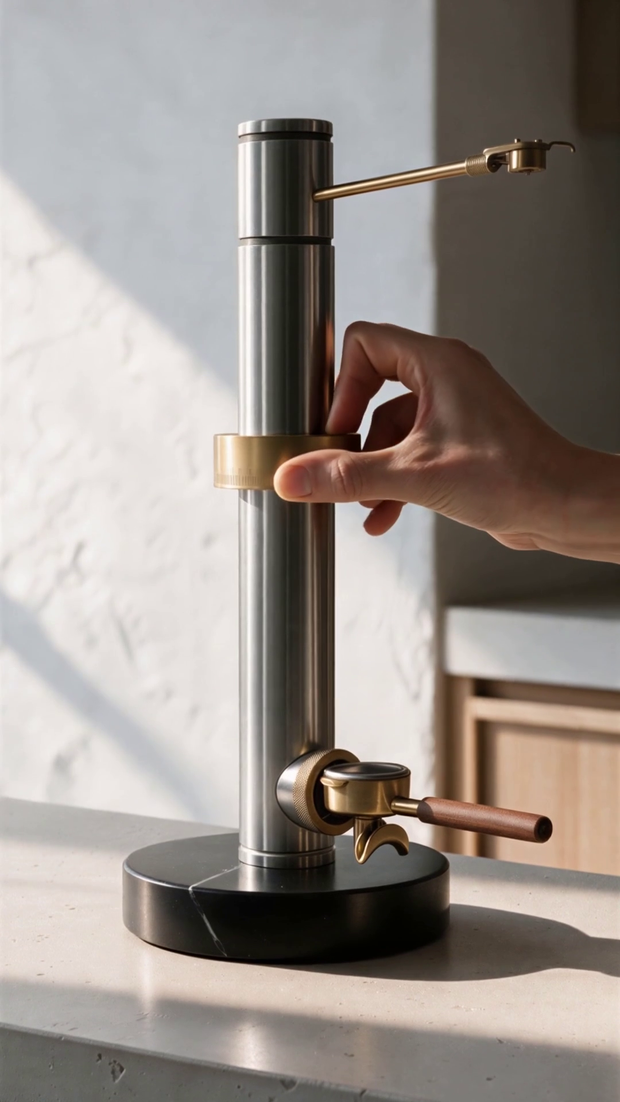
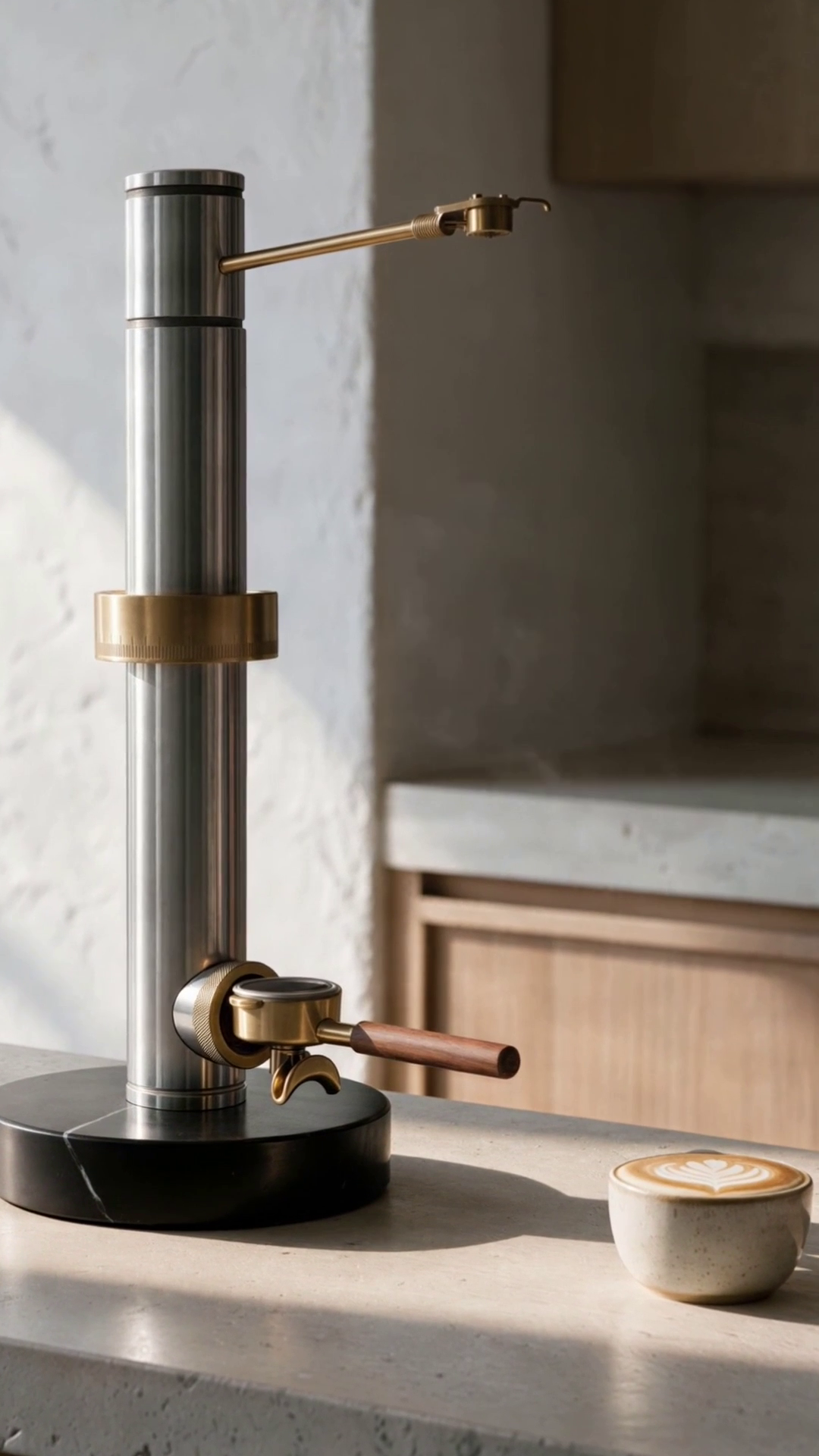
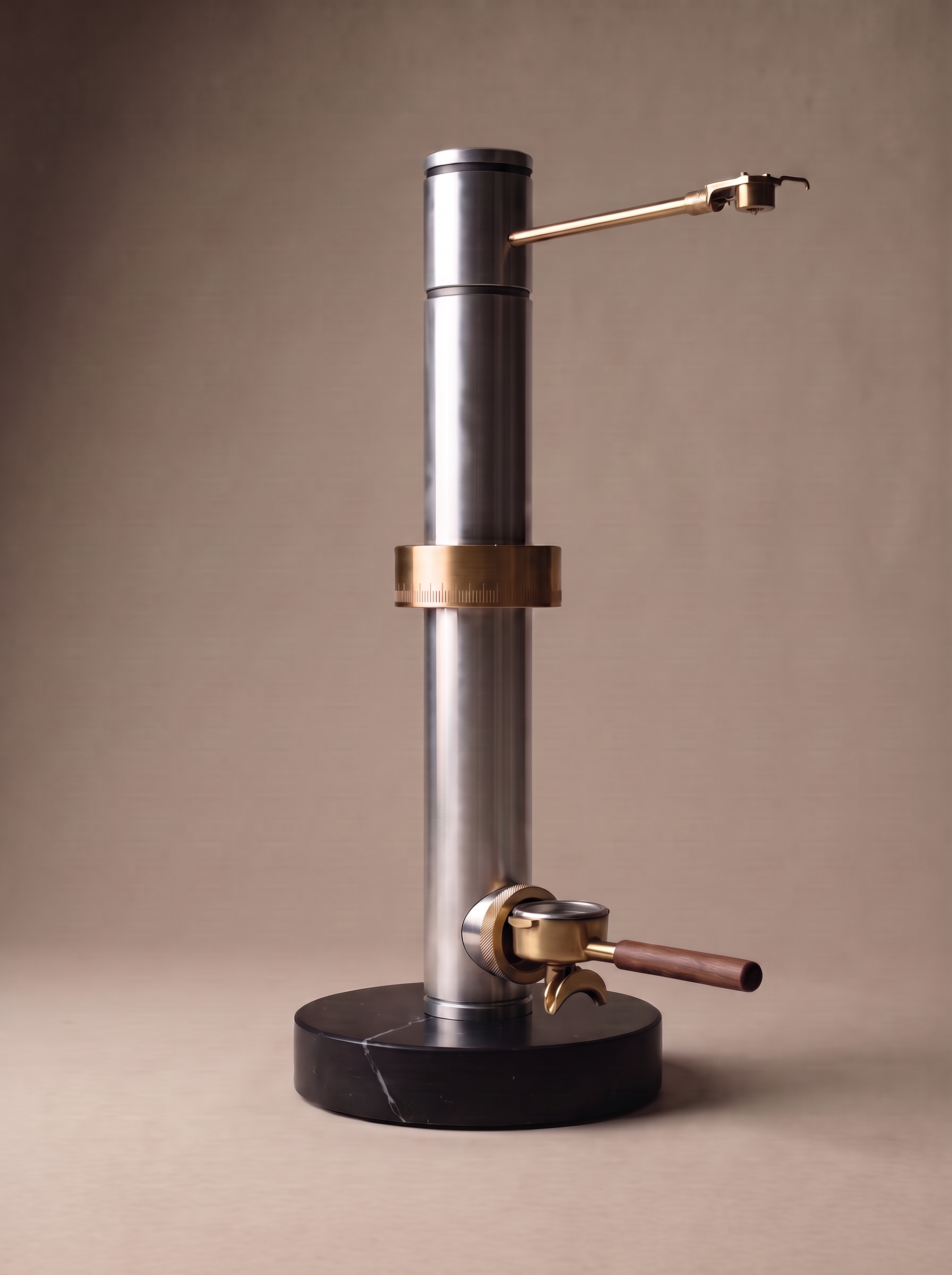
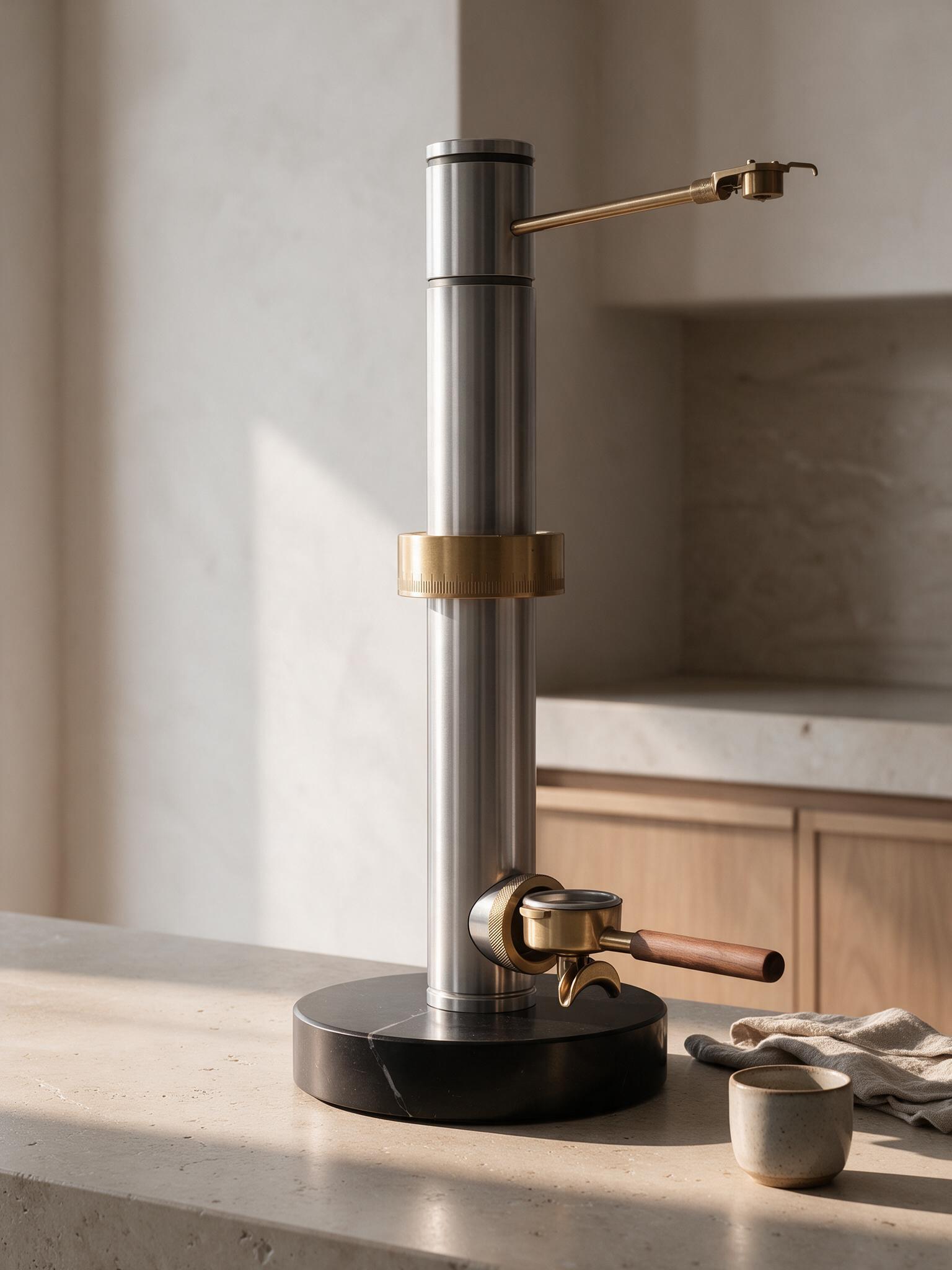
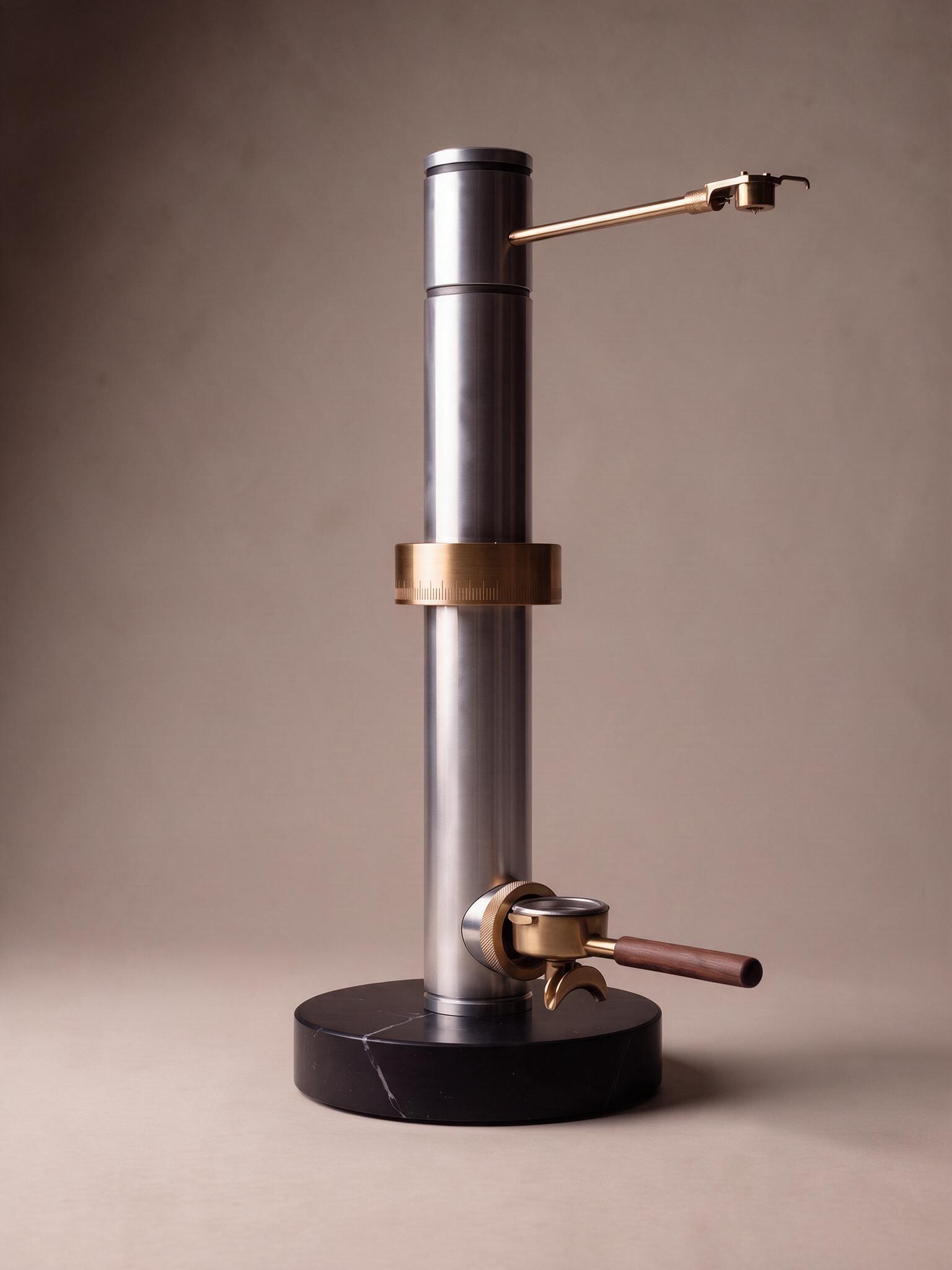
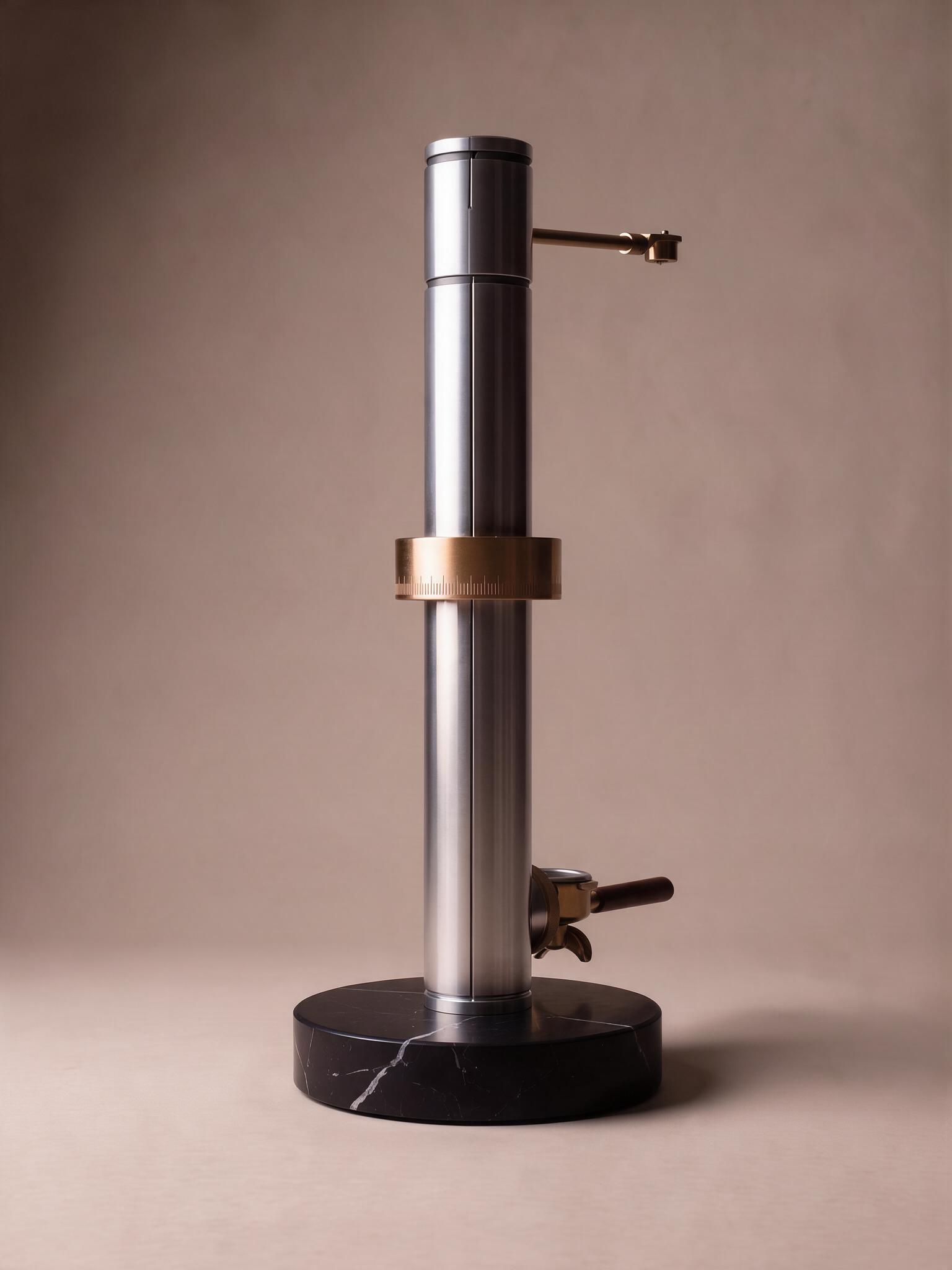
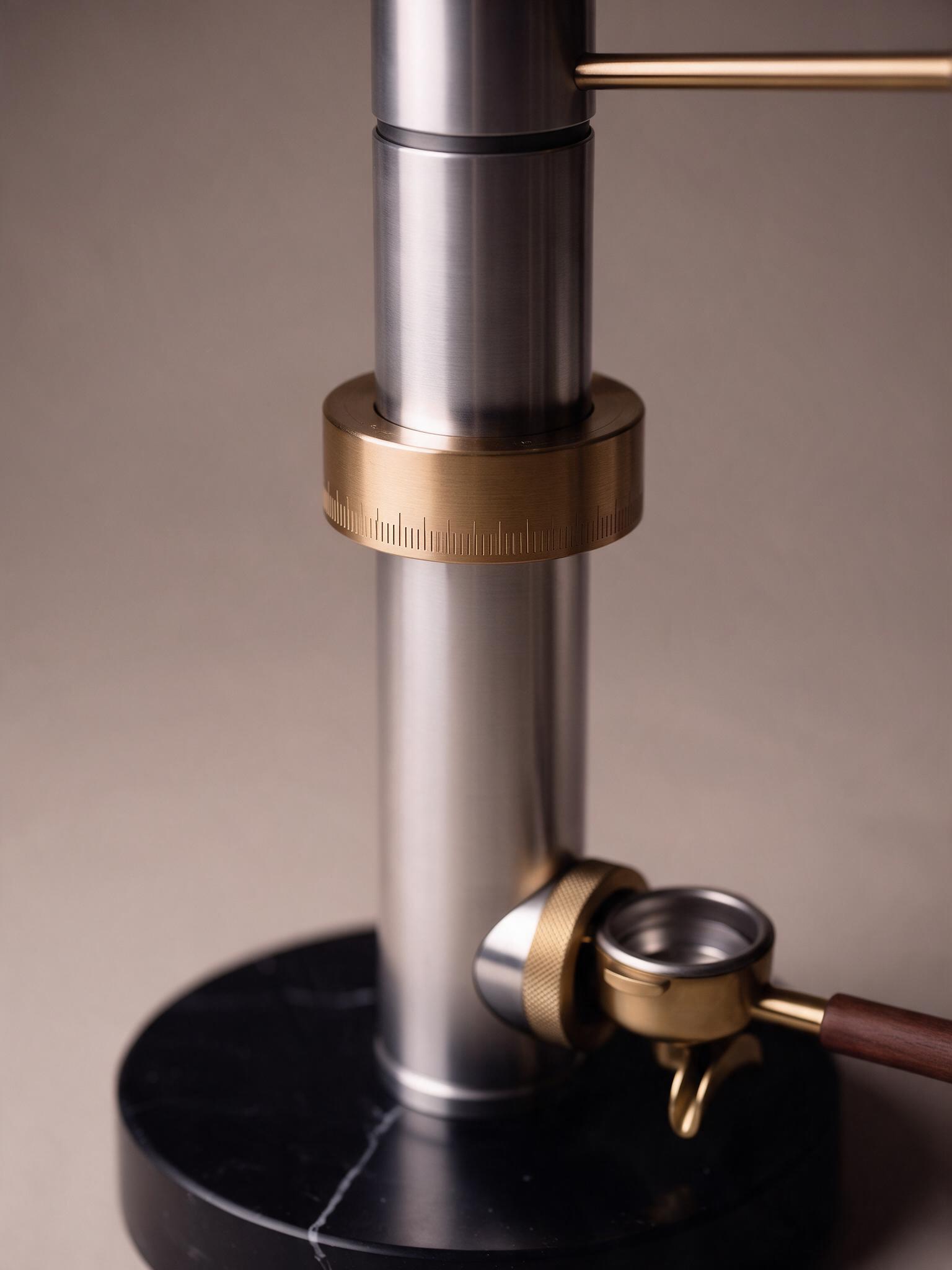
The brief is a contradiction stated as a goal: a barista-grade espresso and milk machine that does not read as a machine. Direction C answers it with the hardest geometry of the four — a vertical column roughly four to five times taller than it is wide, on a heavy stone disc, with the coffee ritual reduced to three brass gestures (a tonearm that steams, a graduated collar that adjusts, a low port where the shot comes out). The engineering job is not to shrink the coffee hardware until it hides — a hidden thermoblock makes worse coffee — but to prove that a system chosen for cup quality first genuinely stacks inside this column, sheds its heat without cooking the touchable aluminum skin, and puts every service point on a face the sculpture already conceals. Where the column's slenderness and its physics fight, this brief resolves the fight on the page rather than deferring it — because on Direction C the fights are real and the form is the moat.
The whole design turns on one triangle, stated up front because it governs every later decision and, in a narrow vertical body, governs it harder:
Thermal stability ⟷ warm-up time ⟷ cost. You can buy any two cheaply; the third is what you pay for. A saturated brew group on a dedicated PID-controlled boiler buys the best stability and the fastest recovery, and costs the most in parts, mass, heat to dissipate, and power. A thermoblock buys fast warm-up and low cost, and gives up shot-to-shot stability. An E61/heat-exchange lineage buys stability and serviceability with the heaviest thermal mass, and pays for it in a 20–30 minute warm-up and the most heat to hide. This object's register — quiet, furniture-grade, "perfect in use" — points hard at the stable end, and Section 1 commits to it. The column adds one constraint the other forms did not: the heat has nowhere sideways to go, so the thermal path must run vertically, and that turns out to be the column's hidden advantage (Section 2).
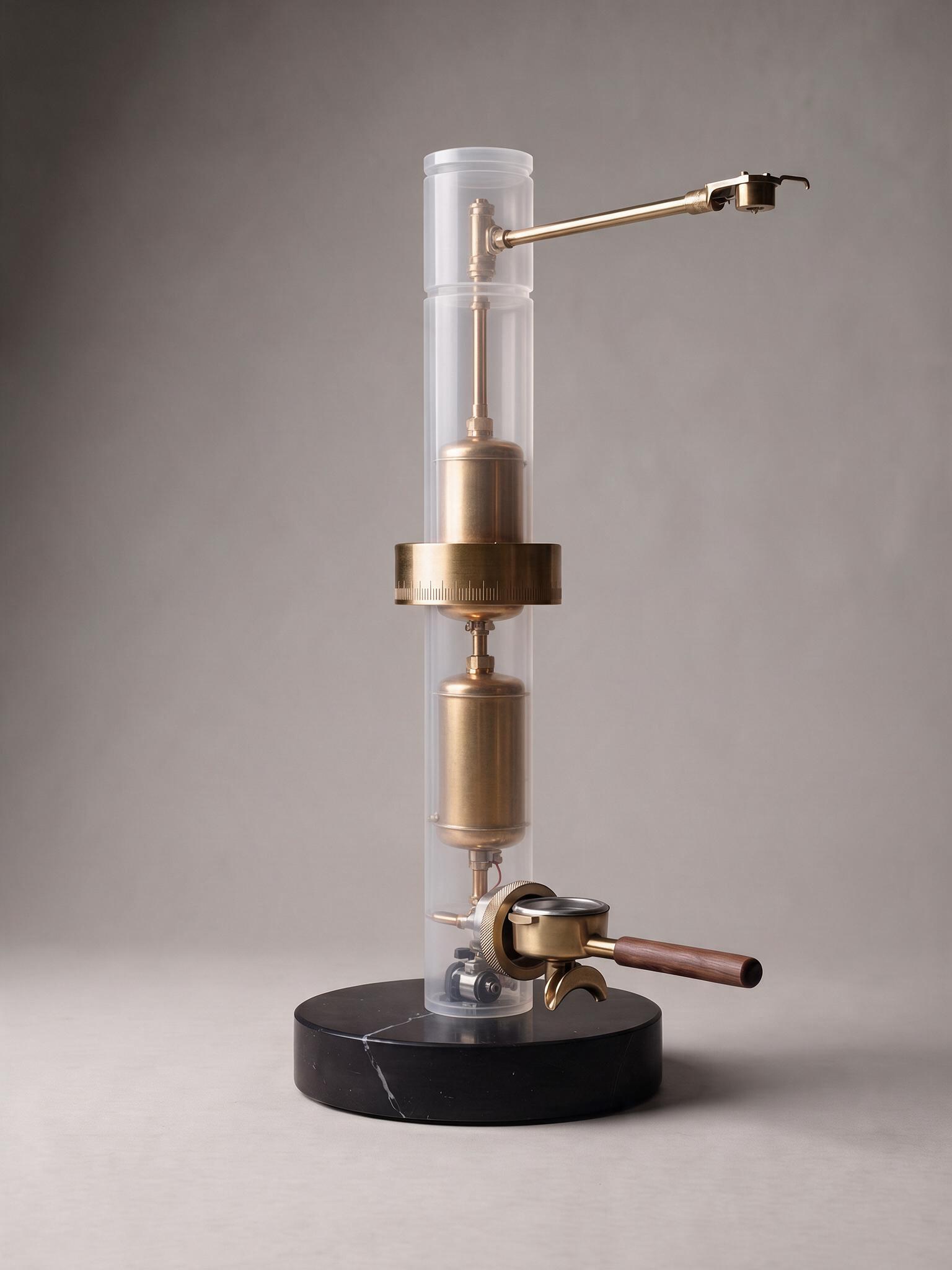
One structural decision the column forces, stated up front: the two boilers stack vertically in the column bore, the pump and reservoir live in and above the stone base, and the tall aluminum tube is not a solid billet — it is a structural outer skin around an insulated thermal core with an air gap between them. That air gap is the whole game. It is what makes the column a chimney instead of an oven, and it is what keeps the touchable surface compliant. Everything in Section 2 follows from it.
1. The internal architecture, real
1.1 The espresso path
Espresso is water at a controlled temperature forced through a compacted coffee puck at a controlled pressure for a controlled time. The barista-grade targets the machine must actually hit, and their sources:
| Parameter | Target | Anchored to |
|---|---|---|
| Brew pressure at the puck | 9 bar (usable window 8–10 bar) | SCA heritage espresso definition, 9–10 atm (SCA, 25 Magazine Issue 3, 2017); Barista Guild of America 2017 survey: average 8.5 bar, single most-common answer 9 bar |
| Brew (slurry) temperature | 90–96 °C, held to within ~1 °C through the shot | SCA heritage definition 90.5–96.1 °C; SCA Standard 310-2021 slurry window 90–96 °C; BGA 2017 survey average ≈ 93.5 °C (200.3 °F) |
| Shot volume / dose | Double: 14–20 g dry coffee → ~36–40 mL / ~2:1 yield by weight | SCA heritage 14–18 g double; BGA 2017 survey average dose 18–20 g, output 36.5 g |
| Extraction time | 25–30 s | SCA heritage 20–30 s; BGA 2017 survey just over half report 25–30 s |
| Pump rating (headroom above 9 bar) | 15 bar class | Ulka/CEME EP-series vibratory pump rated 15 bar max; prosumer rotary pumps rated 15–20 bar (Meraki, Fluid-o-Tech) |
Pump: vibratory vs rotary — and what the column's center of gravity demands. A vibratory pump uses an electromagnet to drive a piston at line frequency (~50/60 Hz); it is compact, cheap, energy-efficient, and buzzes audibly while running. A rotary vane pump uses a motor-driven eccentric rotor, is larger and heavier, runs markedly quieter, delivers a smoother pressure curve, and can be plumbed to a water line. Neither makes better espresso in the cup — the puck does not know which drove the water (Clive Coffee; Fluid-o-Tech; Meraki).
For the column the choice is over-determined toward rotary, for two reasons. First, the register: a furniture object that buzzes for 28 seconds every use has broken its own promise. Second, and specific to Direction C, a tall slender column is a stability and vibration problem — it is top-heavy by silhouette and it will telegraph pump vibration up the tube like a tuning fork. A rotary pump's smoother, quieter running is not a luxury here; it is what keeps the column from humming. And critically, the pump's mass belongs low, inside the Nero Marquina base — the heaviest single component sitting in the heaviest part of the object, dropping the center of gravity into the stone disc where the form already puts its visual weight. The stone base stops being only an aesthetic plinth and becomes the counterweight and the vibration sink. On a compliant/isolated mount inside the base, the rotary pump is both the quiet choice and the stability choice.
- Real supplier classes — rotary: Fluid-o-Tech, Procon. Vibratory alternate (lower-cost SKU only, noise trade stated honestly): CEME/Ulka (EP5: 48 W, 15 bar max, ~650 cc/min, available NSF-listed). (Anchored to: Ulka EP5 vendor spec sheets; rotary suppliers named by Clive Coffee and Meraki.)
Boiler architecture: thermoblock vs single/dual boiler vs heat exchanger. This is the heart of the triangle.
| Architecture | Thermal stability | Warm-up | Simultaneous brew + steam | Heat to hide | Relative cost | Fit to the column |
|---|---|---|---|---|---|---|
| Thermoblock | Variable; fluctuates mid-session | Fastest (seconds–1 min) | Sequential, with recovery lag | Least | Lowest | Rejected — undercuts the "perfect in use" promise |
| Single boiler | Good with PID, but brew and steam share one vessel | Moderate | No (switch modes) | Moderate | Moderate | Possible for a low-cost SKU; compromises milk workflow |
| Heat exchanger (E61 lineage) | Very good; heavy brass thermosyphon | Slowest (20–30 min); most mass | Yes | Most | Moderate–high | Superb coffee, but the most heat and mass — the worst fit for a slim column |
| Dual boiler + saturated brew group | Best; <1 °C variation | Moderate–fast | Yes, independent | High (two boilers) | Highest | Recommended — and it stacks: two compact cylindrical boilers suit a bore better than one heavy horizontal HX |
(Stability figures anchored to: Clive Coffee "Saturated vs E61"; Espresso Outlet saturated-group explainer citing a 2014 study of La Marzocco saturated groups showing <1 °C variation; Coffeeionado / Cliff & Pebble on E61 thermosyphon behavior and warm-up.)
Recommendation: dual boiler with a saturated brew group — and it is the right choice for the column specifically. A saturated group is bolted into (or in constant contact with) the brew boiler, so group and brew water sit at the same temperature at all times — the source of its <1 °C stability. Paired with PID control (a digital controller holding the brew boiler within ~1 °C of setpoint), it is the most repeatable shot. A second, independent steam boiler lets the machine steam and pull a shot without the two fighting over one vessel. Beyond cup quality, the dual-boiler choice is geometrically the right one for a column: two compact cylindrical boilers stack in a bore far more naturally than a single heavy horizontal heat exchanger, which wants to lie flat and would force the column wider. The architecture that makes the best coffee also happens to be the one that fits the slimmest tube.
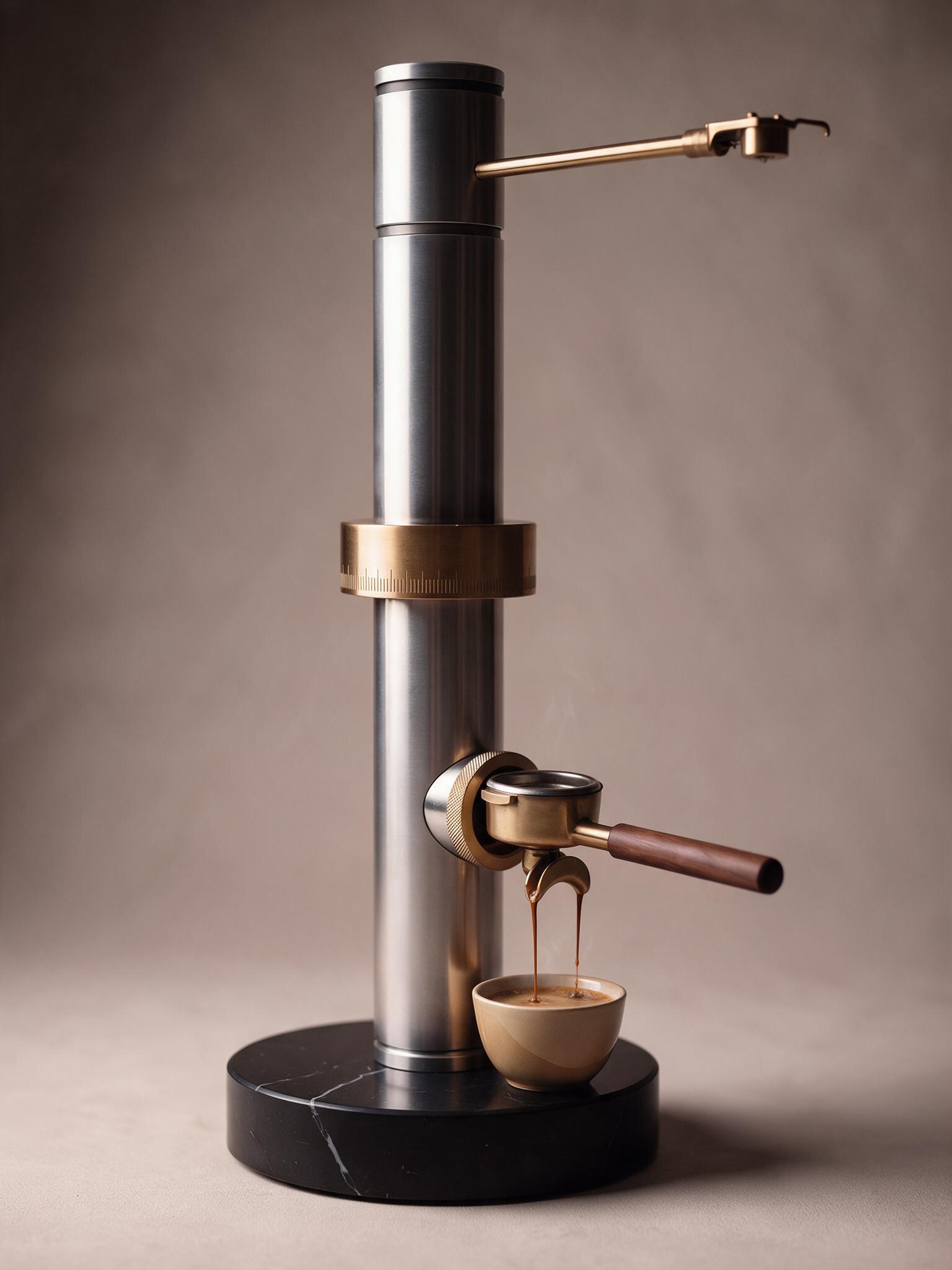
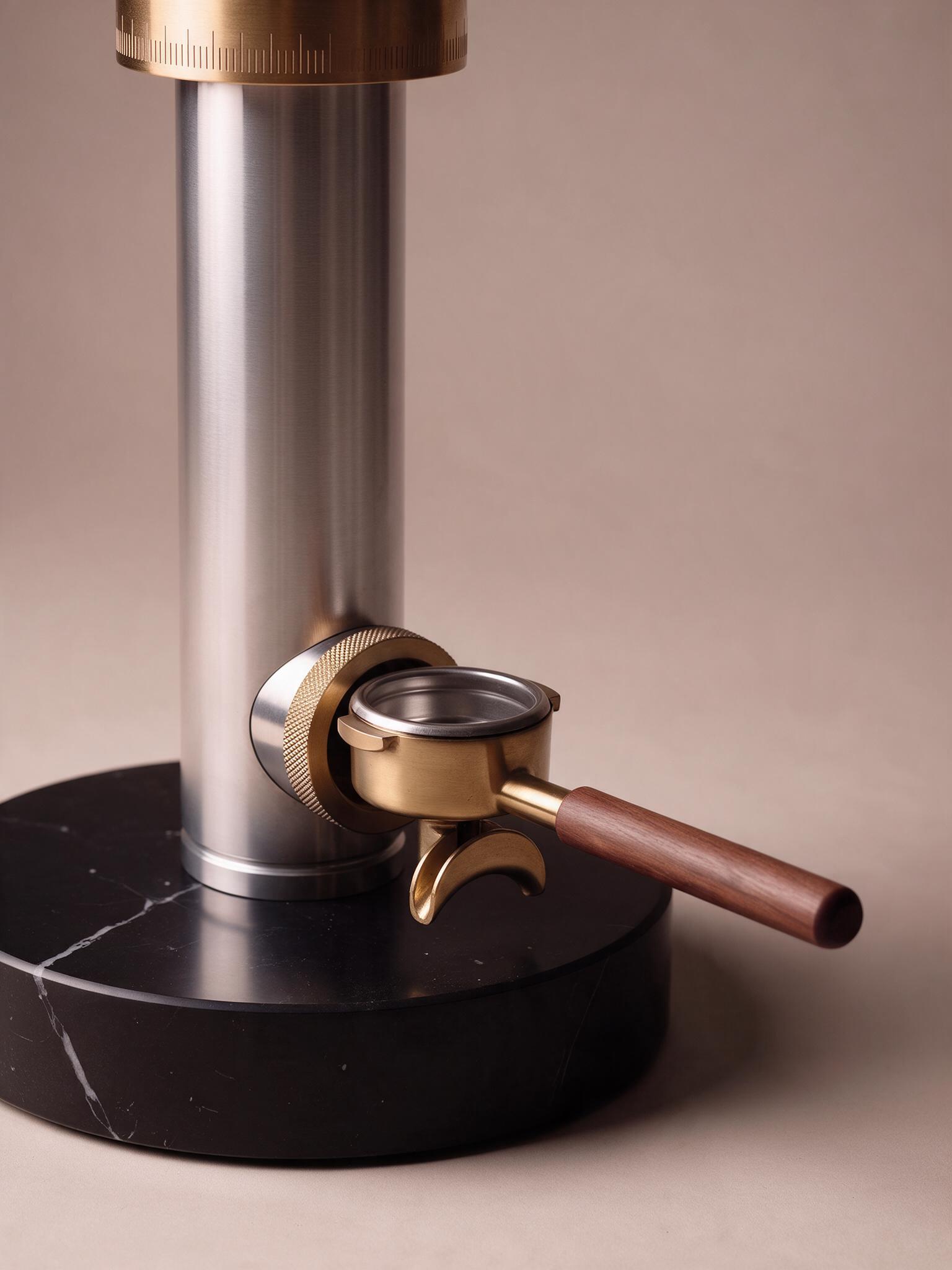
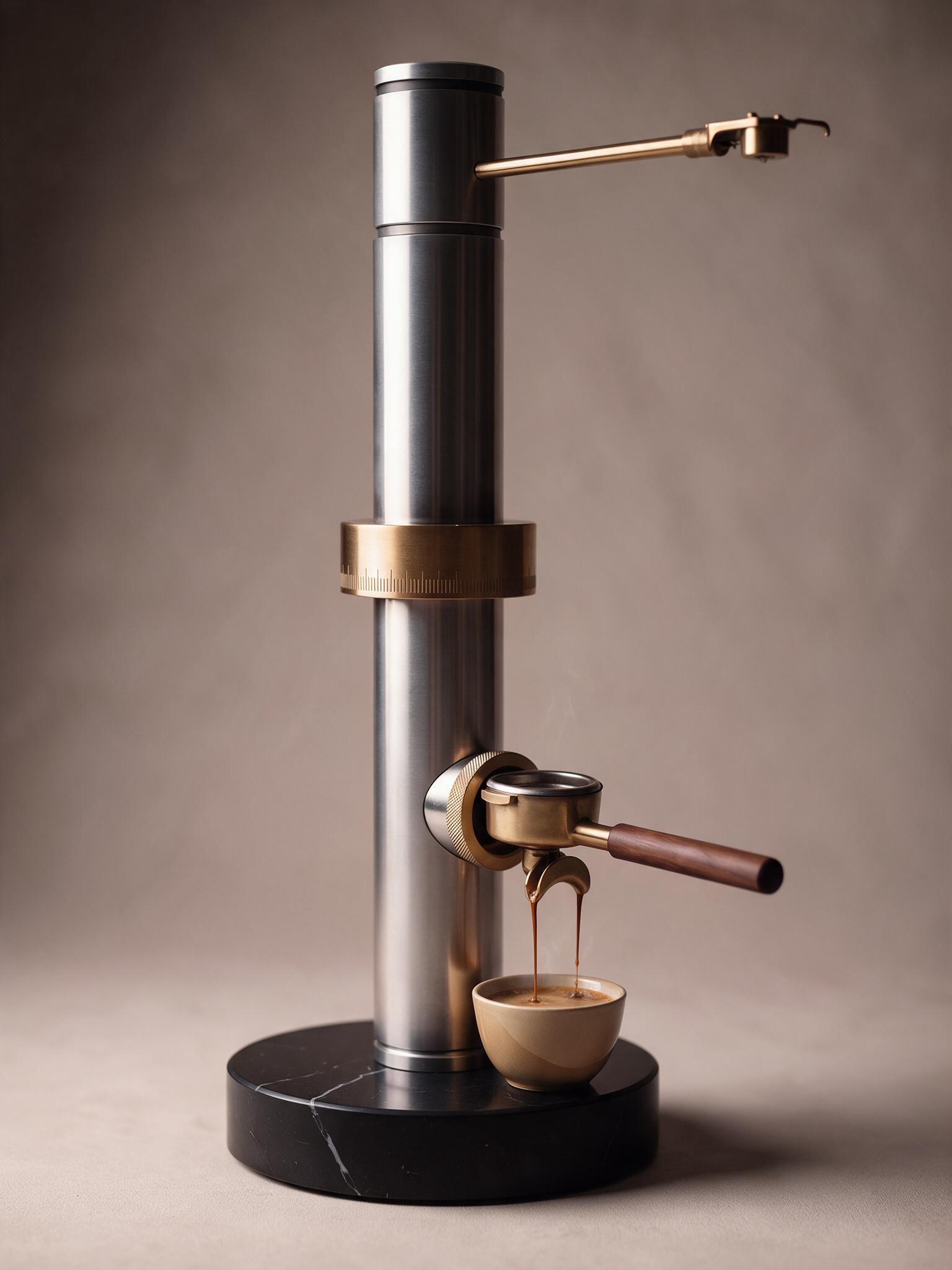
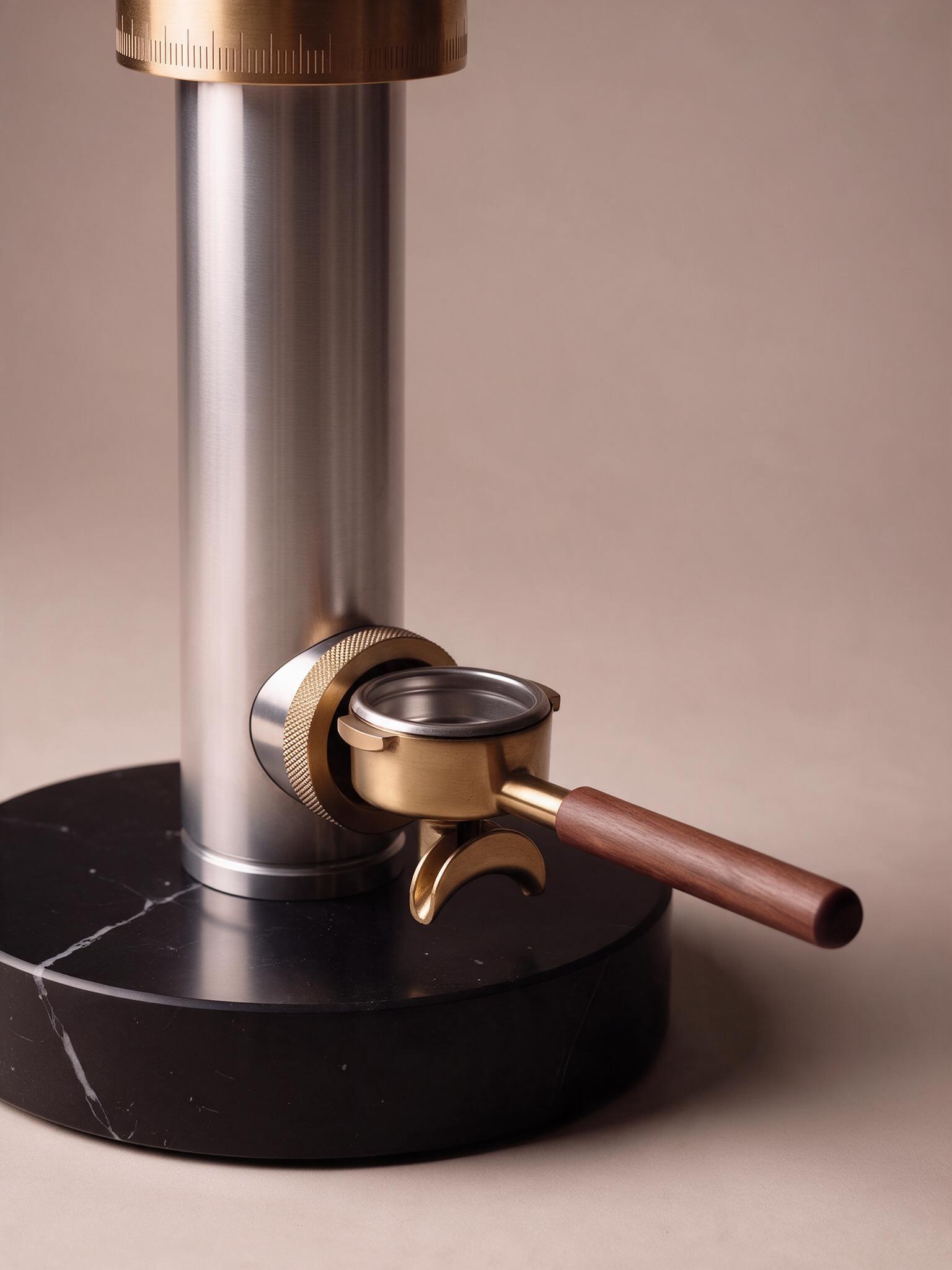
Group head and portafilter path — where the shot comes out on a column (Conflict 5, resolved). The saturated group carries the shower screen and dispersion plate and integrated pre-infusion. On Direction C the group cannot sit at the top (no room, and the shot would have to travel down the whole column) and cannot fully hide (it is inserted, twisted to lock into a bayonet, and pulled out full of hot coffee). The form already answers this correctly: the group and portafilter live low on the column, just above the stone base, presented as the object's one deliberate mechanical gesture — a brass bayonet ring with the black-handled portafilter locking into it, the shot dispensing directly down into a cup on the stone base. This is right, and it is what the physics wants:
- The saturated brew boiler sits directly behind/above the group at the base of the column, keeping the thermally critical group-to-boiler path short (long brew-water paths lose temperature and blur the ±1 °C target).
- The shot has almost no distance to travel — group to cup is a few centimeters — which is thermally cleaner than a tall machine that pipes water up and coffee down.
- The stone base is the natural drip zone (see Conflict 3). A shallow removable tray or a channel machined into the top face of the stone catches the shot's inevitable few drops.
- Basket format: 58 mm commercial-format is the serviceability and accessory default (widest basket availability). On a slim column a 54 mm format is a legitimate and possibly better choice — it reduces the group diameter and lets the column stay narrow, with real basket availability (Breville / 9Barista lineage). This is a genuine form-vs-function lever to set at the design stage: 58 mm buys accessory ubiquity, 54 mm buys 4–6 mm of column diameter. Recommendation: 54 mm for the hero column, 58 mm noted as the option if accessory ecosystem is prioritized.
Numbers the espresso path commits to (for the pitch spec table):
- Brew boiler: PID-controlled, setpoint adjustable 90–96 °C; brew-water delivery held to ~±1 °C. Heater ~1000–1400 W class (to confirm at thermal design; anchored to prosumer dual-boiler heater ratings, La Marzocco Linea Mini class ~2200 W total split across boilers).
- Pump: rotary vane, low in the stone base, delivering a stable 9 bar at the group, 15-bar-class rated.
- Group: saturated, integrated pre-infusion, 54 mm portafilter (58 mm alternate), low on the column, shot dispensing to the stone base.
1.2 The milk / steam path — the tonearm
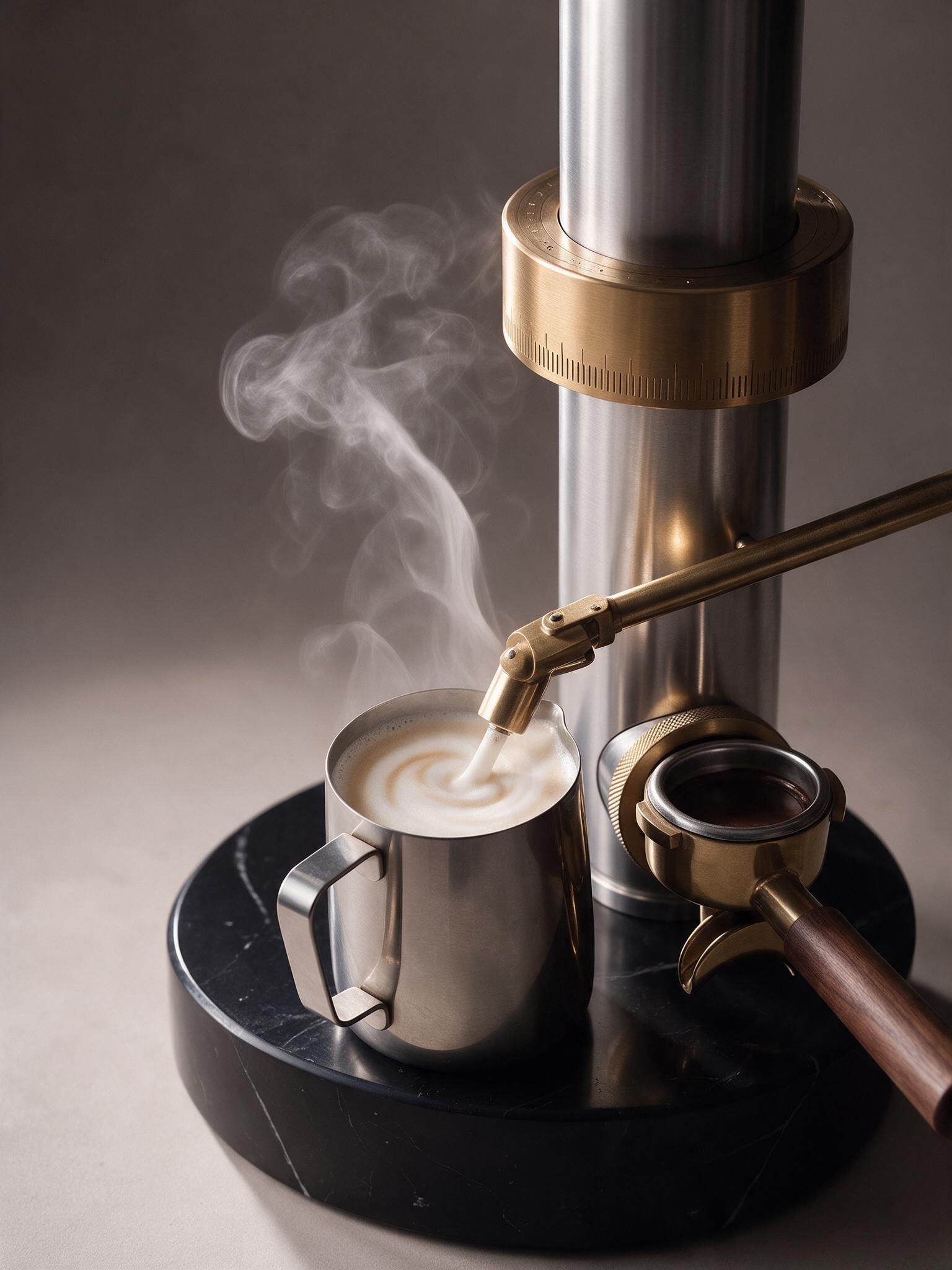
Microfoam — the glossy, paint-textured milk that pours latte art and tastes sweet — is made by injecting dry steam into cold milk to first stretch (aerate below ~38 °C / 100 °F) and then spin (a vortex that shears large bubbles into micro-bubbles), pulling the wand at ~54–56 °C (130–132 °F) and letting residual heat carry the milk to its ~60 °C (140 °F) sweetness peak (CoffeeRoast Co. microfoam guide, 2026).
Steam generation. Dry, high-velocity steam requires a boiler held at pressure. Espresso-machine steam boilers run at 1.0–1.5 bar gauge (≈ 110–112 °C saturated steam); commercial and strong home machines sit at 1.2–1.5 bar for enough velocity to spin a full pitcher without the steam "wetting out" (Barista Hustle MSLA 3.01; CoffeeRoast Co.). The dedicated steam boiler (the dual-boiler choice) holds that pressure independently and recovers fast. Steam-boiler heater power is the dominant power draw and the dominant recovery lever; ~1000–1400 W class is the working assumption (to confirm at thermal design). In the column, the steam boiler sits in the stack above the brew boiler and feeds the tonearm.
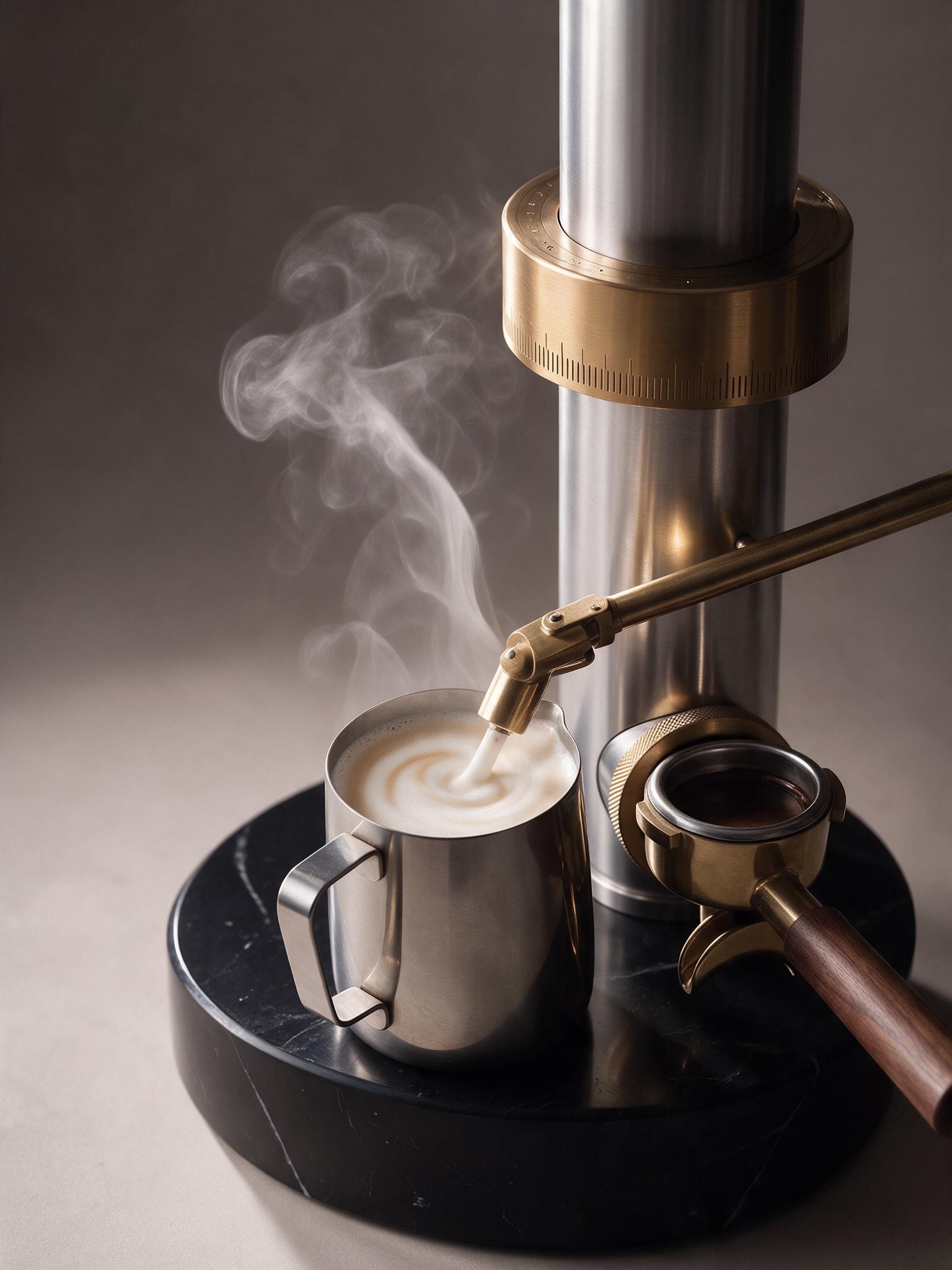
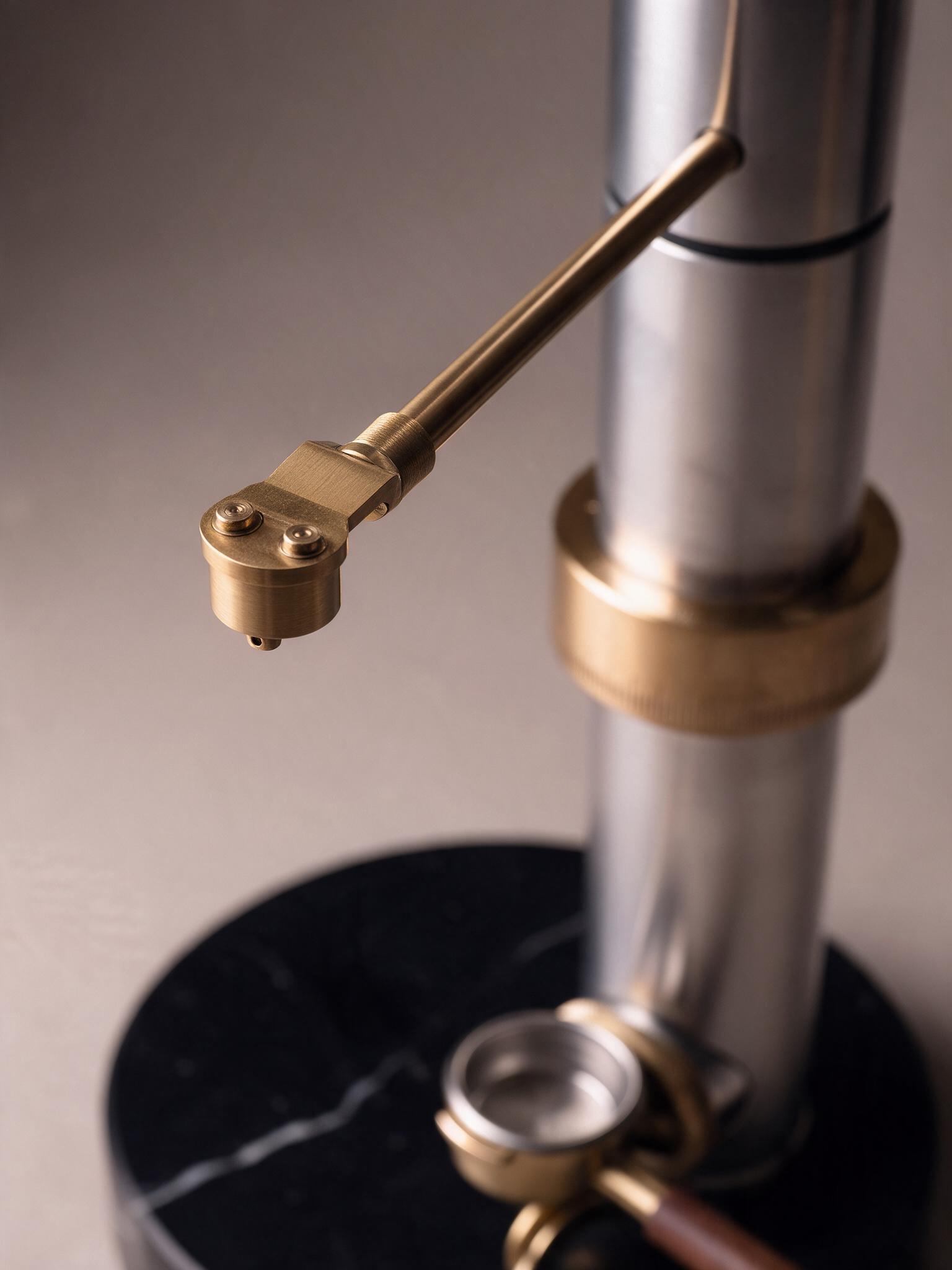
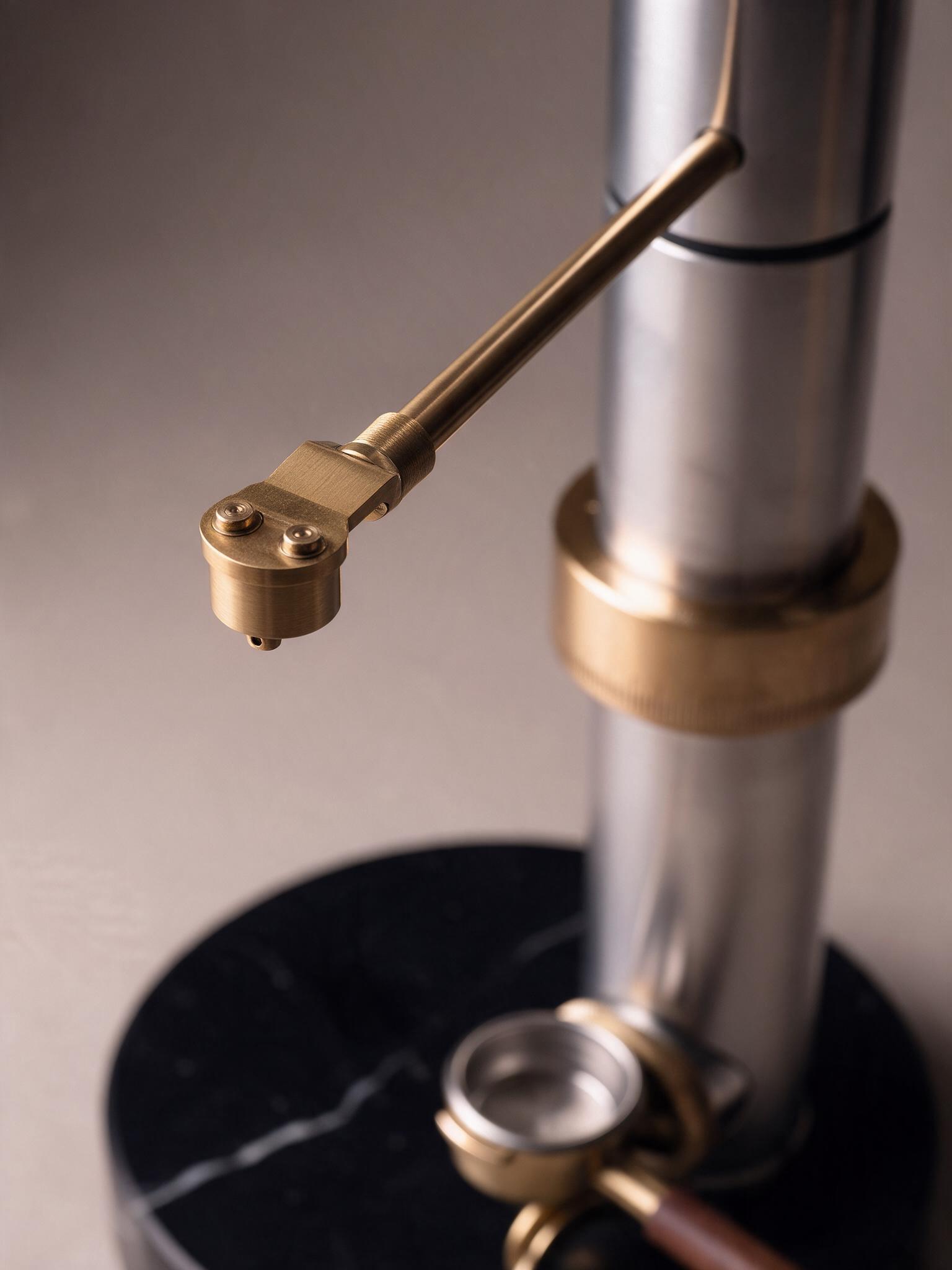
The tonearm is the steam wand — and it is the hero's best physics-meets-form move. The floating brass tonearm at the top of the column is not decoration; it is the steam arm, and a pivoting brass arm is a genuinely excellent steam-wand solution:
- A tonearm pivots and swings, which is exactly what a steam wand needs to do — reach out over a pitcher, then return flush against the column when stored. The turntable gesture is the wand-articulation the form requires.
- Steam is piped up the column interior to the arm's pivot and out through the arm to a tip at its end (the "headshell" reads as the steam tip). Brass is the correct material — it is what real wands and boilers are made of, it tolerates the heat, and it matches the register.
- The stored position must not trap milk in the tip (food-safety and odor — restated from the wand physics). The arm's rest position should let the tip drain toward the drip zone, and the tip needs a purge after each use, blown into the base's drip channel.
- Manual, not automatic. The tonearm is a manual wand and should stay one — it preserves the highest microfoam ceiling and it is the object's ritual. An automatic frother would demand an internal milk path (pump, air valve, temperature probe, self-purge cycle) that fights the slim column for volume and adds a food-safety cleaning burden. If a skill-free SKU is ever wanted, the automatic path is a separate product decision, named as a trade, never the hero.
Numbers the milk path commits to:
- Steam boiler: dedicated, 1.0–1.5 bar gauge, target 1.2 bar for pitcher velocity, stacked above the brew boiler.
- Wand: manual, multi-hole tip, presented as the pivoting brass tonearm.
- Milk targets baked into user guidance: aerate below 38 °C, pull at ~54–56 °C, ~60 °C peak.
1.3 The honest tradeoff summary
The recommended architecture (rotary pump low in the stone base + stacked dual boiler + saturated PID group at the column base + manual tonearm wand) sits deliberately at the stability-and-quiet corner of the triangle and pays for it in cost, mass, two boilers' worth of heat, and a moderate 10–20 minute warm-up. That is the correct trade for an object whose promise is "perfect in use" and "quiet furniture." The warm-up is the one user-visible cost, and the column turns it into ritual: a scheduled/"wake" pre-heat (app or the graduated collar as a timer dial) warms the column before it pours, the way a record warms before it plays. The heat and mass are the costs that land on the sculpture — they are the subject of Section 2, and on the column they resolve into a single elegant idea: the column is a chimney.
2. How the architecture fits the column — the five conflicts, resolved
An earlier draft flagged five places where "invisible seams / no appliance shouting" fights physics, and left them as a checklist because the form did not yet exist. The form now exists. This section resolves all five for the column specifically — the answers, not the questions.
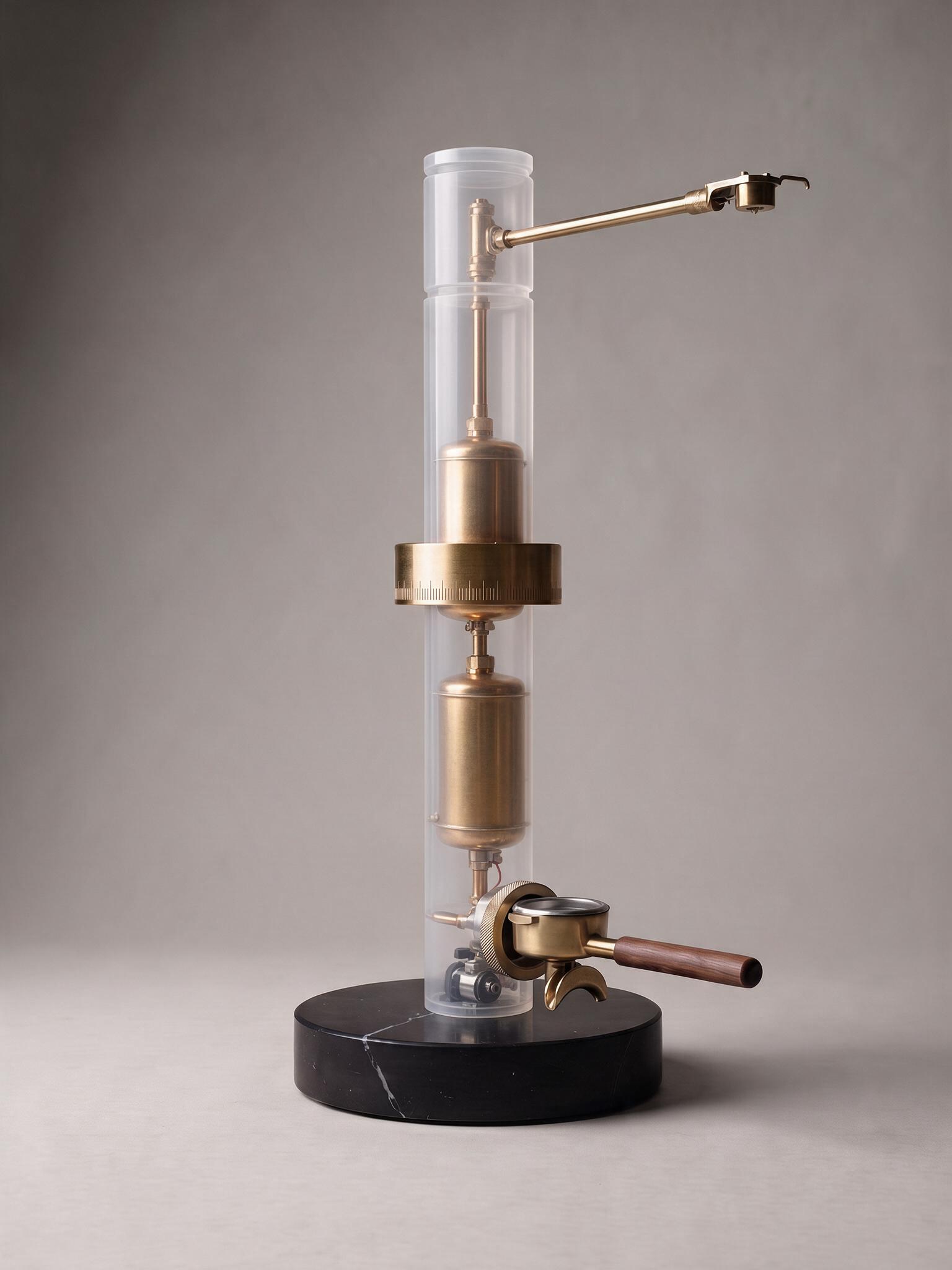
The vertical stack (envelope trued to Direction C):
| Subsystem | Where it lives in the column | Why there |
|---|---|---|
| Rotary pump + motor | Inside the Nero Marquina base | Lowest CG; heaviest mass in the heaviest part; base is the vibration sink |
| Water reservoir | In the base / lower column, ~1.2–1.8 L in this footprint | Low CG; near the pump; fed from the top (Conflict 2) |
| Brew boiler + saturated group | Base of the column, directly behind the low group port | Short group-to-cup path; the shot dispenses to the stone base |
| Steam boiler | Mid/upper column, stacked above the brew boiler | Feeds the tonearm at the top; keeps the two boilers in a bore, not side by side |
| PID controller + power PCB + thermal cutoffs | In the base, in a dry, cooler, EMC-shielded zone away from the boilers | Electronics must stay cool and dry; the base is the coolest, driest volume |
| Tonearm steam wand | Pivot at the top of the column | Reaches over a pitcher, returns flush; the ritual gesture |
| Drip zone / tray | Top face of the stone base | Catches the shot and the wand purge (Conflict 3) |
Reservoir capacity honesty: a ~1.2–1.8 L reservoir is smaller than a wide benchtop machine's 2.5–3 L tank — the column's footprint costs some capacity. That is a real trade of the form, and it is fine: it means more frequent fills, mitigated by the plumbed option (Conflict 2). Stated plainly rather than hidden.
Conflict 1 — Heat dissipation inside a sealed vertical shell (THE load-bearing fight)
This is where Direction C is hardest and where it is, once solved, most elegant. Two boilers at 90–120 °C sit inside a slender aluminum tube whose whole surface a person will touch. Solid aluminum conducts heat superbly — a solid skin over a boiler becomes a hot exterior surface, which is both a burn hazard and a certification failure (see the surface-temperature limits below). A narrow column has no room for the sideways air gaps and vent grilles a wide machine hides in its flanks. The heat must go up.
The solution: the column is a chimney, not a billet. Three coordinated moves, all of which the industrial-design work must build into the form:
- A structural outer skin around an insulated thermal core, with an air gap between them. The visible aluminum tube is not the boiler housing — it is an outer sleeve. Inside it, the boilers wear an insulated jacket (mineral wool / calcium-silicate / a microporous insulation blanket, the materials real espresso boilers use), and between that jacket and the outer aluminum skin runs a continuous annular air gap of a few millimeters. The outer skin never touches the hot core; it touches only slowly-warming air.
- A stack-effect (chimney) airflow path. Hot air rises. The base has a concealed intake reveal — a shadow-line gap where the aluminum column meets the Nero Marquina stone (the natural seam the two materials already create). Cool air enters there, rises through the annular gap around the insulated boilers, gathers their shed heat by convection, and exits through a concealed exhaust at the top of the column, hidden under the tonearm pivot boss or read as the top cap's shadow line. No fan is needed if the gap and the openings are sized for natural convection; a small, quiet, low-speed fan in the base is the fallback if the thermal budget needs it (and the base already houses the pump, so a whisper fan there is inaudible). The column's height is the asset: a tall chimney has strong natural draft. The form that is hardest to fit heat into is also the form with the best natural stack.
- Thermal isolation of every touchable surface. The insulated jacket + air gap keep the aluminum skin cool. The one place this needs extra care is the group at the base, which is deliberately hot metal exposed to the hand near the portafilter — but that is a handle case, governed by the handle limits below, and the black portafilter handle itself is the touch point (a moulded/composite handle, not bare metal), which is exactly why real portafilter handles are phenolic/wood, and why Direction C's handle reads black.
The surface-temperature target that clears the certification bar (verified). The pass/fail is set by two standards read directly:
- IEC 60335-1, Table 3 (temperature rise above ambient, i.e. above ~25 °C): the external enclosure of a motor-operated appliance may rise 60 K (→ ≈ 85 °C at 25 °C ambient); a metal handle/knob held for short periods may rise 35 K; a metal part continuously held may rise only 30 K; the same parts in moulded material/rubber/wood may rise 50–60 K (which is why the portafilter handle is composite/black, not bare brass). (Verified: IEC 60335-1 Table 3, read directly.)
- IEC 60335-2-15:2024 newly introduces its own Table 101 external-accessible-surface limits, and — critically for a countertop column — splits them by whether the surface is less than 850 mm from the floor or at/above 850 mm, with separate rows for bare metal, coated metal, glass/ceramic, and plastic. A countertop machine and its column sit low, so the touchable column skin falls in the stricter low band, and a bare-metal touchable surface is the least forgiving material row. (Verified: IEC 60335-2-15:2024 clause 11.101 / Table 101 and the AOC IEC 60335-2-15 test-report structure, read directly; the probe is applied at 4 N ± 1 N for a 30 s contact period.)
The design target, stated for the pitch: the touchable aluminum column skin holds a temperature rise within the Table 101 bare-metal low-band limit (a burn-safe surface), and the deliberately-hot group is handled only via its composite black handle, which sits within the moulded-handle limit. Where the exact Table 101 numeric for the 2024 edition's bare-metal low-band row must be cited to the certifier, it is confirmed with the test house at DFM — but the architecture (insulated core + air gap + chimney) is precisely the construction that meets it, and the reason bare aluminum is safe to leave visible is that it is never the boiler's housing. This is the single most important sentence in the build case: on Direction C the beautiful bare-metal skin is compliant because it is a cool outer sleeve, not a hot boiler wall.
This must agree with the thermal escape the form provides. The intake reveal at the stone-to-metal seam and the exhaust at the top cap are shared decisions between the engineering and the industrial design — they are drawn once. The vent is not a grille; it is the shadow-line the two materials already make. This brief confirms the airflow path the seam must carry.
Conflict 2 — Water fill vs no seams
The column is meant to read seamless, and the reservoir needs filling often (~1.2–1.8 L). Two resolutions, one chosen:
- Chosen for the hero: a top-lift fill. The top cap of the column lifts (or the tonearm pivot boss doubles as a fill access) to reveal the reservoir throat. This reads as a lid — a deliberate, singular gesture, like lifting a decanter's stopper — and keeps the column's body a single unbroken surface. It also cooperates with the chimney: the top of the column is already the exhaust and the tonearm mount, so a lifting top cap is a feature the top already wants.
- Certification note (verified): IEC 60335-2-15 clause 7.12 requires that espresso makers with a pressurized reservoir filled by the user carry the instruction "WARNING: The filling aperture must not be opened during use." The reservoir here is the cold-water tank (not pressurized), which sidesteps that clause, but the fill design must ensure the tank is a cold reservoir feeding the pump — not a pressurized vessel opened by the user. This is the correct architecture anyway.
- Offered as the premium install: a plumbed line. The rotary pump enables direct plumbing. A plumbed column never needs filling at all — water enters through a concealed line in the base, out of sight. For a kitchen where the column is a permanent installed object, this is the most seamless answer of all and removes the fill question entirely.
Named choice in the form: top-lift fill for the portable hero; plumbed line as the installed-premium option.
Conflict 3 — Steam venting and drips in a vertical body
The tonearm emits live steam and milk droplets; the group dispenses the shot. In a vertical body everything drains down to the stone base, which is the design's advantage:
- The stone base is the drip zone. A shallow tray or a channel machined into the top face of the Nero Marquina catches the shot's drops and the wand purge. Stone is impervious and wipes clean; it is the right material to be the wet surface.
- The tonearm purges into the base. After steaming, the tip is purged; the arm's geometry directs that blast down toward the base channel, not out onto the counter. The arm's rest position lets the tip drain downward so no milk sits in it.
- No puddle on the counter is a designed outcome, not a hope: everything wet lands on stone that is part of the object.
Conflict 4 — Serviceability vs seamless
A furniture object with zero access is a landfill object after its first failure. Boilers scale, gaskets wear, the pump is a service item. The column resolves this cleanly because it has a natural hidden face and a natural hidden volume:
- The service face is the base. The Nero Marquina disc unbolts from below (or the column lifts off the base on a captive fastener set), giving a technician access to the pump, the PID/PCB, the plumbing, and the bottom of the boiler stack — all the wear items — without a single seam on the shown column surfaces. The base is already thick and heavy; it can carry concealed fasteners on its underside where no one looks.
- Descaling (the routine owner-service) runs through the normal water path — fill with descaler, run a cycle — needing no disassembly at all.
- The top cap / tonearm boss gives secondary access to the top of the boiler stack and the steam-arm plumbing.
- Agreed before lock: the base is the service face. This shapes the internal layout (wear items low, near the base) and it is consistent with the CG strategy (heavy serviceable parts low) — the two constraints point the same way.
Conflict 5 — The portafilter/group path in a column
Resolved in §1.1 and restated here as a form decision: the group and portafilter live low on the column, above the stone base, presented as the object's one deliberate mechanical gesture. It cannot and should not hide — it is inserted, twisted, and pulled out full of hot coffee, and making that the ritual (as a tonearm is the turntable's ritual) is the honest and beautiful answer. The shot dispenses directly down to a cup on the stone base, the shortest and thermally cleanest path.
Design coordination — two shared decisions to draw at the form stage: All five conflicts resolve on the column, and three of them resolve in the column's favor — the tall body is a natural chimney (Conflict 1), the heavy stone base is the natural drip zone and service face (Conflicts 3, 4), and the low CG the form wants is the same low CG the pump mass gives. The two shared decisions the engineering and the form draw together are (a) the thermal airflow path: intake reveal at the stone-to-metal seam, exhaust under the top cap/tonearm boss, and (b) the top-lift fill. The one honest cost of the form is reservoir capacity (~1.2–1.8 L vs a wide machine's 2.5–3 L), mitigated by the plumbed option.
3. The build case for a manufacturer / investor pitch
3.1 Bill of major systems — buy vs make, supplier classes, order-of-magnitude unit cost
Costs below are order-of-magnitude unit cost at the component level; each row states what it is anchored to. Two volume columns: Low (pilot / early production, hundreds to low thousands of units) and Scale (tens of thousands+). These are engineering planning ranges for a pitch, not a quoted BOM — a real BOM comes after DFM and supplier RFQs, and this brief says so.
| Subsystem | Buy / Make | Real supplier category | Unit cost — Low vol | Unit cost — Scale | Anchored to |
|---|---|---|---|---|---|
| Rotary vane pump + motor | Buy | Fluid-o-Tech, Procon (espresso pump makers) | $40–90 | $25–55 | Prosumer rotary pump component pricing |
| Brew boiler + saturated group | Buy → Make (buy proven group early; consider make at scale for the sculptural interface) | Espresso boiler/group foundries (Italian group-head lineage) | $80–180 | $50–120 | Order-of-magnitude for brass/stainless boiler + machined group |
| Steam boiler | Buy | Same boiler foundry class | $50–120 | $35–80 | As above |
| PID controller + power PCB + SSR | Buy (module) → Make (custom PCB at scale) | Appliance control-board CMs; PID module vendors | $25–70 | $12–35 | Appliance control-electronics ranges |
| Heater elements + thermal cutoffs (incl. the required independent cutoff) | Buy | Appliance heating-element / thermal-fuse suppliers (e.g. the thermal-link class SETsafe/SETfuse describe for coffee machines) | $15–40 | $8–22 | Commodity heating elements + a mandated independent thermal cutoff |
| Water reservoir + pump/valve plumbing (food-contact) | Buy fittings / Make tank | NSF-listed brass fittings/valves for coffee machines; food-grade tubing | $20–50 | $10–28 | NSF/ANSI 51 + 372 component listings exist for coffee-machine brass |
| Portafilter + baskets (54 mm hero / 58 mm option) | Buy | 54/58 mm portafilter + basket makers (IMS and equivalents) | $18–45 | $10–26 | 54/58 mm commercial-format parts widely available |
| Enclosure / sculpture — machined aluminum column + Nero Marquina stone base + brass tonearm/collar/ring | Make | CNC machining shops; stone fabricators (Nero Marquina); brass machining/finishing | $180–500+ | $90–280+ | Wide because material + finish drive it; this is Direction C's largest and most variable line — machined aluminum, real stone, and machined brass are all premium processes |
| Steam wand path + valve + tip (the tonearm's internals) | Buy → Make (buy valve/tip; make the brass arm) | Espresso wand/valve makers; brass fabrication for the arm | $20–55 | $12–30 | Commodity wand internals + a made brass arm |
| Fasteners, gaskets, seals, insulation (boiler jacket), wiring, cord | Buy | Appliance hardware distributors; insulation suppliers | $25–55 | $15–32 | Commodity + the boiler-jacket insulation the thermal design needs |
| Indicative total component cost (excl. assembly, test, margin, cert amortization) | ≈ $470–1,250+ | ≈ $280–740+ | Sum of ranges; the stone/aluminum/brass enclosure dominates |
Reading of the BOM for the pitch. The espresso mechanism is largely a buy — the world already makes excellent pumps, boilers, groups, and PID controllers, and buying proven espresso hardware also shortens the certification path (§3.3). The make content, and the money, is concentrated in the enclosure and sculptural interface — which is exactly right, because that is the client's actual product and moat. On Direction C the enclosure line is higher and more variable than a plainer form because it combines three premium processes: machined aluminum (the column), fabricated natural stone (the Nero Marquina base — real stone, cut and finished, is a genuine cost and a genuine yield/breakage risk), and machined and finished brass (the tonearm, the graduation collar, the bayonet ring). The pitch should present this line as a range explicitly tied to the material and finish spec, and should say plainly that Direction C is the most expensive of the four forms to build — and that cost is the moat. A machine anyone can injection-mold is a machine anyone can copy; a machined-aluminum-and-stone column is not.
3.2 Tooling cost & amortization for the make parts
The make parts on Direction C are machined and fabricated, not injection molded — which changes the tooling story fundamentally and is worth stating clearly to an investor who may expect the plastic-appliance amortization curve:
- Machined aluminum column, brass tonearm/collar/ring, and Nero Marquina stone base are produced by CNC machining and stone fabrication. The "tooling" here is fixturing, CNC programming, and setup — thousands to low tens of thousands of dollars total — amortized across the run, with a higher per-part cost that does NOT fall steeply with volume the way injection molding does. This is the honest economics of a furniture-grade object: it stays relatively expensive per unit because it is machined and hand-finished, and that is a feature of the register, not a failure to optimize. The investor story is not "drive unit cost to $2 at a million units"; it is "a premium object with premium margins at hundreds-to-thousands of units."
- Injection-molded parts appear only in any internal housings, the water tank, or a lower-cost future SKU's shell. For those, the standard amortization math (anchored to 2025/26 tooling references — Jaycon, ZetarMold, RapidDirect, WeilinPlastic):
| Tooling class | Material | Typical tool cost | Shot life | Per-part at volume |
|---|---|---|---|---|
| Bridge / prototype (SPI Class 105) | Aircraft-grade aluminum (7075-T6) | $2,000–5,000+ | 500–10,000 shots | ~$4–5/part at 100–1,000 pcs |
| Low/mid production (SPI Class 103) | P20 pre-hardened steel | $5,000–25,000+ | 100,000–500,000 shots | ~$3/part at 5,000–10,000 pcs |
| Ultra-high volume (SPI Class 101) | Hardened H13 / 420SS | $50,000–100,000+ | 1,000,000+ shots | <$2/part at 100,000+ pcs |
(Anchored to: Jaycon 2025; ZetarMold 2025/26; RapidDirect SPI tool-class table; WeilinPlastic 2026. Amortization method: tool cost ÷ lifetime shots added to piece price; most buyers amortize tooling over 12–24 months.)
The productization strategy this implies for the column. Phase the CapEx with the volume. CNC and stone fabrication for the first hundreds of units (low tooling CapEx, high per-part, ideal for a premium launch at premium price), then invest in committed fixturing, finishing jigs, and possibly castings only once demand is proven. Because Direction C is machined rather than molded, the launch does not require six-figure tooling before the object has buyers — a real advantage for a first product from a founder. The stone base carries a specific note: Nero Marquina is a natural material with veining variation and breakage yield, so cost per unit must include an honest fabrication-yield allowance, and the veining variation (visible in the hero render's base) should be presented as a feature — every base unique — not a defect.
3.3 Certification / regulatory path
This is a countertop, heated, pressurized, food-contact electrical appliance — one of the more heavily regulated appliance categories, because it combines mains electricity, pressure, steam, hot surfaces, and potable-water contact. The standards below are verified against real sources, not asserted from memory.
United States / North America
- Product safety: UL 1082 — Household Electric Coffee Makers and Brewing-Type Appliances, Edition 6 (published 2016, last revised July 2024); scope covers portable electric coffee makers rated ≤120 V heating liquid above 46 °C, with an active work item for pressurized brewing appliances. (Verified: UL Standards & Engagement scope text.) If marked/sold for commercial use, UL 197 — Commercial Electric Cooking Appliances applies instead. (Verified: Daily Coffee News; UL bulletin.)
- The common mark in practice: most espresso machines carry ETL Listed (Intertek testing to the same UL standard); a UL mark is generally unnecessary when ETL + NSF are present. Either satisfies electrical-safety listing. (Verified: Clive Coffee NSF/ETL guide.)
- A required construction item to price in: a thermal cutoff independent of the main controller — the heating element must have a cutoff that stops power even if the control board fails (a real UL clause and a real BOM line; the thermal-link/thermal-fuse class SETsafe/SETfuse describe for coffee machines). (Verified: Daily Coffee News on UL clauses; SETfuse coffee-machine protection note.)
- Electronics / EMC: FCC Part 15 applies because the machine contains a PID/microcontroller (any device with a clock ≥ 9 kHz is tested). (Verified: JJR Lab US coffee-maker certification note.)
- Sanitation (if commercial): NSF/ANSI 4 and NSF/ANSI 51 — Food Equipment Materials for wetted materials, plus NSF/ANSI 372 for lead content (weighted-average lead ≤ 0.25 % in water-contact portions, aligned to the Safe Drinking Water Act). NSF-listed coffee-machine brass fittings, valves, and portafilters already exist as component listings — buying NSF-listed wetted parts shortens this path. (Verified: NSF listings under Standard 004; ISM/NSF on 51 and 372.) For a household product, NSF listing is optional; the wetted-material safety obligation (21 CFR food-contact) still applies.
European Union (CE marking) — CE is a self-declaration of conformity, demonstrated by testing to harmonized standards:
- Low Voltage Directive (2014/35/EU), via EN 60335-1 + EN/IEC 60335-2-15.
- IEC/EN 60335-2-15 — Particular requirements for appliances for heating liquids, Edition 7.0 (2024-11); scope covers coffee-makers ≤ 250 V. Its espresso-specific clauses, read directly, are the pass/fail gates for this machine:
- Clause 22.7 — the espresso pressure test: fill to rated capacity, run at rated power with the filter blocked and outlet closed, measure the maximum pressure, then subject the appliance to twice that measured pressure for 5 minutes; it must not rupture and must not emit hazardous jets of steam. (Verified: IEC 60335-2-15:2024 clause 22.7, read directly.)
- Clause 22.111 — espresso makers with a pressurized reservoir must be constructed so there is no spillage or sudden jets of steam/hot water that expose the user to a hazard. (Verified: Intertek CSA 22.2 No. 60335-2-15 clause list; IEC 60335-2-15:2024.)
- Clause 11.7.104 — the temperature-test duration depends on whether the espresso maker is automatic or manual (a manual espresso maker is tested producing 100 mL per cycle if no max quantity is specified, then run to steady state; a steam outlet adds a 1-minute steam period). (Verified: IEC 60335-2-15:2024 clause 11.7.104, read directly.)
- Clause 11.101 / Table 101 — the external-accessible-surface temperature limits that govern the touchable column skin (bare metal / coated metal / glass-ceramic / plastic, split by <850 mm vs ≥850 mm from the floor); the probe is applied at 4 N ± 1 N for a 30 s contact period. This is Conflict 1's certification gate. (Verified: IEC 60335-2-15:2024 clause 11.101 and the AOC test-report structure, read directly.)
- Clause 7.12 — the "WARNING: The filling aperture must not be opened during use" instruction for espresso makers with a user-filled pressurized reservoir (sidestepped by keeping the fill tank a cold, unpressurized reservoir — see Conflict 2). (Verified: IEC 60335-2-15:2024 clause 7.12, read directly.)
- EMC Directive (2014/30/EU), RoHS, and food-contact compliance under EU Framework Regulation 1935/2004 for all wetted materials. (Verified: 360 Compliance LVD/EMC; NSF food-contact regulatory page on 1935/2004.)
The pressure question — is a heavy pressure-vessel code triggered? The steam boiler runs at low gauge pressure (~1.0–1.5 bar); the brew side sees ~9–12 bar but at tiny volumes. Small espresso boilers generally fall under the thresholds that trigger heavy pressure-equipment directives (e.g. the EU Pressure Equipment Directive's volume/pressure-product thresholds), and the pressure hazard is instead governed by the 60335-2-15 clause 22.7 test above. Flagged "to confirm at DFM with the test house" — the exact boiler volume and pressure decide it; it is a real question for a manufacturer, not something to assert here.
Certification cost/timeline for the pitch (planning figures, to confirm with the test house): a full UL/ETL + IEC 60335-2-15 + EMC campaign for an appliance in this class is typically a multi-week to multi-month effort with test-lab fees in the thousands to low tens of thousands of dollars per market, plus re-test on design changes. The design lever that lowers it: build from already-certified component classes (NSF-listed wetted parts, proven boiler/pump/group assemblies) so certification is largely a system-integration test rather than qualifying novel pressure hardware.
3.4 Where the real engineering risk sits — column-specific ranking
Ranked, most to least, with the honest reason and the credible mitigation. The column's tight-footprint thermal fit is the top risk, named as such, with its mitigation.
- Tight-footprint thermal integration (Conflicts 1) — THE TOP RISK. A slim sealed aluminum/stone column has the least room of the four forms for the air gaps and vents that keep the touchable skin below the burn/compliance limit (IEC 60335-2-15 Table 101, low band, bare metal — the least forgiving row). If the thermal path is under-designed, the machine fails touch-temperature certification and the register (a hot, beautiful, non-compliant box). Mitigation, credible and specific: the chimney architecture — insulated boiler jacket + continuous annular air gap + stack-effect airflow (base intake reveal → up the column → top exhaust), with a quiet base fan as the fallback. The column's height is a genuine advantage here (strong natural draft), and the compliance argument is clean: the visible aluminum is a cool outer sleeve, never a boiler wall. This risk is retired by a thermal proto (Gate 2) instrumented with surface thermocouples against the Table 101 probe method before any tooling is cut.
- Steam-boiler pressure + hot-surface compliance under IEC 60335-2-15 clauses 22.7 / 22.111. Real, testable, gated by boiler sizing; the 2× overpressure test and the no-jets clause are pass/fail. Mitigation: proven boiler components + a pressure-relief device + the independent thermal cutoff.
- Vibration and stability of a tall column. A top-heavy silhouette telegraphs pump vibration and can be tippy. Mitigation: rotary pump (smooth) on a compliant mount, mass concentrated low in the heavy stone base (the form's own CG strategy), and the base sized to pass the 60335 10°/15° tilt-stability test. This is why the base is heavy stone, not light metal.
- Reservoir capacity vs footprint. ~1.2–1.8 L is smaller than a benchtop machine. Mitigation: top-lift fill made pleasant (a ritual, not a chore) + the plumbed-line option for permanent installs.
- Serviceability of a seamless object (Conflict 4). Mitigation resolved: the base is the designed service face; wear items live low, near it.
- Stone fabrication yield (Nero Marquina). Natural stone has veining variation and breakage risk in machining/handling. Mitigation: a fabrication-yield allowance in the BOM and veining variation presented as a feature (every base unique).
- Warm-up time as a UX risk, not a safety one. The stability architecture's honest cost; mitigated by scheduled pre-heat (the collar as a wake dial), not engineered away.
3.5 Prototype-to-production roadmap
An honest five-gate ramp, each gate a real, fundable milestone a manufacturer or investor recognizes, with the column's specific de-risking called out:
| Gate | Name | What it proves | Key deliverable |
|---|---|---|---|
| 1 | Proof-of-shot ("works-ugly") | The espresso and milk physics hit target — 9 bar at the puck, 90–96 °C held to ~1 °C, dry steam at 1.2 bar, real microfoam — on a bench with proven bought components (rotary pump, dual boiler, saturated group, PID), no sculpture. De-risks the coffee before a dollar goes into the column. | An instrumented rig (pressure/temp logs) that pulls a barista-grade shot and steams microfoam. |
| 2 | Looks-like / works-like + the thermal proto (the column's make-or-break gate) | The sculpture reads right (the locked hero form, materials, finishes) and, separately, the internals hit target — then the first vertical integration prototype that stacks the two boilers, the base pump, and the chimney thermal path, instrumented against IEC 60335-2-15 Table 101's probe method. Conflict 1 is retired here or the form changes here — before tooling. | A looks-like appearance model + a works-like column; surface-thermocouple data proving the touchable skin holds the low-band limit. |
| 3 | DFM (design for manufacture) | The column can be made and serviced at cost: aluminum/stone/brass processes and finishes locked, base service face agreed, tolerances real, wetted parts NSF/1935-compliant, stone-yield allowance costed, thermal path validated. | A DFM package + a real supplier-RFQ BOM replacing §3.1's planning ranges. |
| 4 | Tooling & pre-certification | CNC fixturing / stone-fabrication jigs cut (per §3.2's machined-not-molded strategy), and pre-compliance testing against UL 1082 / IEC 60335-2-15 (clauses 22.7, 22.111, 11.101/Table 101) / EMC catches failures before formal submission. | First fixtured parts; pre-cert test report; corrections fed back. |
| 5 | Pilot run + certification | A small batch (tens–low hundreds) builds repeatably, passes formal UL/ETL + CE + (if commercial) NSF, and validates assembly/test time and stone-fabrication yield. | Certified, sellable pilot units; a costed, repeatable process; the numbers for the scale decision. |
The disciplined sequence in one line: prove the coffee on a bench before spending a dollar on the column (Gate 1); retire the tight-footprint thermal risk on a real instrumented column proto before cutting any tooling (Gate 2); lock the machined-and-fabricated processes at DFM (Gate 3); phase CapEx from CNC/stone fabrication toward committed fixturing only after demand is real (Gate 3→4); and never call it done until a pilot run has actually passed certification and built repeatably at a stone-yield you can cost (Gate 5).
Appendix — provenance of load-bearing figures
Every checkable specific in this brief is anchored to a real source read during preparation (Sept 2026), or marked to-confirm:
- Brew targets (9 bar, 90–96 °C, 25–30 s, dose/yield): SCA heritage espresso definition (25 Magazine Issue 3, 2017); SCA Standard 310-2021 temperature window; Barista Guild of America 2017 espresso survey (275 responses).
- Pump classes & specs: Ulka/CEME EP5 vendor spec (48 W, 15 bar, ~650 cc/min, NSF-listed); rotary suppliers Fluid-o-Tech and Procon named by Clive Coffee and Meraki; vibratory-vs-rotary behavior from Clive Coffee and Fluid-o-Tech.
- Boiler/group architecture & <1 °C stability: Clive Coffee "Saturated vs E61"; Espresso Outlet saturated-group explainer citing a 2014 La Marzocco temperature study; Coffeeionado / Cliff & Pebble on E61 thermosyphon and warm-up.
- Steam/microfoam (1.0–1.5 bar, 1.2 bar target, milk temps): Barista Hustle MSLA 3.01 boiler pressure; CoffeeRoast Co. 2026 microfoam guide.
- Surface-temperature limits (Conflict 1's compliance spine): IEC 60335-1 Table 3 (enclosure 60 K rise; metal handle short-hold 35 K, continuous 30 K; moulded 50–60 K), read directly; IEC 60335-2-15:2024 clause 11.101 / Table 101 external-accessible-surface limits split by <850 mm vs ≥850 mm and by material, and the 4 N/30 s probe method, read directly via the standard and the AOC IEC 60335-2-15 test report.
- Espresso safety clauses: IEC 60335-2-15:2024 clauses 22.7 (2× measured-pressure/5-min test), 22.111 (no steam/water jets), 11.7.104 (auto vs manual temperature-test duration), 7.12 (filling-aperture warning), read directly; UL 1082 Ed. 6 scope (UL Standards & Engagement); UL 197 vs UL 1082 distinction (Daily Coffee News, UL bulletin); independent thermal cutoff (Daily Coffee News; SETfuse); NSF/ANSI 51 & 372 (NSF listings, ISM); FCC Part 15 (JJR Lab); CE LVD/EMC (360 Compliance); EU 1935/2004 food contact (NSF).
- Tooling economics: Jaycon 2025; ZetarMold 2025/26; RapidDirect SPI tool-class table; WeilinPlastic 2026.
- Marked to-confirm at DFM: exact heater wattages; exact boiler/reservoir volumes; the exact 2024-edition Table 101 numeric for the bare-metal low-band row to cite to the certifier; whether a pressure-equipment directive threshold is triggered; the stone-fabrication yield allowance; and the real supplier-RFQ BOM (§3.1 ranges are planning figures, not quotes).
The reel
The gallery
Everything in the package16 piecesDownload everything
- The Instrument — product film (16:9, for the top of the page)5.4 MBFilm
- The Instrument — the concept book8.2 MBDocument
- The Instrument — product film (9:16, for phones)5.3 MBFilm
- The engineering & build case (full brief)169 KBDocument
- Film poster frame (16:9)1.8 MBImage
- Film poster frame (9:16)1.4 MBImage
- The locked hero form5.0 MBImage
- The Column in the kitchen240 KBImage
- The tonearm, steaming milk275 KBImage
- The shot, pulling194 KBImage
- The machine, revealed (cutaway)176 KBImage
- Front elevation173 KBImage
- Rear three-quarter148 KBImage
- Detail — the tonearm179 KBImage
- Detail — the collar174 KBImage
- Detail — the group212 KBImage