
On this page
What it actually covers
Think of a home policy as four buckets. Your policy's first page (called the declarations page, or "dec page") shows how much is in each one.
1. The house itself (dwelling coverage)
The walls, roof, floors, built-in cabinets, the furnace. If a tree comes through the roof during an ice storm, this is the bucket that usually pays to fix it.
2. Other structures on your lot (other structures)
The fence, the detached garage, the shed out back. Usually a percentage of the house amount.
3. Your stuff (personal property)
Couch, clothes, laptop, bike, the guitar. If a pipe bursts in February and ruins the living room, this pays to replace what was damaged, up to your limit. Some things, like jewelry or collectibles, have small limits unless you add more coverage.
4. You, if someone gets hurt (personal liability and medical payments)
A friend slips on your icy front steps in Maple Ridge. Your dog knocks over a neighbor's kid in the yard. Liability coverage helps pay their medical bills and your legal costs if they sue.
Plus one bucket people forget: (loss of use, or additional living expenses)
If a covered problem makes your house unlivable, this helps pay for a hotel or short-term rental and the extra costs of living somewhere else while it's fixed.
What it usually doesn't cover
We'd rather you hear this from us now than from an adjuster later.
- Flood. Water rising from outside, like a creek over its banks or a street that fills up, is not covered by a standard home policy. Flood coverage is a separate policy, often through the National Flood Insurance Program. There's usually a waiting period before it starts, so it isn't something you can buy the day the rain begins.
- Earthquake. Oklahoma does get them. Earthquake coverage is usually an add-on, not standard.
- Wear and tear. A roof that's simply old, a slow leak that's been going for months, termites. Insurance is for sudden accidents, not upkeep.
- Sewer or drain backup. Often excluded unless you add it. Worth asking about if your basement or lowest floor sits below the street.
- A home business. A standard home policy usually covers very little for business equipment or customers coming to your house. If you sell from your garage or see clients at your kitchen table, tell us.
The Oklahoma part
Tulsa sits in one of the busiest weather corridors in the country. A home policy here gets tested by four kinds of storm:
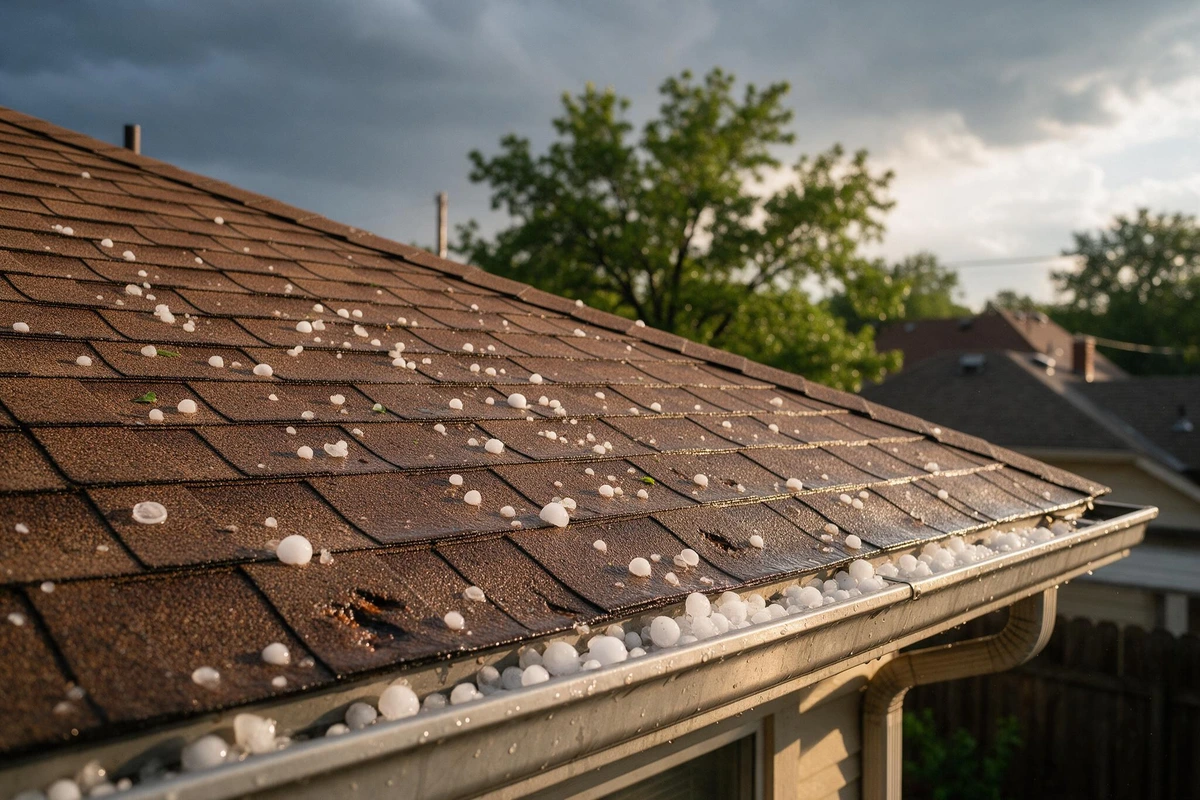
Hail.
Spring hail can total a roof in ten minutes. Many Oklahoma policies have a separate wind and hail deductible, often written as a percentage of your house's coverage amount instead of a flat dollar figure. More on that below.
Straight-line wind.
It isn't a tornado, but it can do tornado-level damage. On June 18, 2023, a windstorm brought down trees and power lines across Tulsa. Wind damage usually falls under that same wind and hail deductible.
Ice storms.
In December 2007, ice took down trees and power lines from Lawton through Oklahoma City to Tulsa, causing the worst power outage in state history. A limb through your roof is usually covered. A tree that falls in the yard and hits nothing often isn't, or is covered only up to a small limit for cleanup. Policies differ here, so we read this part with you.
Tornadoes.
Wind damage from a tornado is covered under most home policies. Your wind and hail deductible usually applies.
One more Oklahoma question: how old is your roof?
Some insurance companies pay the full cost to replace an older roof (replacement cost). Others pay only what the worn roof was worth that day (actual cash value), which can be much less. Two policies that look alike can treat a 15-year-old roof very differently. That's one of the first things we check when we compare companies.
What a deductible is (the kitchen-table version)
Your deductible is the part of a repair you pay before insurance pays the rest.
Illustrative example
A burst pipe does $8,000 of damage. Your regular deductible is $1,000. You cover the first $1,000; your insurance company pays the other $7,000.
The wind and hail deductible works differently. It's often a percentage of your house's coverage, not a flat amount.
Illustrative example
Your house is insured for $250,000.
- A 1% wind and hail deductible means the first $2,500 of a hail or wind claim is yours.
- A 2% wind and hail deductible means the first $5,000 is yours.
So a $12,000 hail claim on a 2% deductible: you cover $5,000, insurance covers $7,000.
All figures are illustrative teaching examples, not prices or coverage recommendations.
Why this matters to you: pick a deductible you could actually pay next spring without wrecking your month. If a hail claim would leave you short, tell us. We'll show you what different deductibles look like across companies so you can choose with clear eyes.
Renting? You need this too, just smaller.
Your landlord's insurance covers the building. It does not cover your stuff, and it does not cover you if your guest gets hurt or your bathtub overflows into the apartment below.
Renters insurance covers your belongings, your liability, and a place to stay if your apartment becomes unlivable. Whether you're in a loft in the Pearl District or a duplex in Kendall-Whittier, it's one of the simplest policies there is. Many landlords now require it.
Why an independent agent helps with home insurance
Every insurance company makes its own choices about Oklahoma. Some write the wind and hail deductible one way, some another. Some pay full replacement on older roofs, some don't. Some are cautious about certain ZIP codes after a bad hail year.
A company's own app can only show you its own policy. We compare 14 companies (illustrative) and lay the differences next to each other: the deductibles, the roof terms, what each does with water and trees. Then you choose.
And if, after a big storm year, your company changes its terms at renewal, we can look at the others. You keep the same agent either way.
When something goes wrong
The first hour after a storm or a leak
- Get everyone safe. Stay away from downed lines. If you smell gas, leave and call from outside.
- Take pictures and video of the damage before you move anything, if it's safe. Get the roof from the ground, the ceiling stains, the room.
- Stop more damage. Tarp the roof, shut off the water, move things out of the wet room. Keep receipts.
- Don't throw out damaged things yet. The adjuster may want to see them.
- Call us. (918) 555-0158, or text the same number. We'll help you decide whether to file, start the claim with your company, and tell you what the adjuster will ask.
What happens next
- Your insurance company assigns an adjuster, the person who inspects and estimates the damage.
- You'll get an estimate. If something looks wrong, tell us. We'll help you ask the right questions.
- After a big hail day, roofers knock on doors. Take your time. Get the adjuster's estimate first, and don't sign anything that hands your claim to a contractor before you've talked to us.
Questions people ask us
Do I have to have home insurance?
The law doesn't require it. Your mortgage lender almost certainly does. And if you own the house outright, it's still the thing standing between you and rebuilding out of pocket.
What's the difference between a homeowners policy and a dwelling policy?
A homeowners policy is for a house you live in. A dwelling policy is often used for a house you rent out to someone else. If you own a rental in Owasso, tell us. It needs a different policy than the one you live in.
Will filing a claim affect my policy?
It can. Claims history is one thing insurance companies look at. That's part of why we talk through small claims with you before you file.
How often should I review my policy?
Once a year, and any time you renovate, replace the roof, start a business at home, or buy something expensive.
Want someone to read your current policy with you?
Send us your declarations page, or just tell us what you're insuring. A person replies.
Sample work. Heartland & Vine Insurance is an illustrative agency. People, numbers and stories are invented; Tulsa and Oklahoma places and events are real. Nothing here is a quote, a price or an offer of insurance. Coverage always depends on the actual policy and insurance company.