On this page
Meet a business: Smokestack Tacos (illustrative)
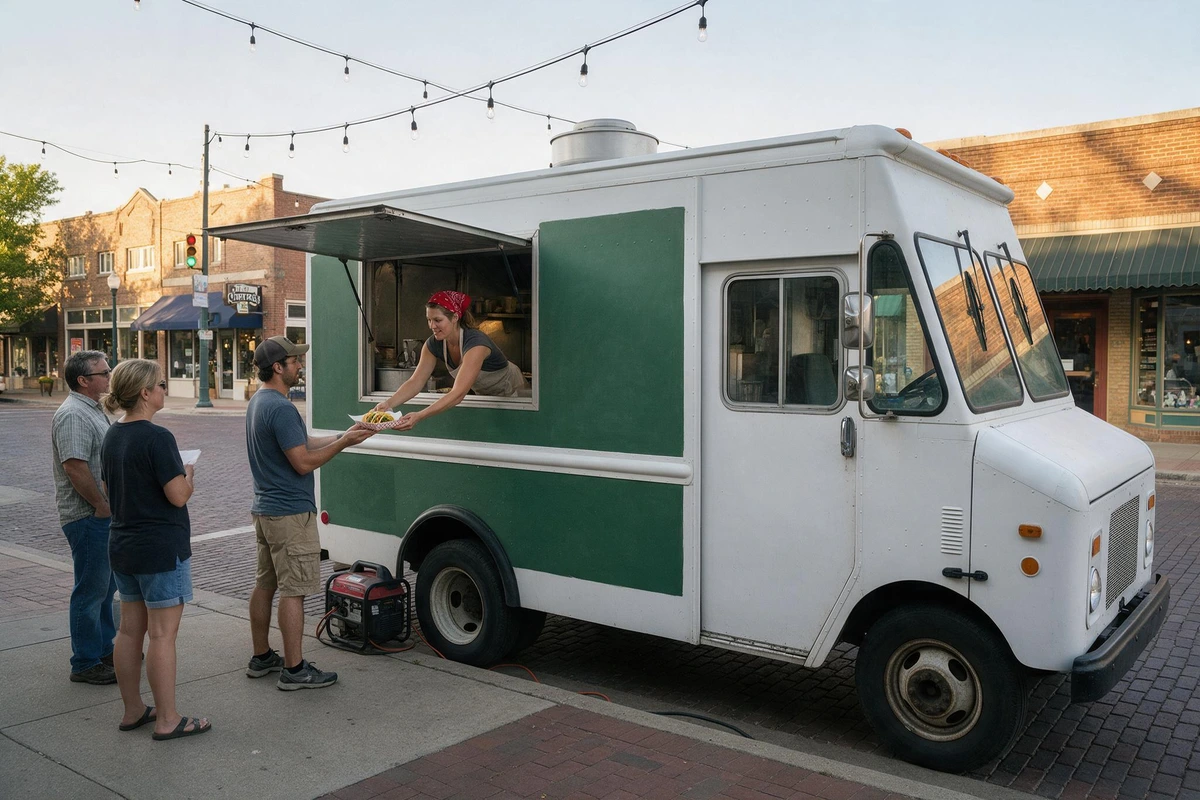
Rosa runs a food truck. Weekdays she parks near offices downtown. Saturdays she's on Cherry Street. She has one part-time employee, a converted step van, a fryer, a generator and a card reader.
Here's what could go wrong in Rosa's week, and which coverage answers each one:
| What happens | The coverage that usually responds |
|---|---|
| A customer slips on a wet patch by the window and breaks a wrist. | General liability |
| A customer says the brisket made them sick. | General liability (product and food-related claims are usually part of it) |
| Rosa clips a parked car pulling out on 15th Street. | Commercial auto |
| The generator fails and a fire ruins the fryer and the inside of the truck. | Commercial property / equipment coverage |
| The truck is in the shop for three weeks and she can't sell. | Business income coverage, if she has it and the cause is covered |
| Her employee burns a hand on the flat-top. | Workers' compensation |
| A Saturday event organizer asks for proof of insurance before she can park. | A certificate of insurance, which we send for her |
Your business isn't Rosa's. But that's the way we think about it: start with your actual week, then match coverage to it.
What each coverage actually does
General liability
Pays when someone outside your business (a customer, a visitor, a passerby) gets hurt, or their property gets damaged, because of your business. Also helps with your legal defense if they sue. Landlords, event organizers and big clients often require it before they'll work with you.
Commercial property
Covers the things your business owns: your building if you own it, your equipment, inventory, furniture, signage. If you rent a storefront in Kendall-Whittier, your landlord's policy covers the building. Your stuff inside it is yours to insure.
Business owner's policy (BOP)
A package that bundles general liability and property together for many small businesses. Not every business qualifies. Restaurants, contractors and some others may need things written separately.
Business income (also called business interruption)
If a covered problem, like a fire or storm damage, forces you to close for a while, this can help replace the income you lose and pay ongoing bills like rent.
Commercial auto
For vehicles your business owns or uses for work. A personal auto policy often won't cover a vehicle used mainly for business, and a food truck, a contractor's pickup full of tools, or a delivery van usually needs a commercial policy.
Workers' compensation
If an employee gets hurt on the job, this pays their medical bills and part of their lost wages. Oklahoma requires most employers with employees to carry it. There are some exceptions; ask us before you assume you're one of them.
Professional liability (errors and omissions)
For businesses that give advice or a service: an accountant, a designer, a consultant, an IT shop. Pays if a client says your mistake cost them money.
Cyber liability
If you store customer card numbers, emails or records, a data breach can mean notification costs and claims. Small businesses get hit too.
Tools and equipment that travel (inland marine)
A contractor's tile saw in the truck, a photographer's camera at a wedding. Covers gear that leaves your building.
Liquor liability
If you serve or sell alcohol, general liability often excludes alcohol-related claims. This fills that gap. A brewery in the Pearl District or a bar in the Blue Dome District needs to ask.
Commercial umbrella
An extra layer of liability coverage on top of your other policies, for the bad day that's bigger than your limits.
The Oklahoma part
Storms close businesses.
Hail damages roofs and signs; straight-line wind takes down awnings and power. A storm like the June 2023 windstorm, which knocked out power across Tulsa, can cost a small business days of sales and a walk-in cooler of inventory. Ask whether your policy covers spoiled food or inventory after a power outage, because that's often a specific add-on, and whether business income coverage applies when the damage is to the utility, not your building.
Wind and hail deductibles apply to businesses too.
Like home policies, many commercial property policies in Oklahoma carry a separate, higher deductible for wind and hail.
Home-based businesses fall through cracks.
A hair studio in a spare room, an Etsy shop in the garage in Broken Arrow, a bookkeeper with clients at the kitchen table: your homeowners policy usually covers little or none of it. Tell us. It's an easy gap to fill and a painful one to discover.
What a deductible is (the business version)
Your deductible is the part of a property claim you pay before insurance pays the rest.
Illustrative example
Hollis Hair Studio (illustrative) on Route 66 has a pipe burst overnight and ruins $9,000 of chairs, product and flooring. The property deductible is $1,000. The owner covers $1,000; insurance pays $8,000.
Liability coverage works differently. Many general liability policies don't have a deductible the way property does, though some do. We'll show you exactly where yours applies.
All figures are illustrative teaching examples, not prices or coverage recommendations.
Why an independent agent helps with business insurance
Insurance companies specialize. One company loves restaurants and won't touch roofers. Another writes contractors all day. A third is great for offices but won't cover a food truck.
If you go straight to one company, you get its view of your business, whether or not it's the right fit. We compare 14 companies (illustrative) and know which ones actually want businesses like yours. Darnell, who handles our business clients (illustrative), will ask about your real week, not just your industry code.
We also do the paperwork nobody warns you about: certificates of insurance for landlords and event organizers, adding a client as an "additional insured," updating your policy when you hire your first employee.
When something goes wrong
Someone gets hurt at your business
- Help them first. Call 911 if it's serious.
- Write down what happened, when, and who saw it, while it's fresh.
- Take pictures of the spot.
- Don't admit fault or promise to pay their bills. Be kind and stay factual.
- Call us the same day: (918) 555-0158.
Storm, fire, break-in or burst pipe
- Get everyone safe.
- Photograph everything before you clean up.
- Stop more damage: tarp, board up, shut off water. Keep receipts.
- Keep a list of the days you're closed and any extra costs. Business income claims depend on records.
- Call us. We'll start the claim with your company and walk you through what they'll ask for.
An employee is injured
Get them care, then tell us right away. Workers' comp claims have reporting deadlines.
Questions people ask us
I'm just one person with an LLC. Do I need business insurance?
An LLC protects your personal assets in some situations. It doesn't pay for a lawsuit, a broken laptop or a customer's injury. Insurance does. Many one-person businesses start with general liability and add from there.
A venue asked for a certificate of insurance. What is that?
A one-page document proving you have coverage. We send it for you, usually the same day. (Illustrative turnaround.)
What's "additional insured"?
When a landlord or a big client asks to be added to your policy so your coverage protects them too for work you do for them. Common, and we handle it.
When should I call you?
Before you sign a lease, hire your first employee, buy a vehicle, start serving alcohol, or take a big contract. Those are the moments coverage changes.
Tell us about your business in your own words.
What you do, where, with how many people. A person replies.
Sample work. Heartland & Vine Insurance is an illustrative agency. People, businesses, numbers and stories are invented; Tulsa and Oklahoma places and events are real. Nothing here is a quote, a price or an offer of insurance. Coverage always depends on the actual policy and insurance company.